
Natalie HigginsBBC Scotcast presenter
 BBC
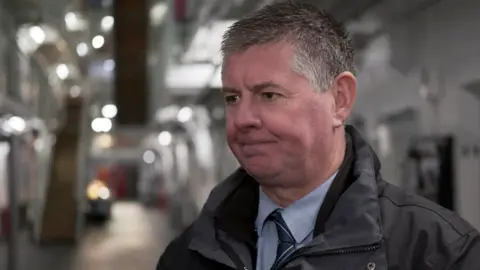
BBC“The first couple of days, I’ll be nervous. I’ll probably not want to leave my mum’s house.”
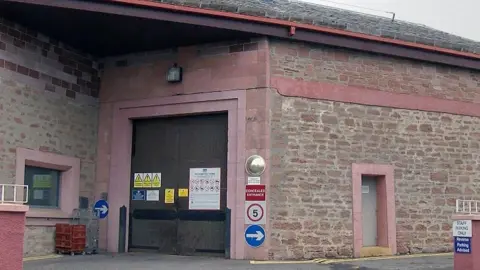
Aaron is about to be released from his third, and longest, stint in Scotland’s biggest, oldest and most notorious prison, HMP Barlinnie.
Now in his late 20s, he’s been getting into trouble with the police since he was a child.
“As soon as I was a teenager, I used to start drinking all the time with my pals. We’d be running about causing trouble, smashing windows, being daft wee boys, constantly getting taken home by the police,” he says.
“I’d probably say I was the one getting into the most trouble. I was the wee bad influence.”
Aaron is leaving prison two months early as part of an emergency plan that the Scottish government estimates will see nearly 1,000 inmates freed by April.
It says this is a necessary measure to relieve pressure on a system struggling to cope with overcrowding.
On the day the scheme began, there were 8,441 people in Scotland’s prisons. They are designed to hold 7,805.

 PA Media
At Barlinnie, prisoners and officers agree that the situation is critical.
Deputy governor Jim Beaton says that even 100 prisoners leaving early would provide some short-term relief.
“But as everybody in this justice environment knows, there needs to be a longer-term solution,” he says. “We can’t be in this position every other year.
“There needs to be a proper strategy going forward.”
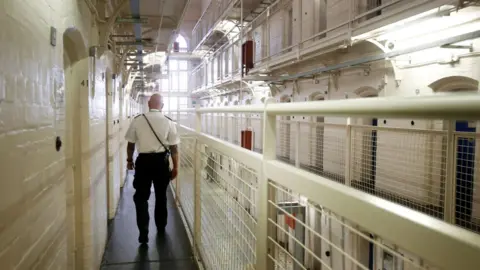
It’s not just the number of men in his care that makes Jim’s job difficult – about 1,450 on the day we speak. The prison itself is working against him.
When we visit, the imposing stone halls that house Barlinnie’s prisoners are glowing gold in the cold sun of an early winter morning.
They’re typically Glaswegian: Victorian architecture, now well over a century old.
“Lots of things break, lots of things have sticking plasters on them,” Jim says.
“But we do our best with what we’ve got.”
The prison’s design means it takes “an exceptional amount of time” for staff to safely move prisoners from their cells to eat, shower, exercise or participate in activities.
That leaves less time and opportunity for the rehabilitation work that is intended to make prisoners better citizens when they are released, and reduce their chances of reoffending.
Jim hopes the new prison being built to replace Barlinnie, HMP Glasgow, will be a better environment in which to build supportive relationships.
He expects staff there will work with smaller “communities” of about 20 prisoners.
But it isn’t due to open until 2028.
Aaron says frustrated prisoners stuck in cells creates a volatile situation.
“Sometimes you think the place is ready to explode because prisoners aren’t getting what they’re wanting, because there’s too many people,” he says.
“People are up there, they’re getting mad with it, they’re just fed up.”
Scotland’s Justice Secretary Angela Constance says she hasn’t taken the decision to pursue the policy lightly.
She has acknowledged concern from victims’ groups, who say early release has a “detrimental impact” on those harmed by crime.
Opposition politicians have criticised the move, with the Scottish Conservatives describing it as a “sticking plaster response” that endangers public safety.
Prisoners are only eligible for the scheme if they are serving a sentence of less than four years and are within 180 days of their release date.
It excludes those serving time for sexual offences or domestic abuse, as well as registered sex offenders.
Prison governors assess intelligence reports and can apply a veto if they believe a prisoner would pose an immediate risk of harm to a specific individual or group.
This isn’t the first time Scotland has looked to early release as a short-term solution.
Two previous schemes, carried out in 2024 and the spring of 2025, saw almost 800 prisoners freed – but the prison population has remained stubbornly high.
The two new prisons being built – in Inverness, as well as Glasgow – will add around 450 spaces to the prison estate.
But that extra capacity may not be enough to match demand so seems unlikely to solve the problem of overcrowding on its own.
So how could Scotland reduce the number of people who end up in prison?
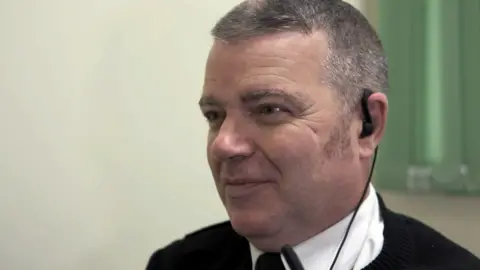
Prison officer John Sneddon is part of the team at Barlinnie’s Link Centre that ties up the loose ends prisoners leave behind on the outside.
These range from bills and bank accounts to unsupervised pets.
John also prepares them in the weeks leading up to their release.
The team make sure everyone has somewhere to stay, some access to funds and helps them to set up bank accounts so they can receive benefits.
Each prisoner leaves with a £77 liberation grant.
“Anything we can do to make sure they don’t come back,” John says. “We don’t want repeat customers.”
Nonetheless, they get plenty.
John says some people seem more comfortable with prison than with freedom.
“They’ve got structure, they’ve got the gym, they’ve got three meals a day.
“And it’s quite sad that their life outside is so bad, they prefer losing their liberty and coming to jail,” he says.
The pre-release mix of excitement and nerves that Aaron describes are familiar to him.
John said prisoners “don’t know what they’re going out to”.
He added: “They’re hoping their family’s going to be at the front door to collect them.
“They’re hoping they’ll be able to stay off the drugs, stay off the drink.”
John says that if released prisoners can get past the temptations of the first few days, adjusting to life outside, they’ll have a better chance of staying out for longer.
He doesn’t hesitate when asked to identify the main factor that results in offenders returning to prison.
“Drugs. It’s the biggest problem that brings folk back,” he says. “It could be the shoplifting associated with it, the anti-social behaviour associated with it.
“That’s the biggest factor we’ve got that brings folk into jail, I think.”
Addiction is a complex and long-standing public health challenge for Scotland, which continues to have the highest number of drugs deaths in Europe.
Joe Bowden spends his days in Barlinnie considering what factors in a prisoner’s life may have contributed to their offending, including addiction, homelessness, family problems and mental health, and how these issues can be addressed.
He works for UpSide, which provides ongoing support for short-term prisoners to ease the transition back into the community.
There’s lots of help available, Joe says, but people have to be ready to accept it.
“The person’s got to be in that place to engage. We can’t force anybody to change their ways. It’s not about that.
“It’s about empowering them to make decisions for their life.”
He has supported people in the community “four, five, six times before you get that eureka moment and you don’t see them again.”
John added: “That’s the best feeling in the world.”
Community-based alternatives
Joe is an advocate for more community-based alternatives to prison, which the Scottish government says are more effective than short prison sentences.
An independent commission has been considering how imprisonment is used, as well as what Scotland’s longer-term strategy to achieve a “sustainable” prison population should be.
It is due to present its recommendations to ministers by the end of 2025.
Aaron has now served three sentences, the longest for 13 months. None of them were as a result of convictions for serious violent offences.
But does he think prison was a fair punishment for what he’d done?
“I find it fair. If you’re going to get into trouble, you’re going to have to accept the consequences,” he says.
With a week to go until his release, he’s reflecting on what he’s learned from more than a year in Barlinnie.
He says he’s opened up to other prisoners he was close to, in a way he wouldn’t have spoken to his friends outside.
“You’re locked up in a cell all the time, just sitting there, just thinking,” he says.
“I wasn’t thinking at all when I was younger. I was just acting straight away.”
When he leaves, he plans to spend his time working and looking after his parents.
“This time, I think I won’t be back. I feel strong,” he adds.
Disclaimer : This story is auto aggregated by a computer programme and has not been created or edited by DOWNTHENEWS. Publisher: BBC