
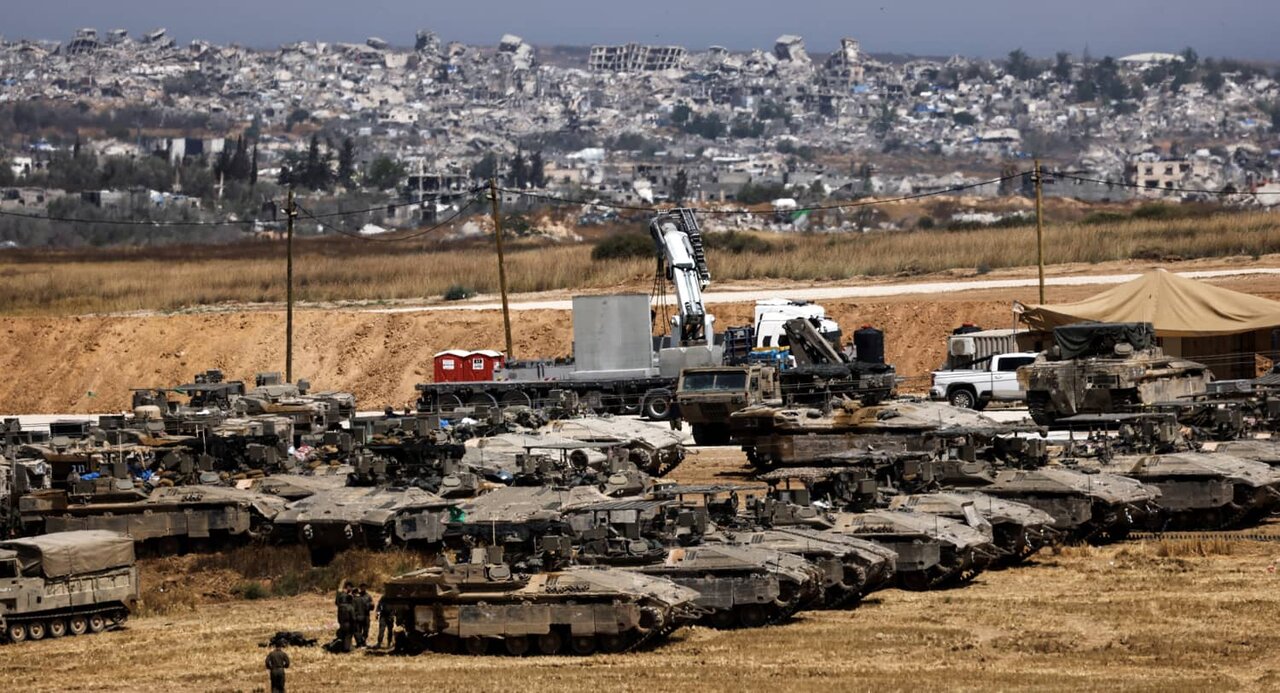
TEHRAN – The U.S. administration revives its dangerous vision of transforming Gaza into a “Middle East Riviera,” sidelining the Palestinians once more.
“Project Sunrise” as first reported by the Wall Street Journal, citing U.S. officials, is presented by the administration of U.S. President Donald Trump as a long-term blueprint to remake Gaza from a war-ravaged enclave into a technologically advanced coastal hub.
The plan imagines Gaza rebuilt with smart infrastructure, modern housing, transport networks and a tourism-driven economy with an initial phase of ten years to complete.
The White House has previously described a similar vision of Gaza as a prosperous Mediterranean destination, often invoking the image of a “Middle East Riviera”. This plan is anchored by private investment, high-end real estate and AI-managed utilities.
At the core of “Project Sunrise” is a reconstruction strategy with a price tag of $112. Gaza’s rubble would give way to permanent urban development, including apartment towers, commercial zones and luxury resorts along the coastline.
There is no mention of the 2.4 million Palestinians, the indigenous people of the land, having any access to this luxury.
A new administrative capital, “New Rafah”, is envisioned as the political and bureaucratic center of Gaza, intended to symbolize a break from the devastation of the genocidal war and the start of a new governance model.
On the 32-page U.S. PowerPoint presentation, as reported, the plan envisages transformation on a massive scale. It speaks the language of growth, investment and opportunity, projecting tens of billions of dollars in future returns once Gaza’s coastline and urban space are fully monetized.
Yet this vision of economic peace with no Palestinian representation rests on assumptions that collide sharply with the realities on the ground.
The most formidable obstacle confronting the U.S. project lies within the proposal itself. The plan cannot proceed unless Hamas fully demilitarizes, surrenders its weapons and dismantles its military infrastructure. This condition is described as non-negotiable by the United States and the occupying Israeli regime, yet it exposes a contradiction the proposal fails to resolve: who will actually disarm Hamas?
Israeli Occupation Forces (IOF), backed by the United States and NATO, fought the Palestinian resistance for more than two years without achieving a decisive victory.
This raises an unavoidable question. If one of the most technologically advanced militaries in the region could not eliminate or disarm Hamas through prolonged genocidal war, it is unclear how this objective would suddenly be achieved. Which country would be willing to send its armed forces to wage a military mission inside a tiny Palestinian enclave where the IOF failed to defeat Hamas?
The experience of the past two years suggests that no external actor has the capacity to impose such an outcome without resuming the aggression on Gaza.
Hamas, meanwhile, retains leverage. While it has at times signaled genuine willingness to discuss relinquishing weapons in exchange for credible security guarantees for Gaza and assurances against renewed genocidal war or ethnic cleansing, it is unlikely to comply with a plan it perceives as serving the Israeli regime’s strategic objectives.
Should Hamas conclude that this American framework is designed to erase Palestinian political identity rather than address Palestinian security, rights, and freedom, it is unlikely to cooperate, regardless of any economic incentives.
The financial architecture of the “Project Sunrise” deepens skepticism. Washington has committed to shouldering about 20% of the costs, signaling that it expects considerable influence and returns.
U.S. pundits have framed the plan as an investment opportunity, reinforcing the perception that Gaza’s reconstruction is being treated less as a humanitarian, political obligation and more as a commercial venture.
The persistent branding of Gaza as a future luxury destination has sharpened criticism. The involvement of figures closely tied to Trump’s real estate and investment networks, particularly his son-in-law Jared Kushner, intensifies concerns about financial interests.
For many observers, the language of resorts, penthouses, and investment yields sits uneasily alongside the reality of mass displacement, trauma, and devastation. It strongly indicates that profit, rather than justice or self-determination, is the driving logic of the project.
One of the most controversial elements is its proposed starting point in Rafah. The plan calls for the construction of an entirely new city, “New Rafah”, envisioned as Gaza’s future governance hub.
According to project materials, the city would accommodate more than 500,000 residents, with over 100,000 housing units and other services.
At face value, this vision appears attractive. Much of Gaza has been reduced to rubble and rendered uninhabitable. A newly built city promises order, services and shelter. Yet this proposal reignites a long-standing and deeply sensitive debate about population transfer.
Concentrating Gaza’s population in the far south risks functioning as a mechanism for illegal relocation under another colonial brand, moving people away from their original towns and neighborhoods without formally declaring forced displacement.
International humanitarian agencies and legal experts have long warned that large-scale reconstruction imposed without political consent can facilitate indirect ethnic cleansing, even when framed as development.
In this context, “Project Sunrise” has revived concerns that Gaza’s population could ultimately be removed from the territory itself, not through overt expulsions but through engineered unlivability.
Concentrating civilians in a newly constructed southern enclave, while the rest of Gaza is redeveloped under strict security and investment frameworks, risks turning displacement into a permanent condition.
This level of population consolidation, if combined with restrictions on return or rebuilding, amounts to forcible transfer by other means or a new form of colonialism, even if presented as voluntary or humanitarian.
Notably, Trump’s plan devotes limited attention to the Palestinians themselves, their inhumane suffering and ongoing occupation. It prioritizes investment flows and urban design, while ignoring Palestinian rights, accountability for wartime destruction and the right to self-determination.
Nothing is mentioned about the estimated 10,000 bodies still buried beneath rubble, or about justice for the civilian toll inflicted over two years of genocide, or the Israeli regime’s deadly blockade.
Instead, the project aligns closely with the Zionist regime’s strategic interests, particularly the neutralization of Hamas and long-term security control. Palestinians appear largely as a population to be managed rather than a people with collective political rights and historical claims.
These concerns are reinforced by Trump’s broader political record. The U.S. President has consistently approached foreign policy through a transactional lens, treating crises as opportunities for leverage, rather than arenas for justice.
From earlier policy decisions that sidelined Palestinian rights to the overt commercial framing of Gaza’s reconstruction, this project appears consistent with an approach that seeks to monetize catastrophe.
The emphasis on real estate and returns contrasts sharply with the absence of any serious framework for reparations, accountability, or self-determination, suggesting that profit is prioritized over justice.
After two years of sustained genocide, Palestinians in Gaza have demonstrated extraordinary steadfastness. Despite widespread destruction and loss, they have refused to capitulate. This resilience poses a fundamental challenge to “Project Sunrise”. A plan that underestimates Palestinian resolve and treats reconstruction as a commercial exercise is likely to encounter severe security, political and humanitarian obstacles.
It offers an elaborate vision of what Gaza might one day become, yet provides little clarity on how to navigate the realities on the ground that must come first. Until those foundational issues are addressed, the “Middle East Riviera” is unlikely to move beyond the drawing board.
Disclaimer : This story is auto aggregated by a computer programme and has not been created or edited by DOWNTHENEWS. Publisher: tehrantimes.com




