No public school has taken steps to introduce the International Baccalaureate (IB) almost three years after Labor promised to make the HSC alternative available, with no funding offered to subsidise its prohibitive cost.
Almost a decade after an internal NSW Department of Education report declared the IB “feasible, possible and practical” for public schools, and a year after the state government lifted a ban on public schools teaching the program, no school has begun the accreditation process for the academically rigorous qualification.
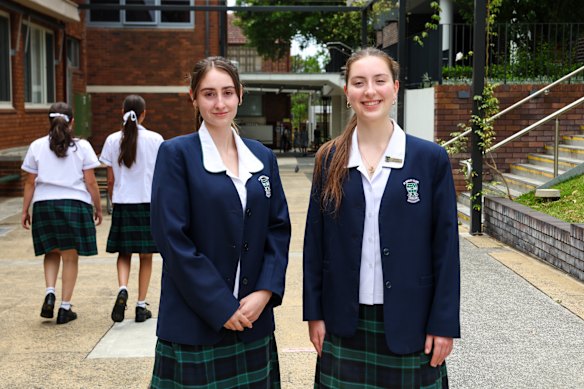
St Ursula’s College IB students Alyssa Truant and Olivia Holt.Credit: Edwina Pickles
A 2023 costings report revealed that schools would be required to fund the program – costing between $44,000 and $300,500 annually – out of their existing budgets. No funding has been allocated for public schools to offer the IB.
Twenty-one NSW independent schools offered the IB in 2025. Their results will be announced on Wednesday.
The qualification is geared towards university preparation. According to the 2017 internal department report, the IB is “considered the best educational option for highly gifted students” but is “highly underutilised in Australia”.
“At present, the greatest inequity is that high-ability public school students cannot access the IB without attending a high fee independent school with a median fee of $50,000 for two years,” the report said, advocating for needs-based equity funding to make the qualification available to more students.
Acting Education Minister Courtney Houssos said the government had delivered on its commitment to lift the ban.
“We were up front when we announced this change that there would be limited demand initially and that lifting the ban is about providing choice long term,” she said.
“Interested public schools can now contact the Department of Education if they wish to explore offering the program, and support will be provided through the process. The IB Organisation’s candidacy process is rigorous for all interested schools and does not happen overnight.”
IB Schools Australasia secretary Antony Mayrhofer said, if there was a political will to introduce the IB into public schools,“it wouldn’t be difficult to do it”.
“Across the world, the vast majority of IB schools are public schools, and so it is showing that in NSW, where we have an excellent education offering, that the IB curricula is only available to students in schools where they are required to pay fees,” he said.
“The IB programs have been growing in government schools in other states. It would be lovely if there were some schools in NSW that could take up the opportunity.”
Mayrhofer said it would be challenging to provide the IB in addition to the HSC without additional funding, but it was feasible.
“You’d really have to know how to operate it very well and … it’d have to be in the right school.”
What is the IB and how is it different to the HSC?
A key point of difference is curriculum structure. HSC students choose from a variety of subjects: from food technology to dance and extension mathematics. There are about 27,000 course combinations, and the only compulsory subject is English.
IB students must study one subject from the arts, sciences, humanities, mathematics, as well as English and a foreign language. Three or four of these subjects are taken at a “higher level”, where students must show greater knowledge, understanding and skill. Those courses tend to emphasise the use of open-ended questions and problem-solving skills and are taught across 240 hours, while the rest are taken at a “standard level” involving 150 hours of teaching.
Students also complete a 100-hour subject on the theory of knowledge and write a 4000-word extended essay on a topic they choose. Finally, they must participate in creative, sporting and service activities, similar to the Duke of Edinburgh Award Scheme.
The 2017 report found that offering the IB in public schools would help to “attract and retain families of bright students in our public school system”. The state’s public schools recorded their worst year for enrolments last year as parents increasingly chose to send their children to private and Catholic schools.
After the IB ban was lifted, several schools made inquiries with the department’s teaching and learning team, but none decided to proceed.
Catholic systemic school St Ursula’s College began offering the IB three years ago. Year 11 students Olivia Holt and Alyssa Truant said they chose the IB due to its focus on independent learning, and love that their marks are not scaled and ranked against their peers, as in the HSC.
Olivia said the IB’s smaller class sizes make for a “tight-knit group” that “guns for each other”.
“There are a lot less students than in the HSC, and I found that the time you get to spend with your teacher is so amazing,” she said.
Alyssa said the IB allowed her strengths to be applied to a wide variety of areas, and to complete an individual research project in each subject.
“I had to choose a language, I had to choose math, I had to choose science, and the fact that I got to explore so many different areas allowed me to extend myself, and I wanted that independent learning,” she said.
Ultimately, the 2017 report found that while implementing the IB may come with “some risks and modest costs”, it will “provide far stronger benefits for our schools, our teachers and most importantly the students and families of NSW public schools”.
Secondary Principals’ Council president Denise Lofts said the council had seen “little interest in the IB” from public school principals.
“The HSC curriculum is rich and engaging, with diverse choices for student learning,” Lofts said.
NSW Teachers Federation deputy president Amber Flohm agreed that there was “little demand” for the IB in public schools, and she questioned the transparency of the IB system.
“Outsourcing authority to foreign bodies like the International Baccalaureate, which is governed from Geneva under Swiss law, also raises serious questions about transparency and who actually controls what our children learn.”
Former Coalition education minister Sarah Mitchell said the IB was “another broken election promise”.
“It’s another example of Labor chasing headlines before an election without any concrete plan for delivery,” she said.
Most Viewed in Politics
Disclaimer : This story is auto aggregated by a computer programme and has not been created or edited by DOWNTHENEWS. Publisher: www.smh.com.au