
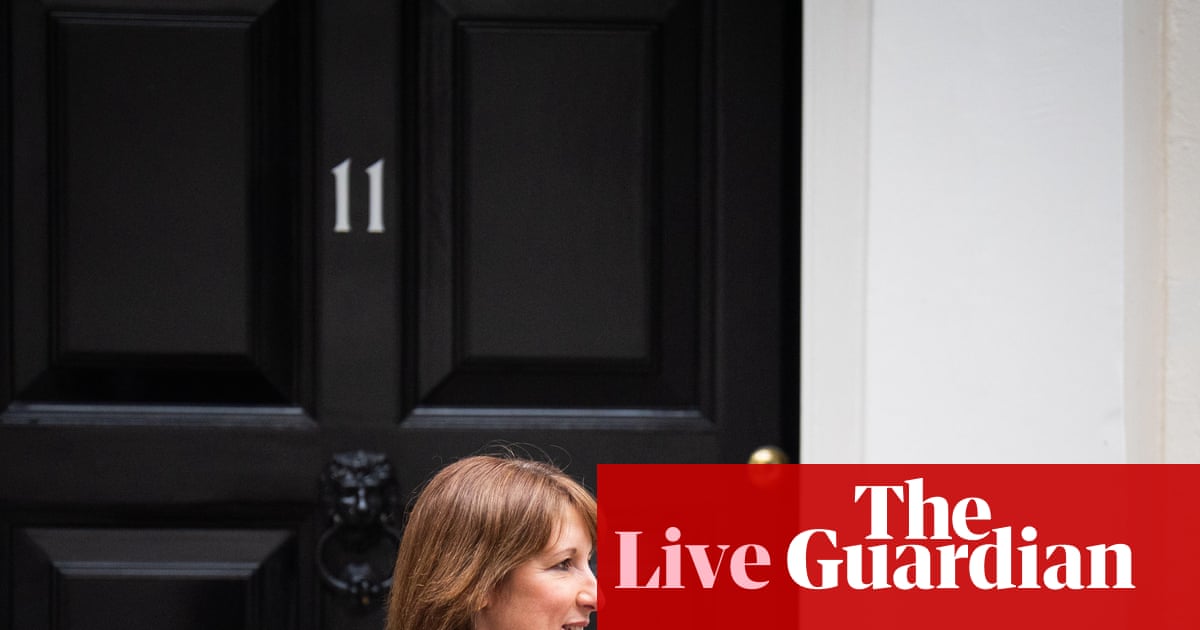
Boom! Rachel Reeves then tells her audience that she has asked the Treasury to work with mayors and businesses to develop a roadmap for future fiscal devolution.
This plan will be published at this year’s budget.
It will set out plans to give regional leaders control of a share of some national taxes – which Reeves points out have long been allocated by central governments. It will include income tax, she suggests.
The chancellor says these reforms will begin with places which have the greatest capacity to deliver them and the greatest potential to benefit.
She insists that it is “not about new taxes, and it’s not about higher tax”, promising “I will not ask taxpayers to pay more”.
These reforms will be fiscally neutral, focused on sharing and retaining a portion of existing revenues with the places that generated them, she says.
Reeves promises:
These reforms will represent a permanent transfer of power and resources, not another exercise in local ambition.
Taxpayers will be able to see what is being delivered with their money and hold local leaders to account for the results, she insists.
She calls it “a genuine break with the past”, calling it:
A generational opportunity for Britain’s regions to make their own future.
Rachel Reeves and her team from the Treasury have now vacated the Bayes Business School lecture theatre (after an amusing vote of thanks from Professor Sir Anthony Finkelstein, President, City St George’s, University of London).
So I’ve listened back to the part of the chancellor’s Q&A where she explained why she won’t, yet, fix the student loan system.
Touching on the state of the UK public finance, she said:
“Yes, the student loan system is broken. But if you try to fix everything straight away, everything will fall over.”
“We have precarious public finances, and that has also been thrown into stark relief in the last few weeks since the conflict in the Middle East erupted.”
“We are reintroducing the maintenance grant for the poorest students going to university.”
We are also investing heavily in further education and apprenticeship, because the majority of young people don’t go to university,
[The chancellor then pointed out that the people who aren’t in education, employment or training don’t tend to be the graduates, they tend to be the kids who didn’t go to university].
Pleading for patience, Reeves says:
“So yes the student loan system is broken, but what is more broken is the fact that we have got one in six kids not in education, employment or training.”
“So yes we want to fix it, yes we want to make improvements. But is it front of the queue? No, it’s not.”
“Because we’ve got to get those hospital waiting lists down. We’ve got to lift kids out of poverty so they get the chance in the first place,and we’ve got to uplift our defence spending.”
“Politics is about priorities. I’m not denying there’s a problem. I’m not blind to that.
“But what I do say is there has to be some patience, you can’t fix everything straight away.
Reeves concluded by insisting that she “strongly” disagreed with anyone who suggested she should have reformed the student loan system rather than tackling child poverty (through ending the two child benefit cap).
Nearly 90 minutes after beginning her lecture, Rachel Reeves wraps up by answering another question about Europe – and repeating that closer alignment can bring benefits.
She repeats her earlier warning that some economists estimate the hit to the UK economy from Brexit could be around 8% of GDP.
[I’m not sure at all, but the chancellor could be referring to recent research from the CEPR, here].
Thus, making trade and investment easier between the UK and European Union countries can begin the process of bringing some of that loss back.
Ultimately, that will be felt in people’s pockets and in their living standards, she concludes.
Q: Following the oil price shock, do you stand by your view that the UK has done enough to avoid the need for any further tax increases, and can withstand further shocks without need for further fiscal action?
Reeves says the UK’s public finances are improving, pointing to a drop in the budget deficit as a share of GDP, and forecasts that it will faster than other G7 countries.
And she fires a warning shot across the bows of anyone who things “this is the moment to change course.”
Standing by her fiscal rules (to bring down the national debt and only borrow to invest)
The chancellor warns:
I just say to them, be very careful about what you are doing and what you are advocating.
We are in a stronger position now because of the fiscal rules.
Q: On Europe, do the red lines that Labour has set out still fully apply?
Reeves indicates they do.
We will not be rejoining the single market, the customs union or rejoining the free movement of people, she insists.
Onto questions, and Rachel Reeves is challenged about the crisis in the student loan system.
Q: Yesterday, the chancellor of the University of Cambridge said the student loan system is broken. What are you going to do to fix it?
Reeves acknowledges that the student loan system is “broken”.
However, she’s not planning to fix it imminently, arguing this isn’t possible.
The chancellor says the “precarious public finances” mean the government can’t fix everything straight away.
She points out that the government is reintroducing maintenance grants for poorer students going to universities.
And she argues that what is “more broken” is the large number of young people who are are not in education or training.
Reeves points out that the majority of kids she went to school with didn’t go to university.
So while fixing student loans is important, it’s not at the front of the queue.
Reeves says:
I’m not denying that there’s a problem. I’m not blind to that.
But, she adds, there has to be “some patience”, as the government can’t fix everything immediately.
Reeves rounds up this year’s Mais lecture by insisting she is still optimistic, despite everything that’s occured in the last two years.
She tells the Bayes Business School lecture theatre:
Two years ago in this lecture hall, I said that despite the challenges, I was an optimist about our ability to face them. And despite further challenges that have come our way, I remain an optimist.
And returning to her key theme, the chancellor says that means optimism about “the capacity of an active and strategic state” to drive investment and growth.
She is also optimistic about the dynamism and the enterprise of British business, and the “talent, commitment and ingenuity of working people in every part of our United Kingdom.”
Cue a warm round of applause.
Rachel Reeves then pins her colours to the mast of closer alignment with Europe, saying:
Let me say this directly to our friends and allies in Europe. This government believes a deeper relationship is in the interest of the whole of Europe.
The chancellor then argues that future UK prosperity will be built through partnerships, with those who share our interests, values and ambitions.
No partnership is more important than that between the UK and our European neighbours, she insists.
Brexit “did damage”, Rachel Reeves then tells the audience at today’s Mais lecture.
She says there is evidence that the GDP impact could be as much as 8%.
That has meant higher costs for businesses, and thus higher costs in the shops.
The chancellor says the government doesn’t want to turn back the clock, but to create a new and stable future relationship.
That means that when it is in our national interest to align with EU regulations, we should be prepared to do such, she suggests.
And that decision must be based on several principles:
-
First, alignment should mean higher growth and investment, more jobs and consumer benefits for the long term.
-
Second, the future direction of policy should be sufficiently stable, and compatible with UK values and objectives.
-
Thirdly, the UK’s economic and national security resilience should be preserved or enhanced when those principles.
Onto geopolitics, and Rachel Reeves says the government wil look carefully at any option to allow the UK to participate in the EU’s efforts to make a 90 billion euro loan to Ukraine.
Onto artificial intelligence, where Reeves confirms the UK wants to have the fastest take-up in the G7.
She says AI has the potential to transform productivity across the entire economy, and reveals she will hold an AI adoption summit later this year.
She argues that AI entrepeneurs should “come to the UK”, as the country will provide support to get projects off the ground.
She acknowledges the concerns people have about AI, before arguing that the government must ensure that the British people canshare in the prosperity it can create.
That means equipping them with the skills they’ll need.
Reeves also announces the creation of an “AI economics institute”, to track impact on economy and labour markets, and make sure people don’t lose out.
Boom! Rachel Reeves then tells her audience that she has asked the Treasury to work with mayors and businesses to develop a roadmap for future fiscal devolution.
This plan will be published at this year’s budget.
It will set out plans to give regional leaders control of a share of some national taxes – which Reeves points out have long been allocated by central governments. It will include income tax, she suggests.
The chancellor says these reforms will begin with places which have the greatest capacity to deliver them and the greatest potential to benefit.
She insists that it is “not about new taxes, and it’s not about higher tax”, promising “I will not ask taxpayers to pay more”.
These reforms will be fiscally neutral, focused on sharing and retaining a portion of existing revenues with the places that generated them, she says.
Reeves promises:
These reforms will represent a permanent transfer of power and resources, not another exercise in local ambition.
Taxpayers will be able to see what is being delivered with their money and hold local leaders to account for the results, she insists.
She calls it “a genuine break with the past”, calling it:
A generational opportunity for Britain’s regions to make their own future.
As reported earlier this morning, Reeves then announces a new push on the Oxford-Cambridge corridor.
That will mean new investment in reservoirs in Oxfordshire and Cambridgeshire, expansionfor Luton airport, and more funding for transport in Oxford, housing in Cambridge and in a new Cambridge innovation hub.
Reeves announces the government will consult on a Development Corporation, and provide more funding to build infrastructure and acquire land to support these cities to grow.
Reeves says she wants these deals done quickly, but when landowners are intransigent or insist on unreasonable demands, the government is ready to acquire land using compulsory purchases.
“I want brilliant, dedicated people in Whitefield and Rochdale and Barnsley to succeed,” Reeves declares, as she outlines how people shouldn’t have to uproot themselves to find a good job.
There is no reason why they cannot live close to home, she argues, if the government can invest in transport infrastructure.
“A few cities shouldn’t have the monopoly on good work,” Rachel Reeves declares, as she outlines the government’s efforts to support growth around the UK – including support for shipbuilding in Belfast, coal manufacturing in the West Midlands and steel at Port Talbot and in Scotland.
She then reveal that the business secretary will publish the government’s steel strategy on Thursday.
Reeves touches on the increased public spending in her budgets, saying the UK is beginning to see the results.
NHS waiting lists are the lowest level in three years, she says, more free childcare is available, and the two child limit will soon be gone for good.
That will lift almost half a million children out of poverty, the chancellor says, adding (channeling New Labour of the past):
Much done. Much more to do.
Disclaimer : This story is auto aggregated by a computer programme and has not been created or edited by DOWNTHENEWS. Publisher: theguardian.com



