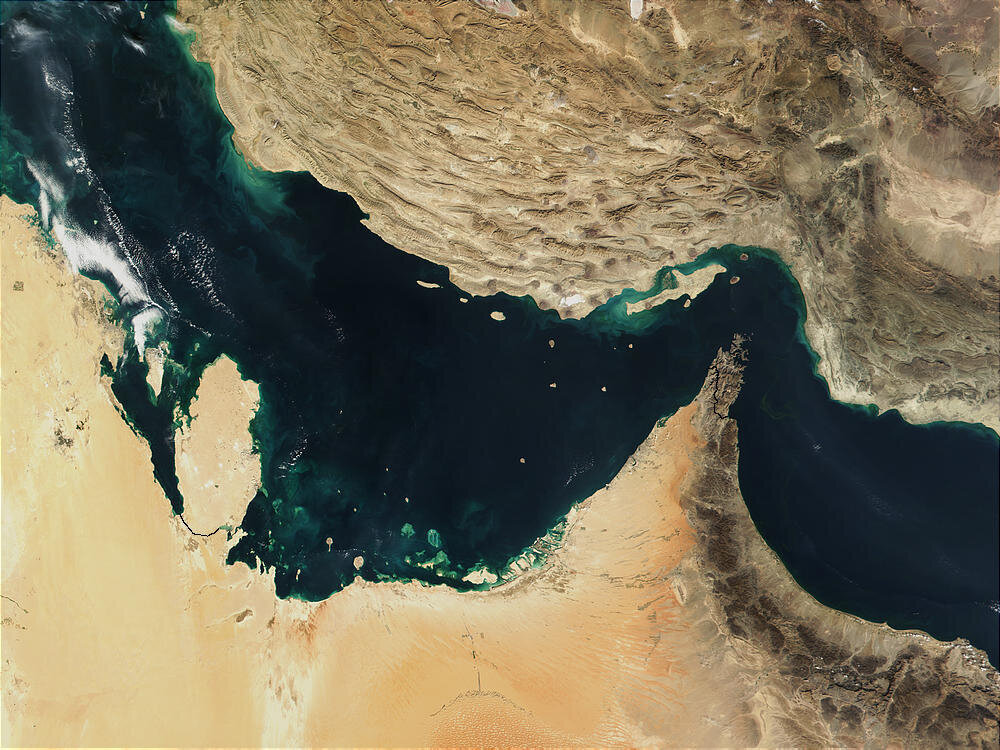
MADRID – The security order of the Persian Gulf is undergoing a gradual but unmistakable transformation. For much of the post-Cold War period, regional stability rested on a relatively clear hierarchy. The United States provided overwhelming military predominance, Persian Gulf monarchies aligned within that framework, and Iran occupied a position defined largely through containment.
That configuration has weakened. What is emerging is not disorder, nor a simple transfer of leadership, but a more diffused and negotiated balance in which external powers overlap and regional actors assert greater autonomy.
Recent developments in relations between Tehran and Washington—from intensified sanctions to ongoing indirect negotiations and military posturing—highlight a reality often obscured by rhetoric. The Strait of Hormuz is not merely a corridor for the transit of energy exports; it is a strategic space in which the broader regional order is being renegotiated. The central question is whether the Persian Gulf will continue to operate within a U.S.-centered framework or whether the region is gradually transitioning toward a more complex, multipolar configuration.
Since the 1980s, the United States has presented itself as the principal guarantor of navigation in the Persian Gulf. A sustained naval presence, reinforced by bilateral defense agreements with littoral states, established the operational foundation of this order. For a time, this predominance was largely uncontested. Yet the American withdrawal from the JCPOA and the subsequent reinstatement of broad sanctions on Iran deepened an already fragile divide. From that point onward, developments in U.S.-Iran relations were mirrored almost immediately in the language and practice of maritime security.
Within the formal framework of international law, freedom of navigation through international straits is clearly articulated in the United Nations Convention on the Law of the Sea. In practice, however, legal principles are mediated by power distribution and political intent. Washington invokes freedom of navigation to justify its enduring provocative military presence. Tehran, emphasizing sovereignty and regional responsibility, argues that lasting security must be organized by the states of the region themselves, without reliance on extra-regional enforcement.
Too often, Iran is described by the West as a disruptive variable within Persian Gulf security. A more precise reading identifies it as a structural component of the region’s equilibrium. Geography alone makes this inescapable. Iran borders the Persian Gulf and the Strait of Hormuz, commands significant demographic and industrial capacity, and possesses deep historical ties across West Asia. No durable security architecture can be constructed around its exclusion.
Western policy over the past decade has relied heavily on economic pressure as an instrument of strategic adjustment. Sanctions have imposed measurable strain, affecting currency stability, inflation, and energy revenues. Yet the expectation that economic constriction would translate into political capitulation has not been realized. Iran has adapted. Trade patterns have shifted eastward, financial arrangements have diversified, and domestic production has been prioritized in key sectors. These adjustments have not insulated the country from hardship, but they have reinforced a strategic culture of endurance.
At the core of that culture lies a particular reading of vulnerability. Iran does not enjoy the conventional air power or integrated defense networks of some nations. Its military doctrine compensates through asymmetric capabilities: missile systems designed to deter superior forces, naval assets capable of operating in confined maritime environments, and partnerships that extend strategic depth beyond its borders. From Tehran’s perspective, these elements are instruments intended to prevent coercion in a region long shaped by external intervention.
Limited escalations in recent years have reinforced this logic. Confrontations remained contained, yet they illustrated that Iran retains the capacity to respond proportionally when directly targeted. They also demonstrated that any serious escalation unfolds within a broader geopolitical context in which extra-regional powers hold concrete interests. China’s expanding presence in the Persian Gulf exemplifies this shift. Beijing’s primary concern remains economic. Secure access to energy resources and stable maritime corridors linking the Persian Gulf to global trade routes are indispensable. However, economic engagement has been accompanied by a modest but tangible security footprint. Naval deployments, enhanced maritime coordination, and diplomatic mediation efforts signal that China views the stability of the Persian Gulf as directly connected to its own development trajectory.
The restoration of diplomatic relations between Iran and Saudi Arabia in 2023, facilitated by Beijing, illustrated a new dynamic. China positioned itself as a stakeholder in de-escalation, reflecting a broader pattern in which Asian powers seek predictability rather than confrontation. For Iran, this engagement provides economic depth and geopolitical space. Energy agreements, infrastructure projects, and financial cooperation reduce the impact of unilateral pressure mechanisms. Tehran has maintained a cautious approach, seeking cooperation without surrendering strategic autonomy.
Russia’s relationship with Iran adds a continental dimension to this emerging geometry. As Moscow’s confrontation with Western powers intensified, connectivity projects linking Russia to the Indian Ocean gained renewed importance. Iran’s geography offers a natural corridor. Military and technological cooperation has deepened incrementally, driven less by ideology than by converging interests. For Russia, Iran is a strategic hinge in a Eurasian framework. For Iran, Russian expertise and diplomatic alignment in multilateral settings enhance resilience. The cumulative effect of these relationships is not the formation of a rigid bloc, but the dilution of isolation. The Persian Gulf can no longer be treated as a theater insulated from wider geopolitical competition. External pressure applied to Iran reverberates within a broader Eurasian context.
Regional actors have responded accordingly. The recalibration in Saudi policy toward Iran reflects pragmatic assessment rather than sudden alignment. Prolonged confrontation exposed critical infrastructure to risk and complicated domestic economic transformation plans. Engagement offers a means to reduce uncertainty without abandoning competition. The United Arab Emirates, while maintaining strong ties with Western partners, has pursued diversified economic relations and selective de-escalation. Oman and Qatar continue to preserve channels of dialogue. This pattern reflects a shared recognition. Large-scale instability in the Persian Gulf would undermine fiscal stability, foreign investment, and long-term development agendas. Risk management has overtaken ideological positioning.
The Strait of Hormuz remains the focal point of strategic calculation. A significant share of global energy exports transits its waters. Iran’s geographic proximity provides it with latent leverage, while the United States retains formidable naval assets in the region. The balance that results is reciprocal. Neither side can escalate without anticipating serious costs. The presence of additional external actors, advanced surveillance technologies, and interconnected defense systems further complicates unilateral action. In this environment, deterrence is mutual rather than hierarchical. The assumption that security could be guaranteed through singular dominance is increasingly difficult to sustain.
Disclaimer : This story is auto aggregated by a computer programme and has not been created or edited by DOWNTHENEWS. Publisher: tehrantimes.com