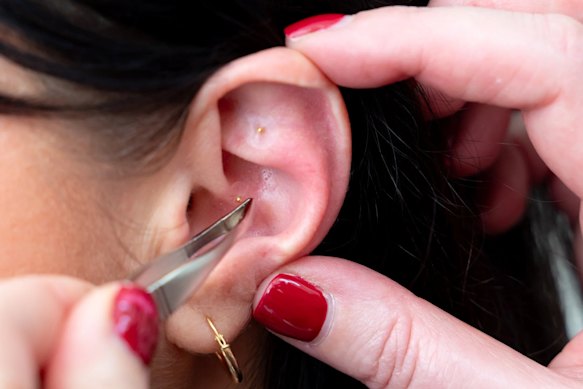

The first time I heard about “ear seeding”, the thought of having small “seeds” stuck in the nooks and crannies of my ear made my skin crawl. I was also dubious of the broad claims on TikTok about the possible benefits – stress reduction, lymphatic drainage, even posture correction. How could a “seed” do all that?
To put this curiosity to rest, I visited The Melbourne Apothecary, a holistic health clinic and wellness collective located within Mecca’s Bourke Street store in Melbourne, where I had seeds applied to my left ear. They aren’t technically seeds, but tiny stainless-steel balls plated with 24-karat gold, all carefully affixed by a registered acupuncturist and Chinese herbal medicine practitioner to specific zones on my ear. They’re meant to address certain “imbalances” I’d previously identified.
Like other traditional Chinese medicine practices, ear seeds are often met with scepticism like my own, especially once they began blowing up on platforms like TikTok. How could a little pressure on the ear target so many different parts of the body, both internal and external? I was about to find out.
What is ear seeding?
Ear seeding is a form of auriculotherapy (ear acupuncture) that has been used for thousands of years in traditional Chinese medicine. Rodd Sanchez, an accredited acupuncturist and representative for the Australian Acupuncture and Chinese Medicine Association, says it began with vaccaria seeds applied to specific pressure points on the ear (of which there are over 200).
“Think of the ear as a small map or GPS,” Sanchez says. “When you’re looking at a map, you can see where the streets are, and the streets are your body. So, you can actually pinpoint a particular area on the ear, which then represents another part of the body.”
This is why ear seeding is said to target a range of ailments, from “cortisol face” to anxiety. Sanchez says it has also been used as a complementary treatment to manage pain and addiction. In fact, the US military has even used it for pain relief.
During my pre-consultation, I pinpointed stress and jaw tension as my main concerns. My acupuncturist, Dr Suzi Craig, placed six seeds on my ear accordingly, and recommended I leave them on for three to five days. I could shower, sleep and exercise as normal. The only thing that might change was my general wellbeing. Perhaps my jaw would loosen, or I’d feel slightly more relaxed, especially after massaging the seeds.
I can’t say I felt any less stressed than usual over the five days, and I certainly didn’t sleep better. That being said, I did notice a distinct relaxation of my jaw. I usually wake up every night with lockjaw, forcing me to painfully knock it back into place. By night three, my jaw had gone from locked to only slightly stiff. By night five, I didn’t notice my jaw at all.
Is it safe?
Any fear that the application would hurt immediately dispelled once my first seed was on. It was placed in the “shen men” point, which aims to promote relaxation, and I barely felt it. The same went for every other seed, bar the liver point (on the ear’s antihelix), which stung slightly. I ended up removing this one after two days because of ongoing tenderness. As soon as it was off, all sensitivity disappeared.
Co-founder of The Melbourne Apothecary, Carly Woods, says ear seeding is non-invasive and therefore low-risk.
“Sometimes you can get tenderness to the point where you can’t lie on your ear while sleeping. But in that instance, you just pull them off,” Woods says.
It’s important to consult a professional acupuncturist before applying the seeds, Woods’ fellow co-founder Charmaine Dennis adds. This will not only ensure the correct zones are stimulated, but will also raise any contraindications. For example, similar to massage, certain points should be avoided on pregnant people.
While there are DIY ear seed kits available, both Woods and Dennis generally recommend having them applied by a trained professional.
“What we’re seeing is that people are putting on 20 ear seeds, and then they get a migraine because they’re totally overstimulating the body. They want it to look amazing, but they’re not thinking about the impact,” Dennis says. “Point location is also really essential. How can you place it correctly if you don’t know where all the points are?”
Why has it gone viral online?
Ear seeding has taken off on social media as a “wearable wellness” trend. Individual videos rack up millions of views, as content creators show off the stylish steel seeds and display their “wondrous” aesthetic benefits.
Since opening their clinic at Mecca in August, The Melbourne Apothecary has delivered over 1000 ear seed appointments. Shantini Morey, Mecca’s head of flagship concept and concessions, says wellness is now a major focus for Mecca, and ear seeding represents the “exciting intersection of beauty and holistic wellbeing”.
Ear seeding has always been relatively popular, says Jon Wardle professor in public health at Southern Cross University, but its recent “virality” could be attributed to the general shift towards a positive health model.
“Previously, you might have focused on things like pain or anxiety, whereas now people are looking at things for self-improvement,” he says.
So, does it actually provide any benefits?
Despite increasing interest in ear seeding, Wardle says it still remains under-researched. The studies that do exist are also often small in scale and oftentimes inconclusive.
“There’s probably a kernel of truth hidden within a blanket of claims that aren’t really appropriate,” Wardle says. “There’s a bit of research in things like reduced anxiety and pain and improved sleep … But very few of these therapies are actually studied anywhere close to how often they’re used, so there’s a gap in research more generally.”
In fact, according to World Health Organisation data, less than one per cent of global health research funding supports traditional medicine. Research in these areas are particularly important, Wardle notes, as traditional use may not necessarily translate to modern-day best practice.
While ear seeding has, at least anecdotally, been beneficial in some areas, Wardle says it’s likely not a cure.
“It might be nice adjunctive treatment,” he says. “The big risks are people making claims that it’ll cure things that it just won’t, and people avoiding other treatments, or being financially exploited to pay for it when they don’t really need to and then not being able to afford other treatments.”
Wardle is most sceptical of claims that ear seeding improves biomarkers like blood sugar or cholesterol levels. “Those conditions will be a bit more serious, and you should really be looking at other options that have a stronger evidence base behind them.”
Sanchez says ear seeding could be a useful complementary tool within a drug-free wellness approach. While no “magic seed” exists, he says he’s seen seeding help people who are seeking to minimise the number of medications they take.
As for aesthetic benefits, Sanchez says he hasn’t noticed a direct cause-and-effect when it comes to things like jaw tightening or facial slimming. But if you’re feeling better, you’ll generally look better too.
“When your friends come back from holidays, and you go, ‘Wow, you look great, why is that?’ It’s because they’re calmer, they’ve been sleeping, they haven’t been eating rubbish. It’s similar with ear seeds. It could be a side effect.”
While I may not have noticed an extreme change in my general wellbeing over my five days with ear seeds, I can understand their appeal as a complementary tool. After all, they don’t hurt, they’re quick to apply, and they look like ear candy. All they need now is the proper research to back them.
Disclaimer: I received complimentary ear seeding treatment from The Melbourne Apothecary.
Make the most of your health, relationships, fitness and nutrition with our Live Well newsletter. Get it in your inbox every Monday.
 Nell Geraets is a Culture and Lifestyle reporter at The Age and The Sydney Morning Herald.Connect via X or email.
From our partners
Disclaimer : This story is auto aggregated by a computer programme and has not been created or edited by DOWNTHENEWS. Publisher: www.smh.com.au