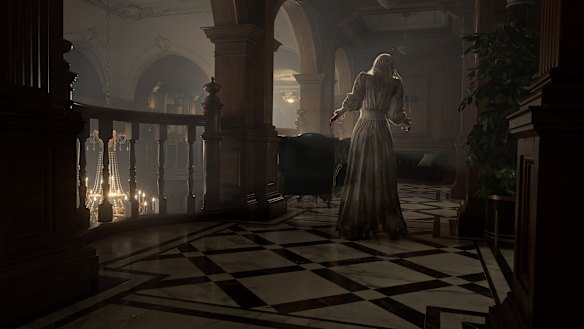

There’s something special about horror video games, which Resident Evil has always understood. You can’t close your eyes or turn away like you can in a movie because you’ll either fail and have to try again or the game won’t progress at all. You have to will yourself to open the door and find out what’s behind it. Or, as is the case early in Resident Evil Requiem, you have to move out of the light and into the dark hallways searching for a way out, even though you know there’s a monster on the hunt for you.
There are moments in this game that will legitimately make your chest tighten and your hands sweat, as a masterfully implemented jump scare or surprise enemy behaviour shatters your ability to rationalise that it’s just a game of hokey simulations. But this also a love letter to a long-running series that hits all the notes fans will expect, with silly puzzles requiring you to turn cranks or find safe combinations scrawled in scientist’s notes, and the return of an iconic character who’s irrepressibly goofy and lovable despite also being a zombie-killing action star.
As a series, Resident Evil turns 30 next year, and Requiem represents a collision between the two schools of design Capcom came up with to revitalise the franchise after its original run became boring and stale more than a decade ago. At their best, the games have always been playable high-budget B-movies, and this one’s a double feature, split dichotomously between two main characters and two styles of horror.
Newcomer Grace Ashcroft is an extremely awkward FBI agent haunted by the murder of her mother in strange circumstances, and now abducted by a ghoulish doctor who thinks she has special genetic properties. Grace’s part of the game continues the lineage of Resident Evil Biohazard (2017), and Resident Evil Village (2021); levels are tense, play-with-the-lights-on horror mazes, with few weapons and an emphasis on escape.
Fan favourite Leon S. Kennedy, on the other hand, is an aged secret agent with some kind of mysterious infection and reprises his role from the 2019 remake of Resident Evil 2 and the 2023 remake of Resident Evil 4. His levels are frenetic action scenes with waves of enemies and ever-shifting perilous situations to overcome. The fear here comes not from the individual zombies, but from the potential to be cornered or overwhelmed.
The dozen-hour adventure has two main parts, and each feels like a miniature sequel. In the first, you see through Grace’s eyes, her shaky breath and whispered pleading ratcheting up the tension as you creep around a gothic intensive care centre, crafting supplies and planning carefully as you learn details about the monstrosities stalking the halls, how to kill them and why they might come back.
The audio design really shines here, in addition to Capcom’s usual grotesque visual splendour, as creaking floorboards and thumping footsteps give you as much information (and dread) as the limited visibility from your lighter or torch. It’s an enormous facility with disquietingly elegant rooms, cold medical wings, hidden labs and a foul, wet industrial basement. This, combined with multiple rampaging giant enemies, makes it feel like a brilliant extension of the Baker house in Biohazard.
Meanwhile, you play as Leon in a few action-packed interludes up top, but his main section comes later when the story moves to the ruins of Raccoon City, the site of the original ’90s games and an area Leon barely escaped 30 years ago before it was bombed to contain the outbreak. Here the camera pulls out to a less-claustrophobic over-the-shoulder view, so you can more easily survey the action set-pieces, including a trippy sequence inside a partially collapsed office tower. Leon’s puns and bravado bring the tone right back to RE4, and the gameplay speeds up to match.
While Grace makes do with what weapons she can carry – she also stores stuff for later, saves her game on old typewriters and takes blood samples to develop zombie counter-measures – Leon always carries a full arsenal. He has a hatchet that can block chainsaw swings, and can roundhouse kick a head off. Both game styles are a lot of fun, but since they’re sharing the playbill here, neither feels truly on par with the best of their predecessors.
On Grace’s side, the upgrades and rewards you get from exploring feel less valuable because you’re not keeping them throughout. I left a bunch of resources in a particular spot in the care centre, planned to go back once I’d dumped my loot in the supply, but I triggered the next scene and never returned. As Leon, I loved revisiting past locations and hearing his action hero quips, and there are heaps of callbacks here for series fans. But there are really only four or five big set-piece moments of note, whereas RE4 is packed full of them.
The return of the Raccoon City story also brings with it some of the series’ worst habits, with a tangled indecipherable plot full of nonsense words and anime drama. This doesn’t so much affect either main section, but it does make the connective tissue feel overwrought as the game is propelled towards a conclusion that needs to explain Grace’s past, pay off on Leon’s, and navigate three decades of expanding codswallop.
And yet, this kind of thing is part of Resident Evil’s schlocky DNA, so I can’t deny that some of the malarkey put a big smile on my face. These are the kind of games big on concepts and details (I love how if you try to reload your gun, but you already have a fresh clip, the character makes a big play of checking it anyway), but not so big on narrative subtlety (Leon’s huge revolver is called Requiem, and the game’s subtitle is only slightly deeper than that).
In contrast to the car crash of Resident Evil 6, which occurred the last time Capcom tried to pull all its threads together, the developers of Requiem have a firm grasp of what works for the series. Intense, unpredictable horror is balanced by moments of calm in a quiet safe room, which combines items to solve puzzles or create healing injections, and examining maps to plan out routes. It’s all here and works as well today as it ever did.
Zombies are more terrifying than in the old games here because they’ve been infected with a modified virus that lets them keep elements of their human memories and behaviours (which also makes them more varied), but they evoke the classic shamblers too. Every one is dangerous, and overcoming them is about managing your resources and suppressing the urge to panic.
While there’s a gulf between crawling through ducts to find keys as Grace and customising guns or duelling chainsaws as Leon, a lovely reverence for the series ties it together as a whole. Even the narrative, wacky though it gets in the third quarter, ends on a satisfying note.
Disclosure: Capcom provided a digital copy of the game for review.
Get news and reviews on technology, gadgets and gaming in our Technology newsletter every Friday. Sign up here.

From our partners
Disclaimer : This story is auto aggregated by a computer programme and has not been created or edited by DOWNTHENEWS. Publisher: www.smh.com.au