One of the downsides of our movie-mad filmmakers — the Quentin Tarantinos who happily plunder from cinema’s illustrious past — is that their worldview can be myopic beyond what’s up there on the screen. For all their technical acumen, the hum and whir of life remains absent in their work, which merely mimics the semblances of behavior they’ve observed from other films. These directors can synthesize the architecture of cinema but not the underlying humanity that transforms movies into something that resonates.
What’s so impressive about Bi Gan’s excellent third feature is that he manages to have it both ways. The Chinese director behind 2015’s “Kaili Blues” and 2018’s “Long Day’s Journey Into Night” makes movies besotted with the act of making movies. They include accomplished long takes and sensuous riffs on well-defined genres.
And yet he’s never lost sight of the fragile characters at the center of his spectacles. With “Resurrection,” Bi delivers something uncommonly rich, boldly conceiving his latest as a salute to the history of film. Still, his focus remains on people — whether they be in his stories or watching in the theater.
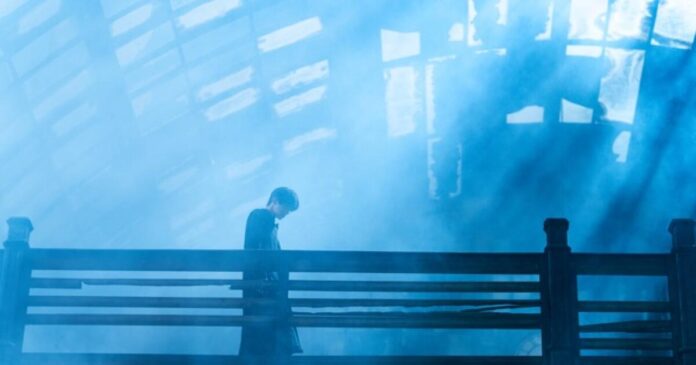
Premiering at Cannes, where it won a Special Award, “Resurrection” imagines a fantastical alternate reality in which society has chosen to stop dreaming in order to live forever. However, an unnamed “deliriant” (Jackson Yee) rejects that arrangement, preferring the chaos and pain of a human life. He escapes into a mystical realm that is shown in a series of short films which span the 20th century, each vignette starring him in a different guise. In one, he plays Qiu, who is accused of murder as part of a noirish thriller. In another, he’s Apollo, a small-time crook celebrating New Year’s Eve in 1999, lured by a temptress, Tai Zhaomei (Li Gengxi), who’s also a vampire.
Traipsing through genres and time periods, these excursions are an opportunity for Bi and his creative team to frolic in various cinematic sandboxes. When we meet Yee’s shifting character, he first resembles a hideous beast reminiscent of F.W. Murnau’s title character from 1922’s “Nosferatu.” The segment expertly samples the jagged production design and theatrical lighting of German Expressionism’s heyday.
But Bi is after more than elaborate dress-up, conceiving each episode as an exploration of how movies amplify and comment on life’s cavalcade of emotions. Later, Yee’s monster is reborn as a stoic con artist who recruits a young girl (Guo Mucheng) to be his partner in crime. This wistful chapter evokes classics like “Paper Moon,” but Bi lands on a resolution that’s uniquely heartbreaking, connecting the illusion of movies with the delusions we cling to in the real world.
As he has done in his previous films, Bi creates a climax for “Resurrection” that culminates in a masterfully orchestrated long take, one lasting just under 30 minutes, as we follow Apollo and Tai Zhaomei on an electric adventure through a New Year’s Eve involving gangsters, karaoke bars and random bloodsucking. The segment is easily the film’s showiest, Bi’s camera snaking through streets and darting into different buildings. But the audaciousness is always in service of capturing the headlong rush of new love, the characters as giddy as the filmmaking. Even here, though, “Resurrection” drills down into something unbearably moving, turning the century’s end into an apocalyptic occurrence, the future perilously uncertain for these impetuous lovers.
The 20th century that “Resurrection” chronicles was a pivotal period for China, bringing to a close the Qing Dynasty and ushering in the rise of a communist superpower. It was also a century that heralded cinema’s ascension as the dominant popular art form worldwide. Bi is far more invested in that latter revolution and consequently, “Resurrection” can be seen as an elegy for a medium whose cultural relevance has somewhat slipped. No wonder, then, that the film’s genre-hopping dexterity is laced with a hint of melancholy.
It’s a cliché to say that movies are a form of dreaming, but people who love them understand that as a foundational truth. The wonder of being alive is to grapple with mortality — to know that everything, including a movie, fades away. Bi throws his lot in with the monsters and “Resurrection” concludes with a personal and artistic reckoning that’s as defiant and emotional as anything cinema has produced in recent years.
Turns out, the world did not, in fact, stop spinning when we entered the 21st century. But Bi’s journey through cinema’s past argues that a movie’s greatness stems not from spectacle but, rather, a belief that we can see ourselves in its story. “Resurrection” is the work of a vivid soul who has kept the faith. He invites us to dream along.
‘Resurrection’
In Mandarin, with subtitles
Not rated
Running time: 2 hours, 40 minutes
Playing: Opens Friday, Dec. 12 at Laemmle Royal
More to Read
Disclaimer : This story is auto aggregated by a computer programme and has not been created or edited by DOWNTHENEWS. Publisher: latimes.com