
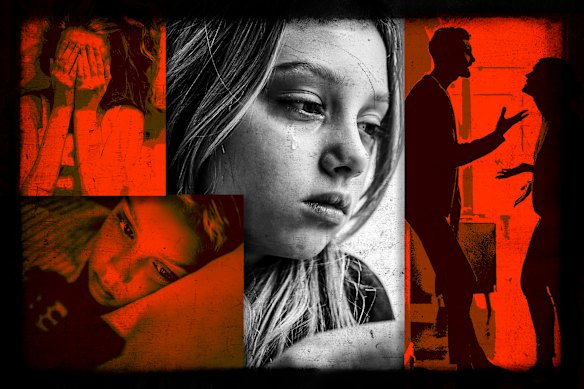

Bad sleep and trouble at home can set adolescents on a trajectory towards depression and anxiety, says an Australian-first study aimed at predicting and protecting the teenagers at greatest risk.
But strong friendships and feelings of belonging in those first years of high school can be powerful inoculators against mental health problems, the Black Dog Institute’s Future-Proofing Study found.
Researchers tracked more than 6000 students from year 8 to year 11 across more than 130 schools, starting in 2019, to provide the clearest picture to date of how the most common mental health issues manifest and evolve in adolescence.
Preliminary findings released today showed two-thirds of the 13- to 18-year-olds had minimal or no significant depression and anxiety symptoms, but one in four participants reported persistently high or worsening mental health, with 26 per cent reporting anxiety symptoms and 19 per cent depression.
The study’s co-lead investigator Professor Aliza Werner-Seidler said, by the time many of these teenagers were in year 8, mental health problems had already set in.
“We have to get in earlier if we want to lower their risk of developing anxiety and depression,” Werner-Seidler said.
“Younger children are reporting things like instances of self-harm and suicidality, which is pretty new. So, we have had to adjust our focus to looking at upper primary school years for prevention work.
“Focusing on those modifiable factors like sleep, connection and belonging at school can probably yield the greatest impact.”
Sleep on it
Sleep was one of the strongest predictors of poor mental health, the study’s preliminary findings showed.
An alarming one in three participants reported persistent and increasing insomnia symptoms, including 11 per cent with clinically significant insomnia who were four and six times more likely to experience high levels of anxiety and depression symptoms, respectively.
Sleep health was the “missing pillar in public health education efforts”, Werner-Seidler said.
“Most young people and their parents don’t know how much sleep they’re meant to be getting, or how to help a child who is lying in bed and worrying so much they can’t fall asleep.”
Before-school extracurricular activities were “completely ill-suited to a teenager’s circadian rhythm”, she added.
“If school starts at 8 or 9am, that should be the first thing they do in the morning.”
University of Queensland Conjoint Professor of Child and Youth Psychiatry James Scott said poor sleep was one of the most common problems he sees in his practice, describing the problem as “kids staying on their phones with or without social media until all hours of the night”.
“This is a big public health challenge that’s modifiable,” Scott said. “We really need to focus on talking to families and kids about how we improve sleep hygiene.”
The study authors suggested routine screening for sleep problems, stronger sleep education in schools, and investing in training clinicians to treat insomnia as options to make a significant difference.
Sleep tips for teens
Adolescents aged 13 to 18 need eight to 10 hours of sleep a night. Here’s what can help:
- Exposure to daylight in the morning
- Have a regular bedtime and wake-up time
- Follow a bedtime routine (e.g., shower, brush teeth, dim the lights)
- Limit the occasional sleep-in to two hours
- Put screens away 30 to 60 minutes before bed
- Avoid daytime naps
- Avoid caffeine four to six hours before bed
- Get some exercise during the day
Peer protection
Participants who reported higher levels of school connectedness and positive peer relationships in year 8 were more likely to report higher wellbeing in year 10.
But about one in four students reported low levels of connectedness at school.
“If young people experience exclusion and bullying at that age, it has such a negative impact on their mental health,” Werner-Seidler said.
“Teenagers’ brains are super sensitive to rejection, more so than younger children or adults. There is something about being a teenager where fitting in matters at a neural and emotional level.”
She said that schools can play an important role by fostering peer relationships and creating environments where students feel a sense of belonging.
The study also confirmed that girls and gender diverse adolescents were significantly more likely than boys to be anxious and depressed, a divide not typically seen in primary school.
“It blows my mind that this is not well known: there is a massive gender difference in the prevalence of mental health symptoms, which you don’t see until kids hit puberty,” Werner-Seidler said.
For Cassia, whose surname has been withheld, teenage troubles began early.
“I was in year 5 when I got quite depressed, I had eating issues and friendship struggles,” Cassia, now 18, said.
She was diagnosed with obsessive-compulsive disorder (OCD), but it wasn’t until high school that her mental health plummeted. She struggled to make friends.
“There was one girl, my best friend … but something happened in year 9. We had a big falling out, and that made everything a lot worse,” she recalled.
“I started to get intrusive thoughts … self-harming thoughts, and I felt like I didn’t have anyone to talk to about it.”
Cassia was getting just six hours’ sleep a night and self-harming at school. She was admitted to a psychiatric hospital in year 10. When she was not permitted to return to school, her peers stopped speaking to her.
“That was really hard,” she said.
But with psychotherapy, medication and two supportive schools with strong wellbeing programs, Cassia graduated with a lasting group of friends.
“My mental health is great now,” said Cassia, who is studying to be a teacher’s aide.
Adversity at home
Experiences such as verbal abuse, parental divorce, household mental illness and life-threatening danger at home by year 8 predicted a range of mental health-related issues by year 10, including new incidents of self-harm and suicidal ideation, an increase in hyperactivity problems, and peer problems.
More than half of participants reported at least one such adverse experience in their home life.
Scott said adversity in childhood was common and often unavoidable. It was also not harmful for many children, and some of these experiences, such as divorce, were not always adverse.
“For some kids, divorce is actually a relief,” he said.
“Mental illness in the household will be very common,” he added. “What’s important is having supports in place to help that child and the rest of the family through any tough times.”
Lifeline 13 11 14
Kids Helpline 1800 55 1800
NSW Mental Health Line 1800 011 511.
From our partners
Disclaimer : This story is auto aggregated by a computer programme and has not been created or edited by DOWNTHENEWS. Publisher: www.smh.com.au






