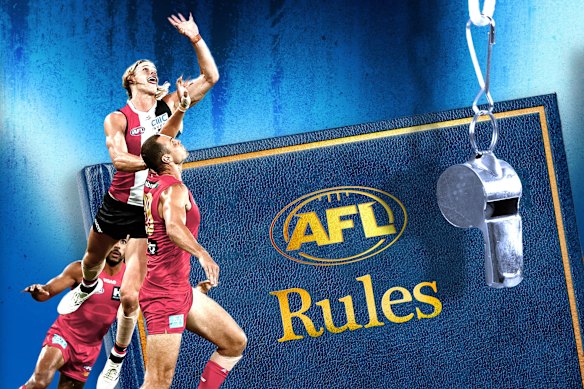
More jumping ruckmen, a stricter stand rule and shorter quarters could be on the cards during the 2026 AFL season as seven rule changes come into play for season 2026.
Among the rules changes are a crackdown on “gut punches” and the removal of the substitute player. AFL bosses are also determined to cut the length of quarters, so expect to see play zipping along.
The AFL has implemented seven rule changes for the 2026 season.Credit: Matt Willis
Last-disposal rule
This rule change will be among the most noticeable to footy fans.
If a player kicks or handballs the ball and it goes out of bounds, then the other team will get a free kick where the ball went out.
Anyone who has watched AFLW or the SANFL in recent years will be familiar with this rule – as will anyone who watches basketball or soccer. It’s designed to speed up play and give the umpires a simpler decision to make.
The rule won’t apply inside either 50-metre arc, while if a player blocks or prevents an opponent from trying to keep the ball in, the umpire can order a throw-in instead.
As shown in the above video from last month’s State of Origin game, Toby Greene’s kick went into Tom Barrass’ leg, but that soccer still counted as the last disposal, so Greene’s Victoria received a free kick. It was a red-hot call that led to a quick restart for Victoria.
Commentator Jonathan Brown was originally worried the rule would result in too many additional free kicks.
“You feel like there will be 20 of them a game, but there was only a handful,” Brown said on Fox Footy after the recent State of Origin game.
“It was only a kick or handball. I think it’s a good rule and it speeds the game up a little bit.”
Centre ball-up contests
The centre bounce is gone and it’s all ball-ups from here.
In the hope they can return the centre ruck duel to more of a jumping contest, the league will stop ruckmen from moving over the centre line before they have physically engaged with their opponent.
According to the AFL, only 21 per cent of last season’s centre bounces featured a ruckman jumping in the contest. Instead, they opted to stand and block their opponent’s leap.
In the above example from the AFL last season, Tristan Xerri stands in Tom De Koning’s path and he topples over while trying to get the tap. Such an act will be illegal in 2026.
Demons skipper and veteran ruckman Max Gawn expects the biggest leapers, such as St Kilda recruit De Koning, to have a big advantage in 2026.
“There is going to be a lot of jumping, and the guys that can jump will really excel. But some of the older guys like me will have to come up with a different way,” Gawn told Fox Footy after the Origin game.
“There are a few people like myself, Jarrod Witts, Darcy Fort – guys who have been around a while and don’t jump as high as Tom De Koning – we will have to come up with something, but I think there were a few moments where Darcy Cameron stayed down that we can work with.”
Ruck nominations
League bosses clearly had lumbering ruckmen in their sights during the off-season as they have empowered umpires to restart play, both ball-ups and throw-ins, regardless of whether a nominated ruckman is present.
If no one nominates for the ruck contest, the ball will be thrown up and players will have to wait for it to hit the ground before “play on” is called – which sounds like a puck drop in ice hockey.
Third-man-up hitouts are still outlawed.
Last season, umpires sometimes waited 20 seconds or more for ruckmen to arrive, in the example above, both rucks were almost on the bench but then turned around and ran across the ground for a throw in, wasting more than 25 seconds.
The stand rule
We’ve been here before, but the AFL is cracking down on not only any movement from the man on the mark but also anyone within five metres of the mark.
Any player in that five-metre area can’t back out of that zone and run away – they must also stand until play on is called.
The example above from 2025 shows Geelong’s Tom Atkins on the mark but backing away to cover the St Kilda player running past his teammate with the ball.
The league hopes that by making Atkins stand in that situation, it will unlock more play-ons or quick-fire possessions as teams look to sprint ahead.
The AFL will also demand umpires crack down on players who hedge off the mark to restrict support runners from linking up with teammates.
The shrug rule
Holding the ball is always controversial, but one aspect of it the league hopes to simplify in 2026 is that an attempt to shrug a tackle will now be considered “prior opportunity”, just like fending off or attempts to evade a tackler.
As shown in the video above, Fremantle’s Caleb Serong tackles St Kilda’s Jack Higgins around the shoulders but Higgins shrugs and Serong’s arms end up above his neck. In 2025, it was correctly ruled as a ball-up.
But in 2026, Higgins would be ruled as having had prior opportunity to get rid of the footy, so te correct decision would be holding the ball.
The league hopes this will make it easier for umpires to call holding the ball and keep play moving.
AFL bosses also believe the shrug is being used to shift tacklers from shoulder-high to head-high contract to draw free kicks.
Aligned kick-in times
The player kicking in after a behind now has less time – just eight seconds – to restart play.
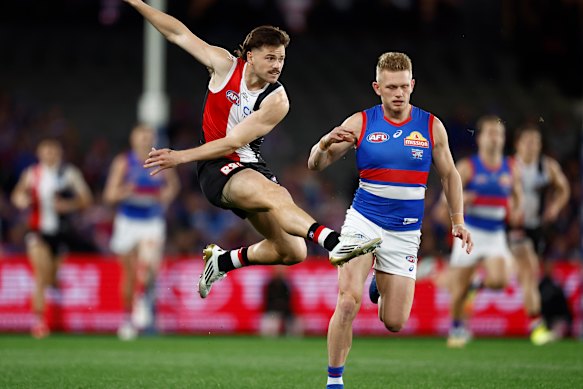
St Kilda’s Jack Sinclair and other players who take kick-ins will have less time to restart play in 2026.Credit: AFL Photos via Getty Images
That’s the same amount of time afforded to players who have marked the ball or received a free kick elsewhere on the field.
Again, this change is projected to help make quarters shorter.
Gut punches
The league has amped up the punishment for “gut punches”, which only attracted fines in recent seasons.
Now, the league wants that act graded as a one-match suspension when it is assessed by the match review officer.
The clips above are clear, whack a player in the stomach and you will likely end up with a one-game ban.
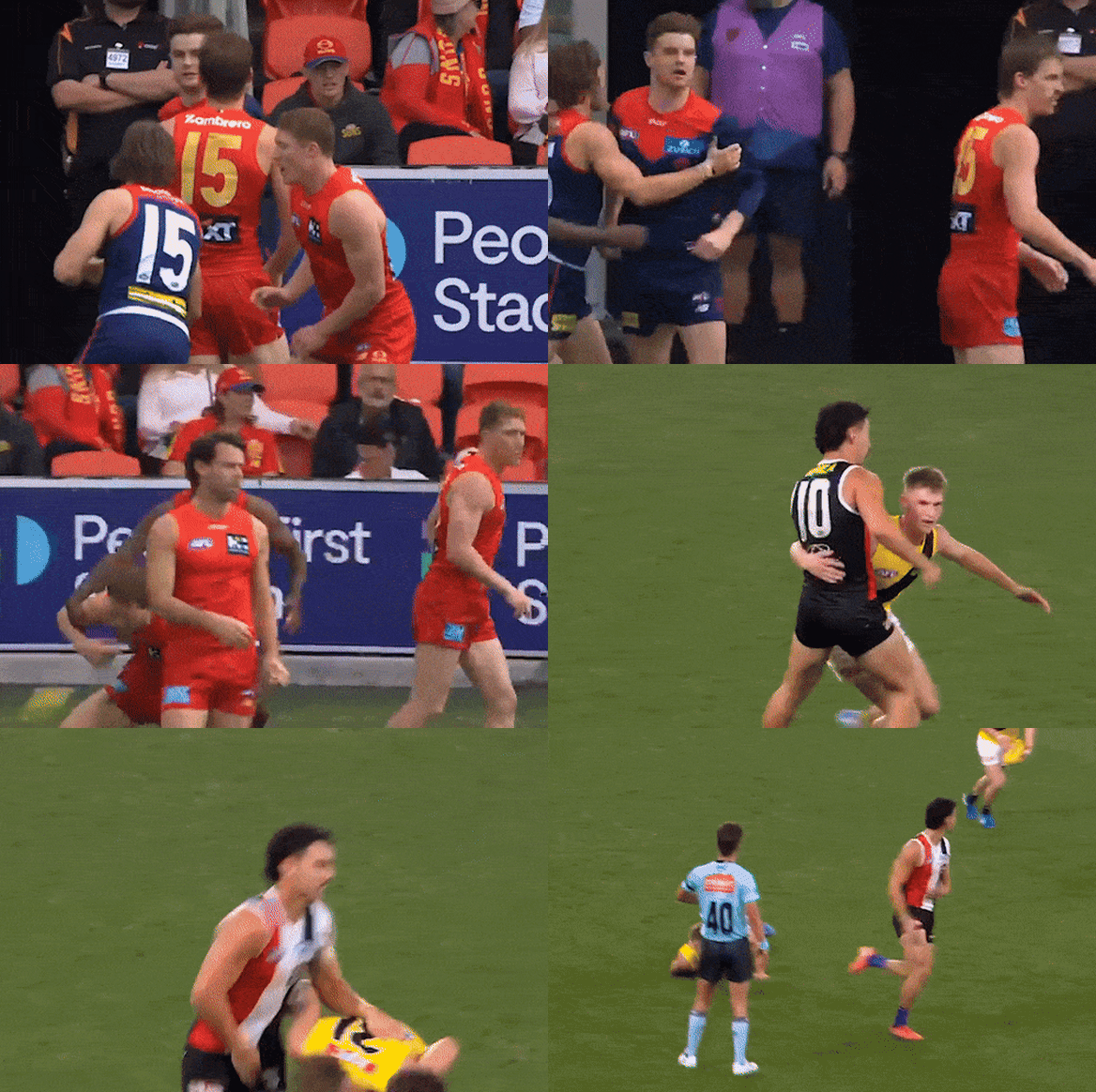
Gut punches, such as these examples from 2025 by Melbourne’s Kysaiah Pickett and St Kilda’s Mitch Owens, will incur a one-match suspension in 2026.Credit: AFL
No more substitute player
The “sub rule” is gone. Instead, the 23 players named will all be eligible to take part in the game from the start.
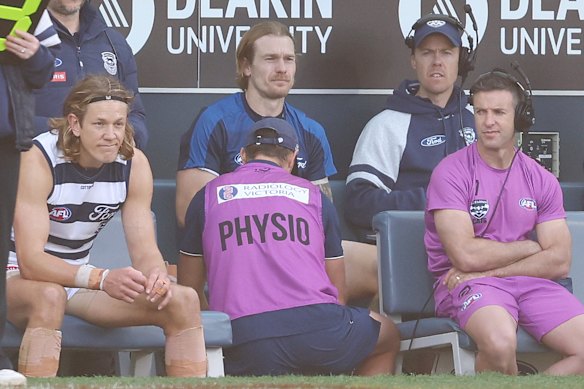
Tom Stewart was subbed off against the Saints in July 2025.Credit: Getty Images
Teams still have the same number of interchanges per game.
Goal square starting positions
This one is straightforward. Teams will still need to start with six defenders in their defensive 50m arc, six midfielders and six forwards in their forward 50m arc.
But they no longer have to anchor a player in the attacking goal square.
League bosses say running a player back to each goal square was delaying centre restarts and could save 20-30 seconds per match.
Time will tell if any astute coaches can use that additional roaming forward to influence the contest.
Keep up to date with the best AFL coverage in the country. Sign up for the Real Footy newsletter
Disclaimer : This story is auto aggregated by a computer programme and has not been created or edited by DOWNTHENEWS. Publisher: www.smh.com.au