
South Australia’s algal bloom has spread north up the Yorke Peninsula, turning waters a sickly brownish-green colour and suffocating southern sand octopus, rays and other marine life.
There are now fears it could spread further north into the Spencer Gulf towards South Australia’s annual aggregation of giant cuttlefish, which is due to take place off the coast of Whyalla from May.
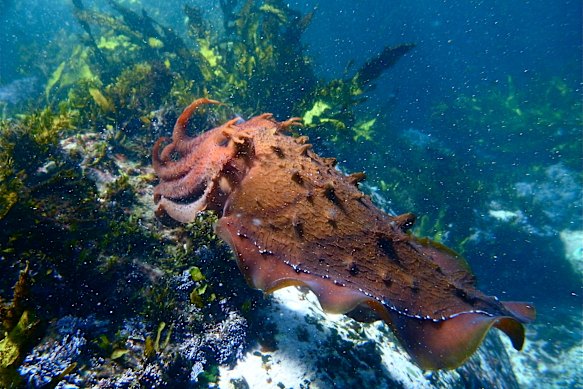
The annual event is the only known mass gathering of giant cuttlefish – which can weigh as much as 10 kilograms – in the world, and is billed as one of the most spectacular natural events in the Australian marine environment.
The natural wonder attracts photographers, divers and researchers from around the world, drawn to the beauty of the colour-changing cuttlefish, which are dubbed “chameleons of the sea”.
Great Southern Reef Foundation co-founder Stefan Andrews surveyed water off the coast of Port Victoria, a town located in the middle part of Spencer Gulf on Monday, and recorded water visibility of less than one metre in parts.
He said he saw multiple marine species, including octopus, starfish and abalone, dead and dying.
“I watched a healthy reef collapse in seven days,” he said.
“One week ago I dived here, and it was full of life. Stingrays, large fish, small fish, octopus. Today I came back to dead octopus on the seafloor and abalone so weak you could lift them straight off the rock.”
South Australia’s coastline has been in the grip of a deadly algal bloom caused by multiple species of the tiny dinoflagellate Karenia, a genus of planktonic organisms that drift in water columns.
The organisms turn seawater greenish-brown, and produces a mucky foam that causes skin irritations among humans.
For the past few weeks, sections of the Yorke Peninsula and Spencer Gulf have been hit by elevated Karenia levels, although figures released by the South Australian government show levels were low last week.
A spokesman for the South Australian environment department was unable to provide data on the Karenia levels this week in the region.
Giant cuttlefish generally live for 12 to 18 months, and die after they mate. Females lay eggs in the winter.
“The next generation is highly dependent on the previous generation and the [survival] of those eggs,” Andrews said.
“They could manage to get through this year, or they could all get wiped out. And if they don’t manage to lay eggs this year, then it might not ever happen again.”
Last year the South Australian and federal governments invested in a trial “bubble curtain” measuring 200 metres by 100 metres. It was hoped the vertical sheet of bubbles would protect cuttlefish and their eggs from the toxic blooms if they approached Port Lowly, where cuttlefish congregate during winter.
However, cuttlefish migrate long distances to reach the aggregation site, and Andrews said it was unknown whether they would get caught in deadly blooms on their migration.
For 12 months, scientists have been engaged in a grim game of cat and mouse with a microscopic enemy that defies definition.
In November, scientists from Australia, New Zealand and the UK published a research paper that showed five Karenia species have contributed to the blooms.
Get to the heart of what’s happening with climate change and the environment. Sign up for our fortnightly Environment newsletter.
 Bianca Hall is The Age’s environment and climate reporter, and has worked in a range of roles including as a senior writer, city editor, and in the federal politics bureau in Canberra.Connect via X, Facebook or email.
From our partners
Disclaimer : This story is auto aggregated by a computer programme and has not been created or edited by DOWNTHENEWS. Publisher: www.smh.com.au