
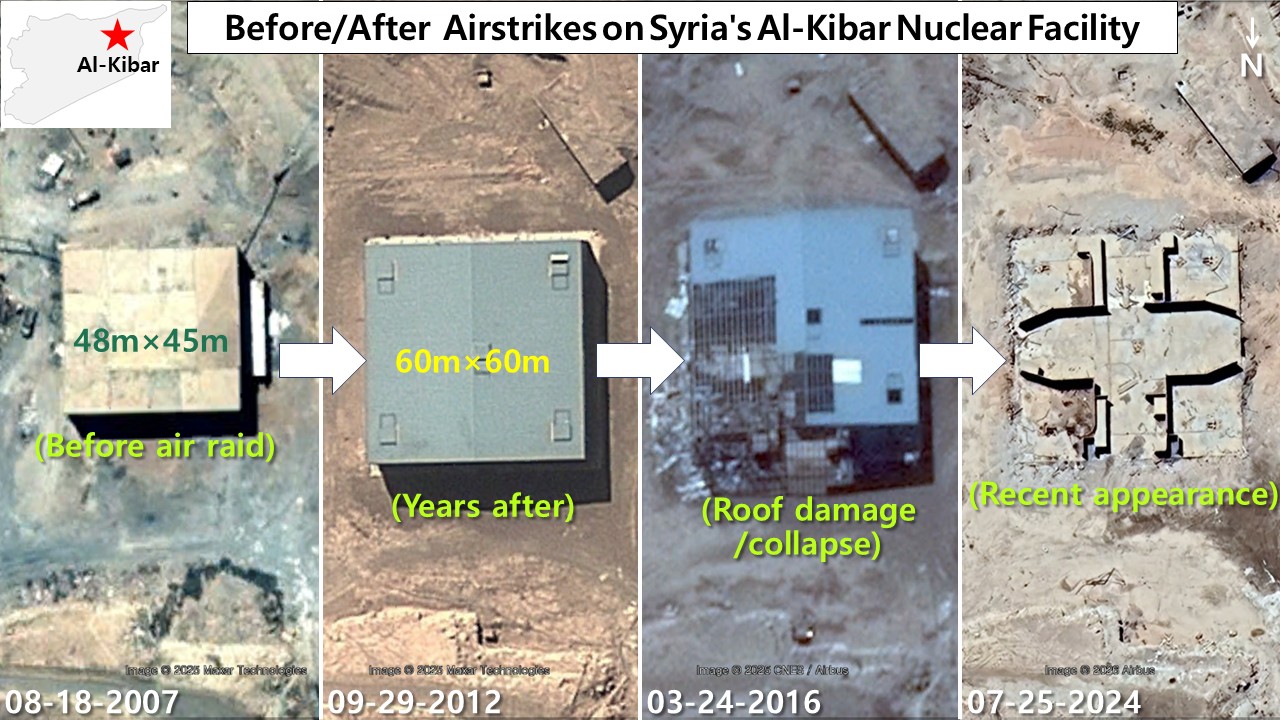
Nearly two decades after an Israeli airstrike obliterated a suspected North Korean-built reactor in the Syrian desert, new satellite imagery of the Al-Kibar site and a Damascus war museum bearing the hallmarks of North Korean monumental art offers a rare visual accounting of what remains of one of the most heavily scrutinized proliferation partnerships of the 21st century.
Al-Kibar nuclear facility: North Korean blueprints in the Syrian desert
In the early 2000s, a large facility took shape in Syria’s eastern desert with no public record of its construction. On Sept. 6, 2007, Israeli Air Force jets destroyed it entirely.
U.S. and Israeli officials alleged at the time that the site was the centerpiece of a clandestine Syrian nuclear program — specifically, a reactor designed to produce weapons-grade plutonium rather than generate electricity. The International Atomic Energy Agency (IAEA) subsequently found traces of processed uranium particles in and around the facility, findings that pointed strongly toward nuclear activity.
U.S. and Israeli intelligence agencies assessed that the reactor’s design closely mirrored North Korea’s Yongbyon facility, built with direct technical assistance from Pyongyang. Photographs and documents obtained by Israeli intelligence agency Mossad reportedly captured meetings between North Korean officials and Syrian nuclear administrators, lending further weight to the suspected technology transfer.
Satellite imagery captured shortly after the airstrike showed complete destruction of the main structure — a rectangular building measuring roughly 48 by 45 meters — with debris scattered across the site. Analysts from the U.N. and nonproliferation research community noted that Syria subsequently covered the remaining traces with soil, consistent with an effort to conceal evidence before international inspectors could access the location.
Comparative satellite analysis conducted over the years shows that structures visible at the site after the strike — including what appeared to be a blue-roofed building — are assessed as routine facility changes unrelated to nuclear reconstruction. Over time, the effects of Syria’s civil war, natural deterioration, and structural decay have reduced the site to ruins. Current imagery suggests the location has no operational nuclear significance and that whatever was rebuilt served general military or storage purposes before falling into disrepair.
A museum built on socialist solidarity

The October War Panorama Museum in Damascus was established in 1998 by President Hafez al-Assad to commemorate Syria’s participation in the 1973 October War and the 1982 Lebanon War. The facility houses Soviet-era tanks and fighter jets alongside large-scale three-dimensional panoramas and paintings depicting battlefield scenes in socialist-realist style.
North Korean artists contributed significantly to the museum’s visual program. The main gallery features a large mural depicting Syrian President Assad alongside North Korean leader Kim Il Sung, an arrangement that art historians and analysts regard as direct evidence of North Korean artistic involvement. The murals and bas-reliefs on display reflect the same aesthetic vocabulary used in North Korean monumental art, where heroic figures and mass scenes are rendered with theatrical realism in service of ideological messaging.
The museum therefore functions as more than a war memorial. It stands as a physical record of the political and cultural solidarity the two governments cultivated across several decades, a solidarity that extended from weapons programs to the visual arts.
Shifting ties and international consequences
Syria and North Korea formalized diplomatic relations in the 1960s and sustained military and technical cooperation across the following decades. The international community has repeatedly flagged the relationship as a direct challenge to nonproliferation norms, with the United States and the IAEA expressing specific concern about nuclear and weapons-related technology links between the two states.
Both countries were subject to Western sanctions during the height of their cooperation, and analysts have assessed that the bilateral relationship served the survival strategies of both governments — each finding in the other a partner willing to exchange arms, technology, and political cover in defiance of international pressure. Multiple testimonies and assessments have pointed to the use of North Korean weapons technology inside Syria.
The relationship may, however, be entering a quieter phase. As Syria expands formal diplomatic ties with other nations following the upheaval of its civil war and the fall of the Assad government, the scope for continued military and diplomatic engagement with Pyongyang appears to have narrowed. Analysts note that the trajectory of the North Korea-Syria relationship remains sensitive to the broader shifts now reshaping the region’s security and diplomatic landscape.
Disclaimer : This story is auto aggregated by a computer programme and has not been created or edited by DOWNTHENEWS. Publisher: dailynk.com








