
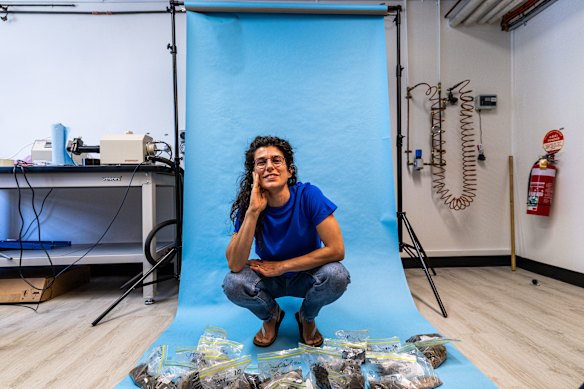

It wasn’t long after Dr Laura Manenti landed in Sydney that she realised her new home was rather radioactive.
The Milan-born experimental particle physicist had been working in Abu Dhabi before she was recruited by the University of Sydney. Like all good physicists, she carries a portable gamma ray detector. In her new office it went comparatively berserk.
“In my office, I have something like 10 counts a second. In my lab in Abu Dhabi, I used to see 0.5 counts a second. So the radiation here was much, much higher than I was used to,” Manenti said.
She searched for maps of Sydney’s background radiation, similar to those available across much of Europe, but there were none. So she resolved to fix that.
The following years-long process has resulted in the first map of Sydney’s environmental radioactivity, built from gamma ray readings and soil samples taken across the city to quantify the energy emanating from radioactive minerals in the rocks beneath our feet.
The maps revealed Glebe and its surrounds as a relative hotspot of elevated background radiation. Even the highest levels, though, are well within safety limits.
But the first-of-its-kind project could lead to better understanding of where a radioactive gas – which can sometimes represent a cancer risk – can seep up from the ground and accumulate in homes and workplaces, and could one day help measure contamination from future nuclear accidents.
Why is Sydney radioactive?
Manenti recruited two students, Tengiz Ibrayev and Matilda Lawton (who was equipped with a rare but perfect double major of geology and physics), for the study that has been published in The Journal of Environmental Radioactivity.
The team took gamma ray readings at about 100 locations across a central patch of Sydney, aiming for parks so that radioactivity from buildings and other artificial structures would interfere less with their measurements.
They also dug up soil across the city and tested the samples for uranium, thorium and potassium.
“These three radionuclides are what contribute to most of the natural radioactivity,” Lawton says. The elements were trapped in rock during the Earth’s formation 4.5 billion years ago and undergo slow radioactive decay.
As they break down into other elements, they emit radiation as alpha, beta and gamma rays.
“The problem with gamma radiation is that it penetrates your skin and it interacts with the DNA of your cells, so it can cause cancer,” Manenti says.
Finally, the team had to account for cosmic rays. Galactic radiation blasts in from distant supernovas, and charged particles in the “solar wind” unleashed by our sun also strike Earth.
To quantify the tiny but measurable amount of space radiation hitting Sydney, the team needed somewhere protected from the radiation beaming up from land.
Their solution? A ferry ride onto Sydney Harbour, where they took cosmic radiation measurements on the open water beside oblivious commuters and tourists.
The cosmic gamma rays were then subtracted from their terrestrial radiation data to isolate the amount of radioactivity emitting from land.
The hot spot
The highest “dose rate” of radioactivity was found around Glebe, due to the underlying sandstone and shale that hold higher levels of uranium and thorium, and the lowest around Centennial Park.
“The finding is, even though the radioactivity is much higher than other cities, we are OK,” Manenti said. “Radiation is not necessarily bad – it’s part of the environment.”
The dose rate of each location was measured in millisieverts per year (i.e. the amount of radiation you’d absorb if you stood in that spot for a year).
The average exposure came to 0.24 millisieverts. That’s about as radioactive as you are; human bodies emit a similar amount of radiation, mostly from potassium, which is absorbed from soil by the plants we eat and is an essential mineral for health.
The research team believes the underlying geology accounts for 98 per cent of the radiation they detected; the older Hawkesbury sandstone and Ashfield shale, laid down in the Triassic Period, is more radioactive than areas built on younger Quaternary sediments.
The minerals containing uranium and thorium are difficult to erode, Lawton said, so they’re more common in sandstone and shale than the younger sedimentary lithology made from eroded silt and sand.
The results around Glebe may also have been influenced by the high urban density (buildings give off more radiation compared with open spaces and parks) or the area’s past as an industrial hub.
The government’s radiation safety body ARPANSA estimates that the average Australian is exposed to about 1.7 millisieverts of natural radiation a year all up, including radiation from rocks, space and diet. That’s equivalent to about 75 chest X-rays.
“There’s evidence that once you get exposures above 100 millisieverts, there’s evidence of increased risk,” said research co-author Blake Orr, ARPANSA’s director of modelling and emergency preparedness.
“So we’re at about a hundred times less than that.”
Radon and nuclear accidents: why the data is useful
“It is a nice demonstration that background radiation isn’t uniform; it varies place to place for perfectly natural reasons,” ANSTO radiation expert Dr Mitra Safavi-Naeini said of the study, which she wasn’t involved in.
“Maps like this shouldn’t be read as suburb-by-suburb risk rankings. The variation is all within normal background.”
The data provides a baseline level of background radiation for Sydney. That could become crucial when trying to detect radiation from possible future nuclear accidents or other sources of contamination.
“ANSTO’s CORIS360 detector found a lost radioactive source precisely by discriminating it from natural background,” Safavi-Naeini said, referring to the technology that tracked down a radioactive capsule lost in the WA outback in 2023.
“We cannot spot the outlier if we do not know what ‘normal’ looks like.”
Understanding terrestrial radiation is also important because part of the natural radioactive decay process produces radon – a radioactive gas that we can breathe in. It’s the leading cause of lung cancer in the US for non-smokers.
Residents of Aberdeen in Scotland are urged to test and ventilate their homes due to high levels of radon, which can accumulate in basements due to the town’s bedrock of uranium-rich granite, for example.
Surveys by ARPANSA show that some areas along the Great Dividing Range may be higher in radon on average due to granite, but overall Australian homes and workplaces have very low levels of the gas.
Nevertheless, more detailed data such as Manenti’s map is useful as ARPANSA plans studies across NSW to check radon levels.
Manenti and her team also plan to expand their radioactivity sampling to larger parts of Sydney and other cities through citizen science.
The Examine newsletter explains and analyses science with a rigorous focus on the evidence. Sign up to get it each week.
 Angus Dalton is the science reporter for The Sydney Morning Herald.Connect via X or email.
From our partners
Disclaimer : This story is auto aggregated by a computer programme and has not been created or edited by DOWNTHENEWS. Publisher: www.smh.com.au





