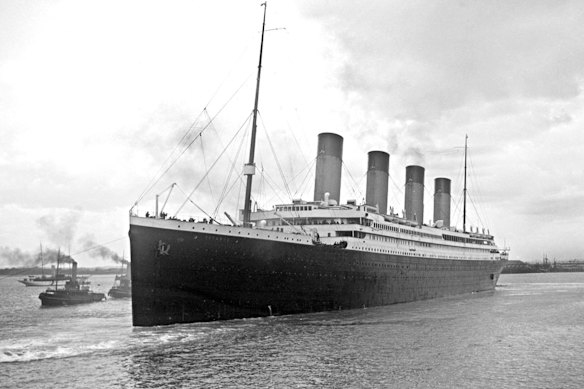

We’ve all wondered many things about Titanic, but until now, it never crossed my mind to wonder what fares it charged its ill-fated passengers.
Now I know. The seven-day crossing cost £7 in third class, which according to the Bank of England is equivalent to £900 ($1718) in today’s money. A second-class passenger paid £13. American heiress Charlotte Wardle Cardeza was the highest-paying guest, coughing up £870 (£86,700 now) for a two-bedroom first-class suite.
Apologies for bringing up Titanic in a cruise column, but the cost of fares is illuminating because it shows travel by ship a century ago was a pricey proposition.
Costs have since steadily declined in real terms. In the late 1960s a first-class suite on Cunard’s Queen Elizabeth sailing to America over the summer cost £1047 (equivalent to £16,100 now) for a main-deck suite. In 1975, suites on Queen Elizabeth 2 from Southampton to New York set a traveller back £3190 (£25,000 now). That’s $47,000 in our money.
You’ll now pay $12,000 for two in a suite on Queen Mary 2 on a similar seven-day transatlantic crossing.
Sign up for the Traveller Deals newsletter
Get exclusive travel deals delivered straight to your inbox. Sign up now.
Let’s skip forward to 1980, when a week-long Carnival cruise in the Caribbean cost $US599 ($850). A cruise of the same length is now about $US850, but adjusted to the 1980 Consumer Price Index ought to be $US3324.
Some other examples don’t show such a startling change. In 1986, a three-day cruise on Eastern Cruise Line cost $US145, or $US570 now. The same cruise today on Royal Caribbean, which took that company over? About $US450, only modestly cheaper.
However, one thing is sure: for a modestly lower price, Royal Caribbean offers customers far more comfort, amenities and entertainment on board its ships than it did a half-century ago.
Way before that, second-class Titanic passengers shared bathroom facilities. A first-class stateroom on Cunard’s Saxonia typically had bunk beds, two wash bowls and a dresser.
Cunard was still a passenger and cargo transport line rather than a leisure-focused company. But even a few decades ago many cruise guests on some lines were squeezed three or four to a cabin, which seldom had a balcony and often no ensuite.
Onboard facilities and entertainment were bare bones, even on luxury vessels, compared to today’s bells-and-whistles ships. In short, today’s consumers are getting more bang for fewer bucks.
Historical prices for Australian cruises have been hard to find and cruise lines are unaccountably coy, but an Age journalist took a 12-night Pacific cruise on P&O’s Canberra in a four-person cabin for $1275 in 1983. In those days, the bathrooms were down the corridor and waiting for showers wasn’t uncommon.
The Reserve Bank of Australia says that’s equivalent to $5000 now, but a 12-day Carnival cruise today still hovers around the 1980s price per person, and in a double cabin with its own bathroom.
To look at it another way, the average Australian salary in 1983 was $336 a week, so a Pacific cruise required almost a month’s work. In 2025, the average weekly salary was $1425, making today’s cruise less than a week’s work. Happy days.
 Brian Johnston seemed destined to become a travel writer: he is an Irishman born in Nigeria and raised in Switzerland, who has lived in Britain and China and now calls Australia home.
Traveller Guides
From our partners
Disclaimer : This story is auto aggregated by a computer programme and has not been created or edited by DOWNTHENEWS. Publisher: www.smh.com.au