Every Event. Every Medal in 4K.
Watch live & on demand.
Livigno: The biggest challenge Indra Brown had to face when she made her World Cup debut in December wasn’t the 22-foot halfpipe she had to negotiate, nor the field of elite talent she had to battle against.
It was a champagne bottle.
Indra Brown (right) wins bronze in her first world cup start. Eileen Gu (centre) won gold. Credit: Getty
By finishing third on debut at the Secret Garden Resort in China in her first start, becoming the youngest-ever Australian snow sport medallist, Brown was handed a bottle of bubbly to celebrate her bronze, as is customary. The problem was she was 15 years old, and had no idea how to open it.
Fortunately, help was at hand.
Eileen Gu, the Chinese-American superstar who won the event, stepped in to show a struggling Brown how it was done. She had been in that exact same situation before.
“How cute was that? OK, champagne moment: adorable,” Gu told reporters in Livigno on Monday.
“She couldn’t figure out how to open her champagne, so I went over and helped her open it. And I relate to that, because my first World Cup podium was when I was her age … I had the same thing happen to me, but no one helped me.”
Brown’s coach is American Jamie Melton, who also coached Gu when she was bursting onto the freestyle skiing scene at the same age, which is why they have struck up such a cordial relationship.
But the similarities between them don’t stop there. And it’s not us making them – it’s Gu, the biggest name at these Winter Olympics.
“I see her as a little me,” she said of Brown. “Her ski style reminds me a lot of myself, especially in the pipe. The way she grabs, the axis that she has in the pipe, going from slope to pipe, I think you really see that kind of DNA shift, which is really special.
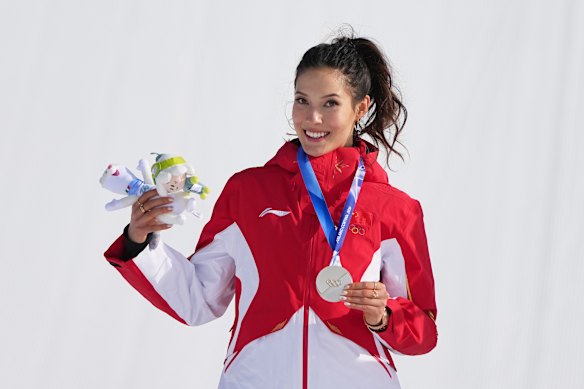
Eileen Gu won silver in the women’s freeski slopestyle on Monday.Credit: AP
“It makes me really happy. I think she’s going to be really good for the future of women’s pipe skiing. I’ve been looking for someone like that for a while, and she, I think, is the real deal. She’s the next thing.”
For the most influential athlete in the sport to offer that glowing assessment – unprompted, without qualification – is no small thing.
Gu is the reigning gold medallist in both the big air and halfpipe events; she also won silver in the slopestyle at Beijing 2022, an Olympic Games that seemed to almost revolve around her because of her controversial decision to represent China, the nation of her heritage, over the United States, where she was born, grew up and first learned to ski.
She is also the fourth highest-paid female athlete in the world, according to Forbes’ 2025 rankings, although unlike those surrounding her on that list – Coco Gauff, Aryna Sabalenka, Iga Swiatek, etc – only $100,000 of her earnings came directly from her sport.
The rest, a lazy $23 million, comes from brand endorsements for mostly Chinese companies, as well as Red Bull, Porsche and Victoria’s Secret. She is also a model, represented by IMG, who has featured in campaigns for Tiffany and Co. and walked down the runway for Louis Vuitton.
If you were to design and manufacture from scratch an athlete with the biggest possible commercial capacity, it would probably look and sound exactly like Gu: supremely talented, intelligent, eloquent, accommodating, polite, beautiful, bilingual, and with heritage ties to two of the biggest markets on the planet, China and the USA, maintaining a committed following in both countries by gracefully sidestepping any questions or topics that are even borderline contentious.
The only thing holding her back is that her chosen pursuit is extremely niche by global sporting standards, but she is now such a big deal herself that she is helping to grow it.
“My biggest goal has always been to bring this sport to more young people, especially girls,” she said. “I hope that if one young girl got to see me today, picked up a pair of skis because of it, then that is my gold medal.”
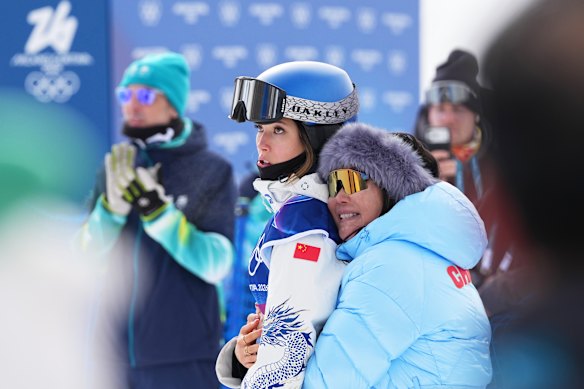
Eileen Gu with her mum Yan Gu.Credit: AP
She didn’t get a physical one on Monday, so that’ll have to do. Gu’s bid to upgrade her slopestyle silver at Milano Cortina 2026 fell short as she finished just 0.41 points behind Switzerland’s Mathilda Gremaud, the same athlete who beat her in Beijing, in a thrilling final.
Slopestype – in which athletes speed through a downhill course filled with a variety of obstacles, like rails and jumps, and have to perform their best tricks while staying upright – is Gu’s weakest discipline, but it didn’t look that way. Her first run, she said, was the best she’d ever laid down, featuring moves and combinations she’d never done before, yielding a score of 86.58. But Gremaud’s second run (86.96) was marginally better, and that slender margin was enough.
Gu had a chance to snatch first place with her third run but stumbled at the start, confirming her silver medal and Gremaud’s second consecutive Olympic triumph, which she celebrated with a double-fist pump at the end of her third-run victory lap.
For the Swiss fans at the Livigno Snow Park, only a few kilometres south of the Italian border, this is as close to a home Olympics as they’ll probably get, so they lapped up the moment, singing football-style chants in her honour as she proudly wore her national flag as a cape.
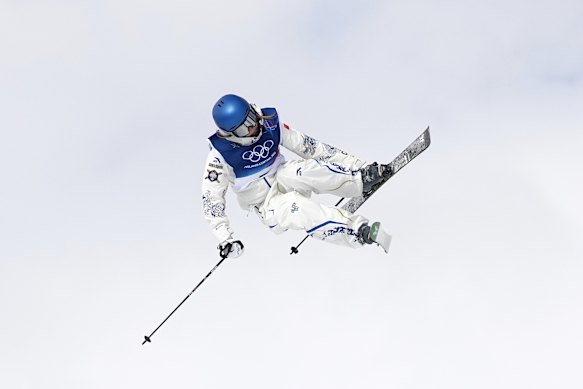
Eileen Gu competes in freeski slopestyle.Credit: AP
But they were still outlasted by dozens of Chinese supporters who hung around for more than an hour after the competition ended, in freezing conditions, screaming and yelling from beyond the barriers for Gu to come and see them while she snaked through the mixed zone, meeting every single media request.
Halfway through, Gu stepped away to greet those fans – and only after that did they leave the premises.
Eventually – after a quick selfie with some adoring volunteers – she was ready to talk to a group of English-speaking journalists, including this masthead, and was incredibly giving with both her time and her thoughtful answers, to the point where one of the mixed zone handlers twice urged her to wrap it up. Outlets from all around the world wanted to talk to her, and it’s to her credit that she did because most stars of her calibre would have brushed them all and done only the mandatory press conference for medal winners. And yes, she did that, too.
This is the circus that follows Gu around; the strange reality that she has to live within, every single day.
“It’s hard. I’ve gone through some things as a 22-year-old that I really think no one should ever have to endure, ever,” she said.
“I was physically attacked on my college campus, physically assaulted on the street. Someone just ran and drew blood … police were called, it was a whole thing. I’ve had death threats. I’ve had my dorm robbed. I’ve had just so many things – like geopolitics, people projecting all sorts of opinions onto me, feeling like I have the weight of two countries on my back. Like infinite, right?
“Things don’t get easier. You just get stronger. That’s what also I think sport has done for me because there have been times when I’ve looked fear in the eye – I’ve looked danger in the eye – and I’ve done it anyways, and I’ve come out successful. The kind of confidence that that instils in you, it makes you feel like you’re capable of anything.”
Gu has the big air event next, in which she may yet go head-to-head with injured Aussie talent Daisy Thomas – then, after that, next Friday morning (AEDT), it’s the halfpipe. Gu is the warm favourite to win gold in both of them. But Brown, who has turned 16 since the last time she competed against her, is one of the biggest threats to her crown, and a prototypical example the kind of young girl Gu said she was hoping to inspire.
“What I really yearn for is a worthy opponent,” Gu said.
“And what I’m so lucky to have is a field full of them, and they’re all so good at skiing. They’ve improved so much over the last few years. To look at the level four years ago versus now is absolutely unbelievable. To continue to push each other and push the sport, I think it’s the best representation we could possibly get out there for women’s skiing.”
The Winter Olympic Games will be broadcast on the Nine Network, 9Now and Stan Sport.
News, results and expert analysis from the weekend of sport sent every Monday. Sign up for our Sport newsletter.
Most Viewed in Sport
Disclaimer : This story is auto aggregated by a computer programme and has not been created or edited by DOWNTHENEWS. Publisher: www.smh.com.au