It is almost three decades since 35 people died in the Port Arthur massacre in 1996, in reaction to which Australia established its world-leading National Firearms Agreement. While the major components of the NFA remain in effect – such as national firearm registration, licences and the prohibition of semi-automatic rifles – the powerful gun lobby has managed to undermine and erode their protective pillars.
Since 1996, the number of guns legally owned in Australia has grown by 25 per cent to 4 million, but now they are in the hands of about half as many owners.
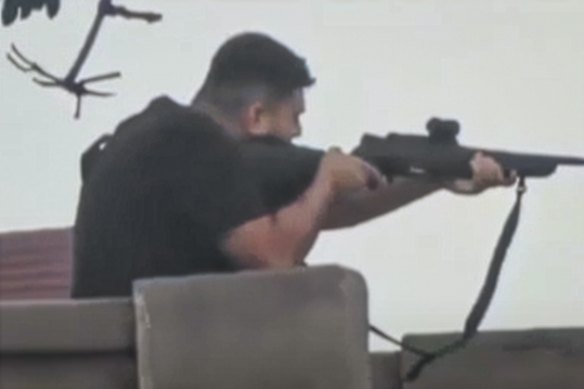
Naveed Akram, the son of licensed gun owner Sajid Akram, amid the mass shooting at Bondi last Sunday.Credit:
Sajid Akram was one of them. On Sunday, the 50-year-old took his six legally acquired, high-powered guns to Bondi, where he and his 24-year-old son, Naveed, allegedly shot dead 15 people and wounded dozens.
How did Sajid Akram get so many guns? A significant erosion of the 1996 laws has been the winding back of regulations relating to the permit to acquire firearms. The NFA resolutions required licence holders to undergo checks for each application for an additional firearm to ensure circumstances had not changed and that the licensee was still eligible for the type of firearm. Due to pressure from the gun lobby, governments across the country have transformed the permit-to-acquire process into a risky farce.
Instead of a gun licence holder having to undergo checks for each additional firearm, the approval for the first gun serves as justification for providing any number of additional category A/B guns. No doubt, this is how Akram legally acquired his six guns in this category.
It is not such an unusual arsenal for one suburban father. On average, there are 4.4 firearms per gun licence across Australia. In NSW, it increased from four per licence in 2016 to 4.5 last year. In Victoria, it rose from 3.6 in 2016 to 4.1 in 2024.

Ahmed al Ahmed tackles gunman Sajid Akram at Bondi last Sunday; and Ahmed in hospital, recovering from gunshot wounds that followed his bravery.Credit:
On a positive note, these guns are registered, and authorities are aware of their locations. The worrying aspect is that each Australian who holds a gun licence now owns more firearms. And now we are trying to comprehend another atrocity.
The Albanese government has just announced the biggest gun buyback since the Port Arthur massacre in Tasmania. Good. The NSW government will impose a four-gun limit and force owners with more firearms to surrender them, though it will be a 10-gun limit for farmers and sporting shooters. That’s still way too many guns.
Gun massacres have a way of affecting the entire psyche of a nation, particularly in Australia, where such events are still incredibly rare. The killing in Port Arthur was our last major gun massacre, and the worst by a lone-gunman in modern Australian history. Many of us who were alive at that time can recall exactly where we were when we heard the shocking news.
The swift response to Port Arthur – in the form of strong, national and uniform gun laws – changed the cultural landscape of the nation. Today, Australia is still recognised as a country that courageously prioritised public safety by making gun ownership a privilege rather than a right. We effectively rejected an American gun culture.
But the ease with which Australians such as Sajid Akram have acquired guns is not a new problem. It was a concern I raised years ago with numerous politicians. Back in 2017, data obtained by the NSW Greens through freedom-of-information laws revealed that in various Sydney suburbs, individual gun licence holders owned hundreds of firearms. In Mosman, one person owned 285; in La Perouse, one owned 305; and in North Sydney, someone owned 268 guns.
Another major concern is the growing access to high-powered firearms by recreational hunters. In 2016, I expressed my worries to the federal and NSW governments about the emergence of a new type of hunting gun, the Adler. Specifically, the Adler A110 has a magazine capacity of seven rounds, with an additional round in the chamber. The five-shot version of the Adler can be modified to hold up to 11 cartridges, and its lever action allows for rapid firing. It was categorised as a Category B hunting rifle, even though it was a rapid firearm gun.
(Under the new laws in NSW, category A and B firearms will be limited to a maximum of five to 10 rounds, and there will be a blanket ban on firearms that can use a belt-fed magazine.)
The main objective of the NFA was to limit access to high-powered firearms to only military personnel, professional shooters or certain primary producers – not to recreational hunters. It is truly unfortunate that governments turned a blind eye and prioritised political expediency by doing deals with the Shooters, Fishers and Farmers Party.
Predicting who will commit acts of mass violence is extremely difficult. This unpredictability is unsettling, but it should also be the driver for the need for stringent and rigorous gun laws. Those who commit massacres sometimes have no criminal record. There may be no police intelligence about them, and they operate under the radar. If we cannot predict who might commit such a crime, the one aspect we can control is access to firearms. Access to a firearm should only be granted based on a genuine need, particularly for subsequent weapons.
Although the gun lobby in Australia is not as structured as the National Rifle Association in the United States, it still exists. It walks the corridors of our parliaments. Its members include gun exporters, importers and certain political parties.
The gradual erosion of our gun laws is akin to a crab slowly boiling in water. It has happened incrementally, behind closed doors, and with little public attention, until Sunday’s carnage. Now it is for politicians to reassess the framework of our gun laws. It is time for bipartisanship to restore the pillars that had kept us safe until now.
Samantha Lee, a senior solicitor at the Redfern Legal Centre, is writing as a former director of Gun Control Australia.
Get a weekly wrap of views that will challenge, champion and inform your own. Sign up for our Opinion newsletter.
Most Viewed in National
Disclaimer : This story is auto aggregated by a computer programme and has not been created or edited by DOWNTHENEWS. Publisher: www.smh.com.au