
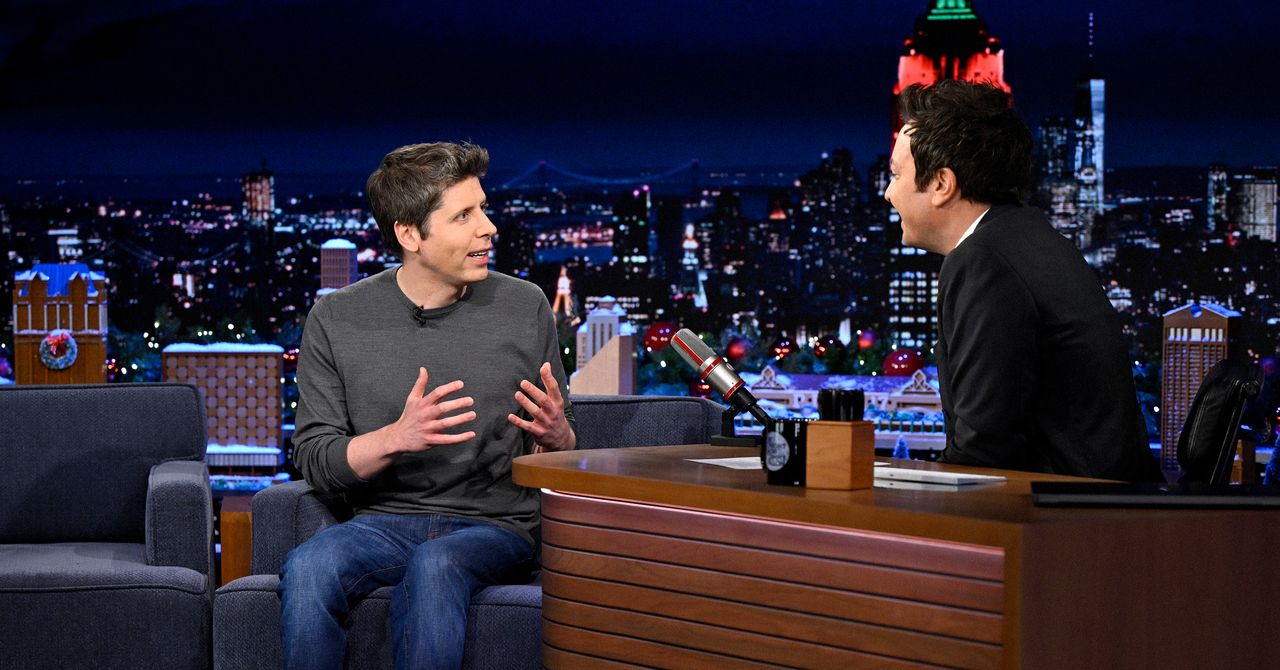
OpenAI CEO Sam Altman was at the center of Silicon Valley’s most visible publicity push in recent memory Monday night when he appeared on The Tonight Show. In a predictably softball interview with host Jimmy Fallon, Altman explained how ChatGPT has helped him alleviate the anxiety that comes with being a new parent.
It was a distinctly clever, if somewhat surprising, choice from Altman who has mostly kept his personal life out of the media spotlight. But Altman is a salesman, and a good salesman understands the optics of good television. So he talked about being a dad and being worried that his son—who wasn’t crawling at six months—was developing slower than other children (spoiler: he’s not). “I cannot imagine having gone through, figuring out how to raise a newborn without ChatGPT,” Altman told Fallon. “People did it for a long time, no problem. So clearly it was possible, but I have relied on it so much.”
As the fears around the future of AI continue to mount, the subtext was patently obvious: Technology can help people better understand their kids. We should welcome it. The timing of that particular message was not by mistake.
Of late, the tech establishment has gone on a charm offensive as age-verification laws sweep the US and the world, and the public backlash to AI intensifies.
Altman acknowledged as much but didn’t get into specifics during the interview. “One of the things that I’m worried about is just the rate of change that’s happening in the world right now. This is a three-year-old technology. No other technology has ever been adopted by the world this fast,” Altman said. “Making sure that we introduce this to the world in a responsible way, where people have time to adapt, to give input, to figure out how to do this—you could imagine us getting that wrong.”
Those concerns have only accelerated a concentrated campaign out of the Valley to better control the narrative, which has included everything from TV ads to pop-ups to create better brand awareness, and explain why the virtues of AI and social media, and all that it can do for people, outweigh the harms. If Silicon Valley is in its “hard tech era,” it is making an even harder sell.
The ads are everywhere you are: streaming, cable, social media. TikTok is great for dad advice. ChatGPT can teach you how to properly exercise, cook memorable dishes, or can curate an unforgettable road trip. Google wants you to “ask more of your phone” with its AI features. Anthropic—which, in a September ad spot, claimed “there’s never been a better time” for AI—is even hosting pop-ups and selling merch. Meta promises to be your personal AI for, well, everything.
In March, the Mark Zuckerberg-owned Meta also rolled out ads for Instagram Teen accounts. One 30-second spot features a mother watching her son cross the street with a text overlay that states, “You’ve always looked out for them. We’re here to do it with you.” On December 10, Australia’s historic social media ban will go into effect for teens. It requires companies to deactivate the accounts of kids under the age of 16. So far, Meta, TikTok, Snap, and YouTube have agreed to comply with the new regulations.
For now, the jury is still out on how well that messaging is working. “I hate these fucking ChatGPT commercials that show it helping folks like planning a date that seems ‘chill,’ or how to become a ‘morning person,’ all things that should’ve been learned from a community not a goddamned spicy autocorrect. Fuck all that noise,” Jonathan Flowers, an assistant professor of philosophy at California State University-Northridge, wrote on Bluesky.
Despite that, the public has never been more ripe for tech’s hard sell than it has at this moment, says Brian Fuhrer, senior vice president of product strategy at Nielsen. More than 70 percent of TV viewing in the third quarter of 2025 was on ad-supported platforms, according to a Nielsen analysis, with streaming accounting for nearly half of total ad-supported viewership. In the last week alone I encountered ads for TikTok and Instagram, and often the same ones, across Peacock, Amazon, and Hulu.
“Advertising has effectively funded television content for decades,” Fuhrer says. The difference now is the intensity with which Silicon Valley seems especially reliant on marketing itself to consumers in a way that proves not only their value, but their benefit.
It’s a direction the tech elite are noticeably aware of as they persuade people to buy into everything they are trying to build. In his telegenic interview with Fallon, Altman said there were “many downsides to technology,” but noted that it was “an equalizing force.” It was all part of the hard sell. Because even Silicon Valley can’t avoid what’s right in front of them: You can’t create a future without consumers.
Disclaimer : This story is auto aggregated by a computer programme and has not been created or edited by DOWNTHENEWS. Publisher: wired.com





