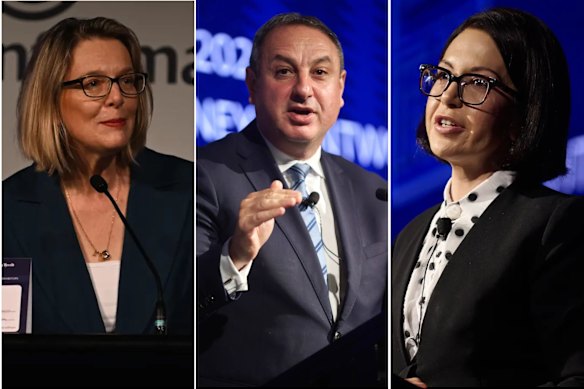
Hello and welcome to our live coverage of the 2026 Sydney Morning Herald Schools Summit today.
A team of reporters is on the ground to bring you all the news, discussion and debate from the state’s school leaders, principals and teachers.
Here are some of the key takeaways from the morning:
- NSW Education Minister Prue Car announced the rollout of gifted education for more than 750,000 students in NSW public schools, a policy she first flagged at the Herald’s summit in 2024. Car said “postcode should never determine a child’s opportunity”.
- Education leaders, principals, and teachers have weighed into how artificial intelligence has played a role in the sector. NSW Education secretary Murat Dizdar said knowledge would “matter even more” in the age of AI, and the chief executive of Catholic Schools NSW Dallas McInerney said schools needed to ‘avoid the mistakes’ universities made with AI. NESA boss Paul Martin said remaining cautious, waiting and watching to take advice was the most reasonable approach.
-
The nation’s curriculum authority will review the kindergarten to year 2 maths curriculum after NAPLAN data showed that around one in three Australian students in year 3 are not reaching challenging but achievable numeracy standards, and one in 10 are still requiring additional support.
- An academic has argued education must shift from a competitive ranking model to an assessment approach that prioritises effort and learning processes.
Stay with us as we take you into the afternoon.
The head of the state’s public school teacher union has said teachers need more relief time off class to deal with workload pressure.
“Teachers are working from home… they’re spending an inordinate amount of time on weekends preparing lessons,” NSW Teachers’ Federation president Henry Rajendra said.
″Fatigue, burnout, pressures on family time, personal time is something real [in the] profession, right across the board.
“I think we can all agree that the classroom is vastly different to what it was decades ago. The expectations on teachers, the expectations of society, parents and carers, on our schools, is just at an all time high.
“Teaching is a rocket science. It does require that significant intellect, but what we’re lacking is the necessary support in terms of making sure that teachers are giving the time, the space in a most practical nature.”
School leaders say the impacts of COVID-19 continue to shape student wellbeing with rising anxiety and growing body image pressures among both girls and boys.
Speaking with Herald education editor Chris Harris, principals from single-sex schools said while academic recovery is underway, the deeper impact has been social and emotional.
Dr Kate Hadwen, principal of Pymble Ladies’ College, said students who began school just before or during lockdowns experienced significant disruption at critical developmental stages.
“That kindergarten group, or the Year 7 group that came in for a short period and then went out again for a long time – that really disrupted social systems.”
Beyond general wellbeing concerns, Dr Hadwen said she is particularly troubled by a noticeable rise in eating disorders among girls.
“Eating disorders have always been there [but] we are certainly seeing a rise and that deeply worries me,” she said.
She linked the trend in part to the growing influence of social media, particularly in shaping how girls perceive themselves, adding that constant exposure to curated images can distort self-image.
“There are absolute concerns around volume and the way that girls view themselves,” she said, adding that signs of disordered eating behaviours are emerging in students as young as Year 5.
The college had already encouraged families to reconsider smartphone and social media use before the government introduced regulations restricting access for children under 16-years-old.
At Ashfield Boys High School, principal Dwayne Hopwood said the school has observed a marked increase in body image concerns among male students, alongside growing interest in gym memberships, protein supplements and muscle-building regimes.
“I really think it’s because [students] are seeing more human beings on screens than they’re seeing in reality,” he said. “The bodies they’re seeing on screens — whether it’s games or social media — are not necessarily real.”
Senior school leaders say solving the state’s teacher shortage requires more than short-term fixes and urge governments to improve support for early career teachers including addressing the workload pressures driving staff away.
In a wide-ranging discussion with Herald education editor Christopher Harris, Denise Lofts, president of the NSW Secondary Principals’ Council, said the focus must shift to retaining the teachers already in classrooms.
“I think we need to start thinking about how we actually look after our teachers who are here,” she said.
Lofts said the “grassroots” aspects of the job — managing behaviour, building relationships and navigating school systems — remain among the most challenging for new teachers.
Dwayne Hopwood, principal of Ashfield Boys High School, said the issue was “a bigger problem than pulling levers.”
He said school location, desirability and access to transport can influence teacher retention. The cost of living in Sydney, particularly closer to the city, has forced many teachers to commute long distances.
Lisa-Maree Browning, principal of Cerdon College, said staffing gaps are particularly acute in key subject areas including technology and science. Browning added that the growing complexity of teachers’ workloads is compounding the problem.
Dr Kate Hadwen, principal of Pymble Ladies’ College, said teacher registration requirements in NSW also contribute to workforce pressures, noting that the state’s accreditation process is more difficult than elsewhere in Australia.
“We bring staff from all over the world, and that’s very difficult in NSW because our registration process is more difficult than any other state in the country,” she said.
As a result, some teachers opt to work in Victoria or Western Australia, where registration is less onerous. “I think that’s a challenge we can address as a state, for sure,” she said.
Chief executive of NESA Paul Martin has acknowledged the difficulty of HSC mathematics, and said the subject had an “image problem”, but reiterated its importance for society to properly function.
Martin pointed to criticisms raised about the difficulty of HSC mathematics, and said: “Maths has a bit of an image problem – so making sure kids feel they’re rewarded is absolutely important.
“Some of the maths content is absolutely essential if we want to have bridges that we can drive over and buildings that are not going to fall down, and physicists, chemists, doctors and oncologists who we all rely on.
“But by the same token, we should also have maths examinations that suit a range of students who are doing the test,” he said.
Hello and welcome to our live coverage of the 2026 Sydney Morning Herald Schools Summit today.
A team of reporters is on the ground to bring you all the news, discussion and debate from the state’s school leaders, principals and teachers.
Here are some of the key takeaways from the morning:
- NSW Education Minister Prue Car announced the rollout of gifted education for more than 750,000 students in NSW public schools, a policy she first flagged at the Herald’s summit in 2024. Car said “postcode should never determine a child’s opportunity”.
- Education leaders, principals, and teachers have weighed into how artificial intelligence has played a role in the sector. NSW Education secretary Murat Dizdar said knowledge would “matter even more” in the age of AI, and the chief executive of Catholic Schools NSW Dallas McInerney said schools needed to ‘avoid the mistakes’ universities made with AI. NESA boss Paul Martin said remaining cautious, waiting and watching to take advice was the most reasonable approach.
-
The nation’s curriculum authority will review the kindergarten to year 2 maths curriculum after NAPLAN data showed that around one in three Australian students in year 3 are not reaching challenging but achievable numeracy standards, and one in 10 are still requiring additional support.
- An academic has argued education must shift from a competitive ranking model to an assessment approach that prioritises effort and learning processes.
Stay with us as we take you into the afternoon.
The nation’s curriculum authority will review the kindergarten to year 2 maths curriculum after NAPLAN data showed that around one in three Australian students in year 3 are not reaching challenging but achievable numeracy standards, and one in 10 are still requiring additional support.
Speaking at the Herald’s School Summit, ACARA chief executive Stephen Gniel said: “These are not statistics to gloss over when we think about the individual child that that relates to and the families that they’re growing up in.”
“It’s why it’s right for us to have a national focus on numeracy. In this context, we’ve proposed to education ministers that we undertake a targeted review of the maths foundation year 2 curriculum, and that’s now under way,” he said.
For the first time, the review will also target financial literacy.
“We must prepare our children for their responsibilities and also the tricks of the trade around financial and consumer and financial literacy,” said Gniel.
The iterative review will focus on four key areas including prioritising mathematical content, giving teachers clarity about what students will learn at each year level, providing content sequencing, and including explicit content on foundational mathematics for consumer and financial literacy.
The review will hand down recommendations to education ministers later this year.
Principals and education leaders have criticised the practice of ranking schools based on the proportion of band 6 results achieved in the HSC as being too narrow, and have called on a broader approach.
St Andrew’s Cathedral School head Dr Julie McGonigle, whose school ranked 74th in the Herald’s HSC 2025 league table, said: “I’m not afraid of accountability measures – but a balanced number of measures that are fair across schools would be great.”
In a panel discussion moderated by Herald education editor Christopher Harris, McGonigle said league tables – which are calculated based on band 6 results – were too narrow and were not a fair or equitable reflection across the school sector.
She pointed to practices in countries overseas such as the UK, where students are also assessed based on their growth over time.
“Of course, none of these schools are equal. A selective school does not have the same starting point as a comprehensive school, and not all schools are equal,” she said.
NESA chief executive Paul Martin was also opposed to league tables: “I think they’re a narrow judgment of schools. They disadvantage the schools that are already disadvantaged. I think it’s a real problem. I prefer and would like to add progress measures,” he said.
Mechel Pikoulas, the principal of Strathfield Girls High School said league tables could be a “really destructive force.
“We know that behind every result is a story, a child, and the humanity around that child. [League tables] serve their own purpose, but at the end of the day … if we feel that child has reached their potential and achieved at that level, that’s a celebration.”
Paul Martin, the chief executive of NESA has said there were already levels of adaptation around the adoption of artificial intelligence in the education sector, but urged caution around its use.
Martin pointed to a handful of HSC subjects which had modernised and moved online – science extension, software engineering, and enterprise computing, with English extension 1 and 2 following suit next year.
“We continue to provide advice to schools around AI, but I think we’re only about three or four years into the AI revolution.
“I think it’s probably reasonable for us to be cautious, wait and watch and take advice rather than leaping into some sort of change of process too early,” he said.
The chief executive of Catholic Schools NSW has also weighed in on the artificial intelligence debate, saying the challenge facing the secondary education sector would be to “avoid the mistakes” of universities.
Dallas McInerney said universities reported being “so flat-footed with respect to AI and the integrity of assessments, that they have run up the white flag and accepted a percentage of AI content in assessment tasks.
“So if you cannot warrant attainment or certify confidence for an examination or an assessment tool, then a big piece of the exercise is missing. That’s the challenge I think we’re going to have for schools.”
A leading education academic has called for a fundamental rethink of how success is measured in NSW schools, warning the current system leaves half of all students labelled “below average” – regardless of how much they improve.
Dr Robin Nagy, adjunct education lecturer at the University of NSW, argues education must shift from a competitive ranking model to an assessment approach that prioritises effort and learning processes.
“Did you know that half of all our students and schools in NSW are currently below average? What a sad indictment of how we measure success,” he said.
He said the paradox lies in the design of ranking systems such as the ATAR, in which only a fixed proportion of students can achieve the highest ranks.
“The ATAR is, by definition, a ranking,” he said. “Only a specific proportion of students can ever receive 99.95, 99.9 or above 70 – irrespective of how much learning growth occurs across a cohort. Half of all students and schools will always be below average.”
Among his proposed solutions is a stronger focus on “effort” reporting – measuring and reporting student growth over time rather than student achievements compared to their peers.
“The majority of our assessments should be strength-based, giving students the opportunity to demonstrate what they have learnt and can do, rather than simply highlighting what they cannot,” he said.
Nagy said such an approach would not mean abandoning standards, but broadening the conception of success to include “effort and improvement.
“When we teach a new concept, most of our assessment should be simple to reinforce students’ learning,” he said. “Just think about the impact of being labelled below average on a student’s self-esteem. That’s the ongoing paradox of our system – and one we must confront if we truly want equity.”
Disclaimer : This story is auto aggregated by a computer programme and has not been created or edited by DOWNTHENEWS. Publisher: www.smh.com.au