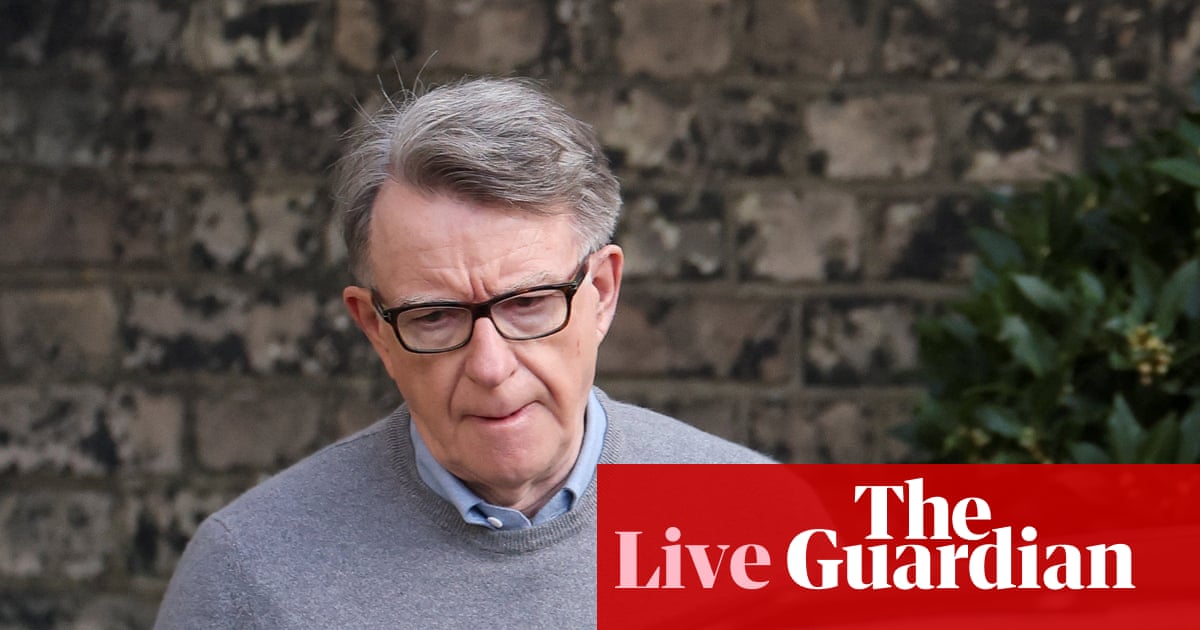
The Tories have called on the government to demand Lord Mandelson return his severance pay and “release the files in full” following the publication of the first tranche.
Shadow chancellor of the Duchy of Lancaster Alex Burghart MP said: “The lapse in the Prime Minister’s judgment knows no bounds. Allowing a scandal-ridden former Minister access to highly sensitive information before proper clearance is completely careless.
“Even more troubling is that this happened while the Government was aware of Mandelson’s long-standing, close connections to Epstein.
“Labour must come clean about what ministers knew, when they knew it, and why national security safeguards appear to have been treated so casually.
“The Government must now release the files in full and demand Mandelson return his severance to the public purse.”
According to the documents, Keir Starmer’s national security adviser Jonathan Powell expressed concerns about the appointment of Peter Mandelson with Morgan McSweeney, the PM’s former chief of staff.
He said he believed Starmer “may have had a couple of political conversations” about Mandelson’s links to the disgraced financier.
Powell also claimed Philip Barton, the most senior civil servant at the Foreign Office, also “had reservations around the appointment”, the BBC reported.
We now have the first tranche of documents promised by the government connected to the appointment of Peter Mandelson as the UK’s ambassador to Washington – 147 pages from a mass of information believed to total in the hundreds of thousands.
Mandelson has previously denied any wrongdoing, and his lawyers have said that he does not intend to make any further statement at this time. Here is what we have learned from the files – and what we do not yet know.
1. Mandelson played hardball over his severance payout
-
The individual’s contract states an entitlement to three months’ notice or payment in lieu of notice. On advice of his counsel, the individual has stated this is insufficient, particularly as they believe the actions of HMG have permanently damaged their employability.
There has already been some controversy about the fact that Mandelson was given a £75,000 payoff. The documents show that he sought much more – £547,000, which would have been the total pay he was due for the entire ambassadorial contract. Mandelson had, they added, sought advice from a KC specialising in employment law.
While ministers can be instantly dismissed if they lose the confidence of the prime minister, as a civil servant, Mandelson was entitled to three months’ notice payment, given he had not done anything wrong in the job itself. This notice totalled £40,330, to which the Foreign Office added a “termination payment” of £34,670.
Why? Darren Jones, the chief secretary to Downing Street, argued in the Commons that this was to save money, as if Mandelson had pursued his case at an employment tribunal, it would have cost much more.
2. Starmer knew about Mandelson’s post-jail links to Epstein
After Epstein was first convicted of procuring an underage girl in 2008, their relationship continued across 2009-2011, beginning when Lord Mandelson was business minister and continuing after the end of the Labour government.
This aspect of the documents is unsurprising, not least as Starmer said last month that he knew before appointing Mandelson that his choice for US ambassador had maintained some contact with Epstein even after the disgraced financier had been jailed in 2008.
It is nonetheless striking to see it laid out in black and white in a document for Starmer setting out the “due diligence” carried out on Mandelson.
There was, the report said, “general reputational risk” from the links to Epstein, and other aspects of Mandelson’s life, including his business links and the fact he had been twice forced to resign as a government minister.
-
The first set of documents relating to Peter Mandelson’s appointment as ambassador to the US was released by the government today. MPs ordered the government last month to release tens of thousands of documents relating to the 2024 appointment after questions over how Mandelson was vetted and what was known about his links to the late convicted sex offender Jeffrey Epstein.
-
A due diligence report by the Cabinet Office on Mandelson’s appointment found there was a “general reputational risk” over his relationship with Epstein. The due diligence report drawn up in December 2024 before his appointment noted a series of reports detailing his links with Epstein, including that Mandelson had “reportedly stayed in Epstein’s house while he was in jail in June 2009”.
-
Mandelson was offered a highly classified briefing from the Foreign Office as US ambassador before he finished the formal vetting process. The documents suggest that the Foreign Office may have begun to brief Mandelson on classified information after his appointment – but before he was formally vetted at the highest levels.
-
Mandelson asked for more than £500,000 severance pay but got £75,000. The documents state that negotiations began with Mandelson requesting a pay out for the remainder of his four-year salary costs of the fixed term appointment. “This would have amounted to £547,201.”
-
Chief secretary to the prime minister, Darren Jones, said Mandelson “should never have been appointed”. But in his defence of Keir Starmer, he said the Cabinet Office due diligence report “did not expose the depth and extent” of Mandelson’s relationship with Epstein.
-
Jones described Mandelson’s request for more than £500,000 severance pay as “inappropriate and unacceptable”. He told the Commons that the final pay out that was agreed “was to avoid even higher further costs involving a drawn-out legal claim at the employment tribunal”.
-
The Conservatives claimed the prime minister “knew all he needed to know” when he appointed Mandelson, describing it as a “bad choice”. Shadow Cabinet Office minister Alex Burghart, who delivered the party’s response to Jones’s statement in the Commons, said it was a choice that “we can now read about in black and white” in the documents.
-
National security adviser Jonathan Powell found the appointment process “weirdly rushed”. The documents summarised a phone call between Powell and Mike Ostheimer, the general counsel to the prime minister, on 12 September 2025, in which “Jonathan Powell found the appointment process unusual of Lord Mandelson weirdly rushed”.
-
Mandelson suggested using Nigel Farage to “better UK connections with the Trump administration”. Mandelson was quoted in the documents as saying: “He’s [Farage] a bridgehead, both to President Trump and to Elon Musk and others … National interest is served in all sorts of weird and wonderful ways.”
The follow-up questions the prime minister asked Peter Mandelson about his links to Jeffrey Epstein before appointing him as ambassador to the US have not been published as part of the documents released today.
This is due to the exchange being subject to an ongoing police investigation into allegations of misconduct in public office, the chief secretary to the prime minister, Darren Jones, said.
Jones told the Commons that after Keir Starmer reviewed the Cabinet Office due diligence report in December 2024, which warned of a “general reputational risk” over Mandelson’s relationship with Epstein, “questions were put to Peter Mandelson by advisers in No 10 … and Peter Mandelson responded”.
“These are matters that are currently the subject of an ongoing police investigation and we will publish this document when the investigation allows,” Jones said.
“When we do, the house will be able to see Peter Mandelson’s answers for themselves, which the prime minister regrets believing.”
Mandelson was arrested last month on suspicion of misconduct in a public office after allegations that he leaked confidential information to Epstein while serving as business secretary in Gordon Brown’s cabinet. He has denied any wrongdoing.
Peter Mandelson was offered a highly classified briefing from the Foreign Office (FCDO) as US ambassador before he finished the formal vetting process, newly released documents reveal.
The documents suggest that the FCDO may have begun to brief Mandelson on classified information after his appointment – but before he was formally vetted at the highest levels. The offer of a briefing came just over a fortnight after Mandelson’s appointment had been announced on 20 December 2024.
An email dated 23 December from the head of the US & Canada department at the FCDO to Mandelson outlined his onboarding arrangements. In this email, the official states: “We’ll brief you further in person from 6 January onwards, including at higher tiers.”
An email does not formally confirm Mandelson’s developed vetting clearance until 30 January 2025, his formal offer of employment.
Read the full report here:
Lobbying and access to government will be reviewed in the wake of the Mandelson scandal, the chief secretary to the prime minister, Darren Jones, said.
Financial disclosures for ministers and senior officials would be looked at by the Ethics and Integrity Commission, Jones told the Commons. The commission was created last October as part of Starmer’s promised robust new approach to government and to any ministerial misdeeds.
Speaking in the Commons, Jones said the Mandelson documents released today “reveal that the due-diligence process fell short of what is required”.
“We have already taken steps to address weaknesses in the system and to ensure that when standards of behaviour fall short of the high standards expected, that there will be more serious consequences,” he said.
“The prime minister has asked the Ethics and Integrity Commission to conduct a review of the current arrangements relating to financial disclosures for ministers and senior officials, transparency around lobbying, and the business appointment rules.
“And we are conducting a review of the national security vetting system to ensure we learn the lessons from the policy and process weaknesses related to Peter Mandelson’s case.”
The files show that Mandelson’s total remuneration package as UK ambassador to the US was £180,252.
This includes a base salary of £153,000, plus £11,406 “COLA”, believed to be the cost of living adjustment, a payment made to compensate for differences in living costs between two locations, and £18,925 “DSA”, which might be referring to the diplomatic service allowance.
Conservative leader Kemi Badenoch has reacted to the released documents, saying Starmer’s judgment is “shocking”.
In comments posted on social media, she said:
Mandelson reportedly leaked sensitive government documents. Starmer knew Mandelson had stayed close friends with Epstein after the conviction for child prostitution, but made him Ambassador anyway.
Now we see he paid Mandelson almost £80k of our money. His judgment is shocking.
Mandelson was arrested last month on suspicion of misconduct in a public office after allegations that he leaked confidential information to Epstein while serving as business secretary in Gordon Brown’s cabinet. He has denied any wrongdoing.
Back to the documents, a No 10 private office record of a meeting on 11 September details what led to Starmer’s decision to sack Mandelson.
It states that emails published by news outlet Bloomberg “revealed a depth and extent of a relationship with Epstein which he had not been aware of previously when he made the decision to appoint Mandelson. On this basis, he proposed to ask Mandelson to resign from his post”.
It later says: “The prime minister was clear about his strong concern for Epstein’s victims.”
Shadow Cabinet Office minister Alex Burghart claimed the prime minister “knew all he needed to know” when he appointed Mandelson as ambassador to the US, describing it as a “bad choice”.
Delivering the response to Jones’s statement on behalf of the Conservatives in the Commons, Burghart said:
It’s very clear that those (Epstein’s) victims were not in the prime minister’s mind when he appointed Peter Mandelson. The prime minister has already admitted that he knew Mandelson had maintained his friendship with Epstein even after the latter’s conviction for his terrible crimes.
That was a bad choice, and it’s a choice that we can now read about in black and white on page 11, where the prime minister was told, after Epstein was first convicted of procuring an underage girl in 2008, their relationship continued across 2009 to 2011, beginning when Lord Mandelson was business minister, and continuing after the end of the Labour Government. Mandelson reportedly stayed in Epstein’s house while he was in jail in 2009.
Now, the prime minister claims that he was lied to. He wasn’t lied to by this due diligence document.
And it may be that Mandelson denied these claims, and if so, maybe the prime minister was lied to, but he was lied to by an inveterate liar who had been fired twice before, and we’re supposed to believe that the prime minister, who was once the chief prosecutor in this country, couldn’t see through this nonsense. It beggars belief.
The prime minister knew all he needed to know. It was on him. It’s on him now. He let his party down. He let his country down. I very much doubt that either will trust him again.
In further comments to the Commons about Mandelson being made ambassador to the US, Jones said he should “never have been appointed”.
He told MPs:
The victims of Epstein have lived with trauma that most of us can barely comprehend. They’ve had to relive it again and again, and they have had to see accountability delayed and too often denied.
We must all learn this hard lesson and a culture which dismisses women’s experiences far, far too often and too easily, Peter Manderson should never have been appointed.
Back in the Commons, Jones addressed the severance pay requested by Mandelson – more than £500,000 – saying it was “inappropriate and unacceptable”.
He said:
Peter Mandelson initially requested a sum that was substantially larger than the final payment, not just two or even three times, but more than six times the final amount.
Despite the fact that he was withdrawn from Washington because he had lost the confidence of the prime minister, the government obviously found that to be inappropriate and unacceptable. The settlement that was agreed was to avoid even higher further costs involving a drawn-out legal claim at the employment tribunal.
Peter Mandelson suggested using Nigel Farage to “better UK connections with the Trump administration”, according to the files.
In the Cabinet Office due diligence report, included among the documents released by the government, Mandelson was quoted as saying of Farage: “You can’t ignore him, he’s an elected member of parliament. He’s a public figure. He’s a bridgehead, both to President Trump and to Elon Musk and others … National interest is served in all sorts of weird and wonderful ways.”
Disclaimer : This story is auto aggregated by a computer programme and has not been created or edited by DOWNTHENEWS. Publisher: theguardian.com