Formula 1 is entering a new era in 2026 because of its regulation overhaul, which is arguably the biggest in the championship’s history with changes to both the chassis and power unit.
An F1 chassis is now approximately 32kg lighter with significantly less downforce, while the engine is more reliant on electrical energy with a near-50:50 split against the internal combustion engine.
There are several other changes as well which came to light during pre-season testing in Barcelona and Bahrain, so here is some of the jargon that should come up during the early rounds of 2026.
Active aerodynamics
For 14 years, F1 had the Drag Reduction System – more commonly known as DRS – which saw the rear wing flaps open when within one second of the car in front to aid overtaking. Now, however, these active aerodynamics apply to both the front and rear wings and are split into either ‘straight mode’ or ‘corner mode’.
In ‘straight mode’, both sets of wings will open, moving to a lower angle of attack to reduce drag, and the front wing is now joining the rear in this to provide better stability. But once a driver lifts off for a corner, the wings will return to their higher-downforce state, meaning they cannot be open for a turn.
This is different to DRS though, because while that could only be used within one second of the car in front, drivers can use ‘straight mode’ and ‘corner mode’ throughout a grand prix, and each circuit will have designated zones where ‘straight mode’ can be used, with ‘corner mode’ in every other location.
Flat floors
In the last regulation era, F1 had ground-effect cars from 2022 to 2025, and one of the distinctive features was the floor as it featured a venturi tunnel, which accelerated airflow to create low pressure. For 2026 though, F1 is returning to the flat floors it used until then, and they are a much simpler design which produces far less downforce.
Overtake mode
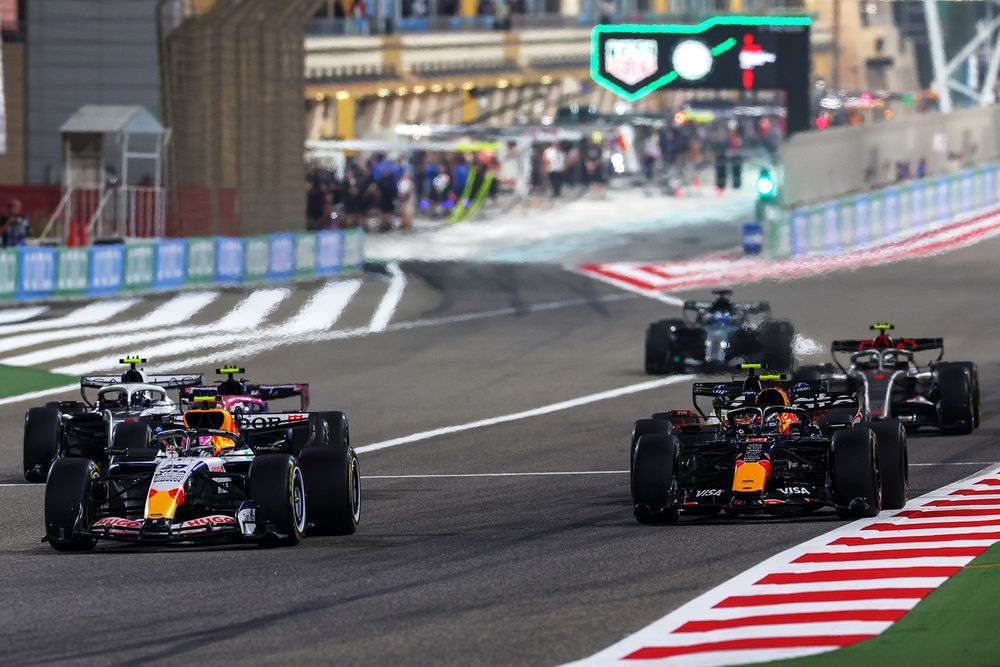
Liam Lawson, Racing Bulls leads Isack Hadjar, Red Bull Racing
Photo by: Andy Hone / LAT Images via Getty Images
The effective replacement for DRS is actually ‘overtake mode’, which can only be used when within one second of the car in front and in designated zones on the circuit. It is effectively a push-to-pass button, keeping the car at a maximum 350kW for longer.
Boost mode
‘Boost mode’ is a manual button on the steering wheel which triggers a new power unit setting. The setting could either be a personalised one created by the team, or one which gives drivers use of the extra battery power they have harvested with the energy recovery system. Unlike ‘overtake mode’, this can be used when attacking or defending.
Recharge
This is largely the contentious part of the 2026 regulations, because it simply refers to drivers recharging their battery to have sufficient power stored throughout the lap. Now that the power unit is more reliant on electrical energy, recharging the battery will play a greater role in grands prix, and Max Verstappen called the new F1 “Formula E on steroids”.
One of the reasons for him saying this is because a way to recharge the battery will be to downshift along a straight or lift and coast into a corner, and although this goes against everything the drivers have been previously taught, it may be necessary for a better overall lap time.
As a result of this, it will see each circuit on the calendar be categorised as either ‘energy-rich’ or ‘energy-poor’. The energy-rich tracks are where recharging the battery will be relatively easy, mainly due to their low-speed nature, while it’s the opposite for energy-poor circuits such as Monza.
Superclipping
‘Superclipping’ came up a fair amount during Bahrain testing and it refers to how the cars can harvest energy while the driver is still at full throttle, usually at the end of a straight or in high-speed corners. This occurs when the MGU-K is put into harvest mode and harvests the power that would usually go to the rear wheels to save it for deployment later in the lap – though it does result in a speed reduction.
Under the 2026 regulations, the energy that can be harvested via superclipping is currently limited to 250kW, but McLaren boss Andrea Stella revealed that the final day of Bahrain testing saw teams trial a limit of 350kW, so that drivers wouldn’t have to lift and coast to regenerate that maximum output.
Compression ratio
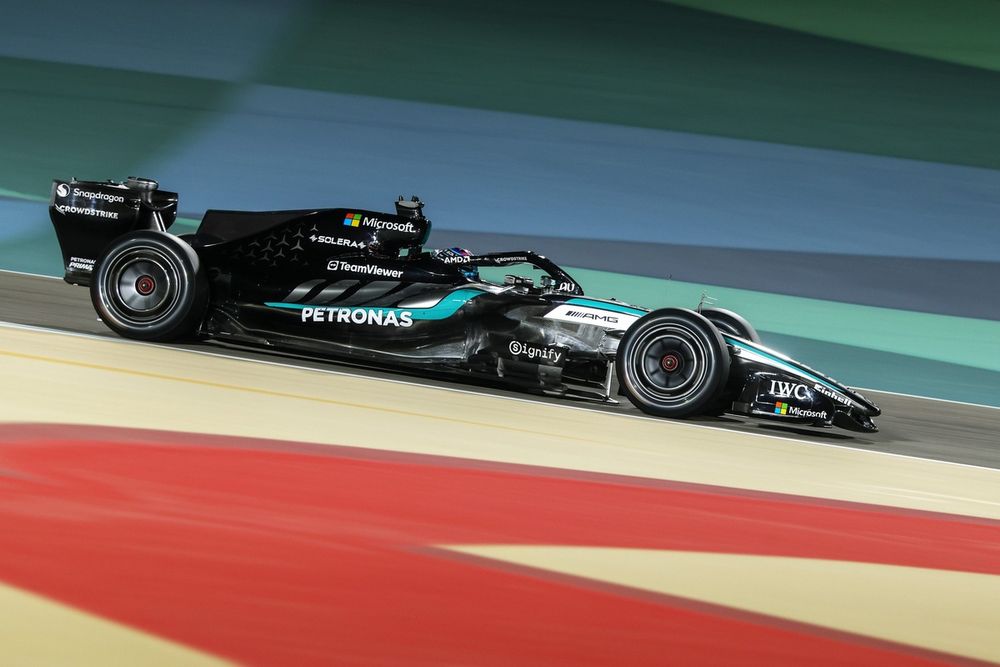
George Russell, Mercedes
Photo by: Steven Tee / LAT Images via Getty Images
Another term which has come up a lot in the build-up to the 2026 season is ‘compression ratio’. This is the ratio between the volume of the engine cylinder when the piston is at the bottom of its stroke and the volume when it is at the top and for 2026, it was reduced from 18:1 to 16:1.
But it then emerged that Mercedes had found a loophole in the regulations, referring to Article C5.4.3 which states that a static test at ambient temperature is the only method of measuring the ratio. So, the Silver Arrows found a way to increase the compression ratio while the engine is running, before returning it to its normal state for when it is due to be measured.
This inevitably caused outcry though, with F1’s four other power unit manufacturers complaining that it gives Mercedes an unfair advantage. The German marque argued that it doesn’t but regardless, the matter has been settled with tweaks to how compression ratios are measured coming into force as early as 1 June.
Turbo lag
Another contentious topic with the 2026 regulations is race starts, which are now more complex thanks to the removal of the MGU-H. That is because the MGU-H was the compression spinner which turned hot exhaust gases into electric energy and helped acceleration be instantaneous.
Now that it is no longer on an F1 power unit, drivers must rev their engines much higher than before and for some 10 seconds to spool up the turbo and overcome lag. Turbo lag is the delay between pressing the accelerator and receiving power from the turbo.
So, timing the new procedure slightly wrong could have significant consequences by pitching the car into an anti-stall. Nailing race starts is therefore of greater importance this year and could be a defining element in the early rounds.
Sandbagging
Another aspect to keep an eye on in the opening rounds of 2026 is who was sandbagging the most in pre-season. In F1, sandbagging is when a team or driver intentionally underperforms in testing to disguise their actual potential, because if they reveal everything early on then rivals may decide to copy certain car components. That obviously then takes away whatever advantage they’d worked on building during the off-season.
Sandbagging can be done through various ways, whether it is running with more fuel, using harder tyres or drivers lifting off on purpose.
We want your opinion!
What would you like to see on Motorsport.com?
– The Motorsport.com Team
Disclaimer : This story is auto aggregated by a computer programme and has not been created or edited by DOWNTHENEWS. Publisher: motorsport.com