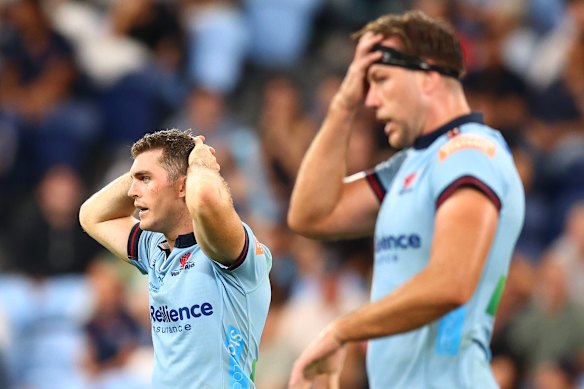

Rugby Australia and New Zealand Rugby are presiding over a state of affairs in Super Rugby Pacific that the NRL would never tolerate. After just six rounds of the competition, the top six teams – the Hurricanes, Blues, Brumbies, Reds, Crusaders and Chiefs – are effectively locked in for the finals.
Of course, anyone can mathematically make the top six, but let’s drop the charade: the sixth-placed Chiefs already have a three-point gap over the Waratahs, who have had four home games.
The Chiefs also have the advantage of about a dozen current All Blacks and host the Waratahs in two weeks.
The top six teams have all made the play-offs for the past four years, except in 2024 when the Crusaders narrowly missed out. In fact, only two other teams have finished in the top six during that four-year span: the Waratahs and Highlanders each crept into sixth place on one occasion each.
So, the question is not whether Super Rugby Pacific is an unequal and predictable competition – that has been established – but whether that situation is sustainable.
Rebels were the canary in the coalmine
The answer to that last question is probably not. A lack of success and consequently low attendance contributed to the collapse of the Melbourne Rebels. Similar issues are unfolding at the Western Force and Moana Pasifika – and everyone also understands how fickle the Sydney market can be for the Waratahs.
The Highlanders are doing OK, partly because attending their games has become a rite of passage for thousands of students in Dunedin.
Regarding the Force, it’s all very well to say that the Forrests have plenty of cash, but why would anyone, even billionaires, just throw money at a team that has no realistic chance of winning?
The smart play – and billionaires tend to be smart – would be to pivot to a competition that has a salary cap or other talent equalisation measures. It’s the same with Moana Pasifika, who understandably drew a very modest crowd against the Crusaders on Saturday.
The deck is so stacked against them that the Chiefs recruited their star outside back Kyren Taumoefolau and put him in reserve grade this year: rugby Robin Hood in reverse.
Team of the week
1. James Slipper (Brumbies) – player of the week, 2. Josh Nasser (Reds), 3. Nick Bloomfield (Reds), 4. Seru Uru (Reds), 5. Nick Frost (Brumbies), 6. Rob Valetini (Brumbies), 7. John Bryant (Reds), 8. Charlie Cale (Brumbies), 9. Ryan Lonergan (Brumbies), 10. Declan Meredith (Brumbies), 11. Corey Toole (Brumbies), 12. Hunter Paisami (Reds), 13. Isaac Henry (Reds), 14. Kye Oates (Brumbies), 15. Sid Harvey (Waratahs)
Don’t blame Super Rugby chief executive Jack Mesley
The competition’s Sydney-based chief executive knows the lack of competition is a huge issue: he said so before the season started. In fact, displaying much-needed candour on the issue, Mesley went as far as saying that some hard conversations about salary caps and drafts were needed –anything to even up the competition.
But, rather predictably, the Crusaders shot down even the idea of changing the status quo. Why would they support any change after eight titles in nine years? Self-interest is rife among the Super Rugby clubs, and the Chiefs’ “warehousing” of Taumoefolau shows that other clubs are trying to mimic the Crusaders by building depth in every position.
So, the onus is on RA and NZ Rugby to sort this out: they can’t just wish the problem away. Having lost the South African franchises from Super Rugby, are they simply happy with what is effectively now a two-tier Super Rugby competition, believing the Wallabies and All Blacks will be more cohesive if built around two or three teams?
The discipline slips that will annoy Waratahs coach
Having said all of that, there were some things the Waratahs could control in their 35-20 loss to the Blues on Saturday.
Make no mistake, the Blues are a talented and well-coached side. The way they patiently broke down the Waratahs in the second half shows that the Reds have recruited an excellent coach in Vern Cotter to replace Les Kiss.
But the Waratahs conceded soft back-to-back penalties around the 65th minute when the game was still in the balance, piggybacking the Blues up the field from deep in their own territory. From that point on, the Blues took control.
After a poor season last year they found a way to integrate Beauden Barrett’s playmaking skills into the forwards-based approach that Cotter loves.
The Waratahs simply lack that quality at No.10. Sid Harvey is a real discovery – he is so beautifully balanced on his feet – but as the Reds enjoy a glut of quality No.10s, the Waratahs are struggling to find one to play the game they want.
New Brumby is making waves
Since his debut a few weeks ago, Kye Oates has been exceptional for the Brumbies. He has many qualities important in modern wingers: he excels in the air, has a high work rate, speed and shows real bravery and commitment in defence and around the ruck.
The Brumbies rode their luck a bit against the Chiefs – Nick Frost got away with head contact on Quinn Tupaea in the first half and the visitors showed awful game management in the final stages – but you can only praise their ability to consistently find players who immediately fit into their system.
Oates looks like another outside back in the Andy Muirhead-Corey Toole mode and his emergence has certainly softened the blow of losing Tom Wright for the first part of the season.
 Paul Cully is a rugby columnist for The Sydney Morning Herald.Connect via X or email.
From our partners
Disclaimer : This story is auto aggregated by a computer programme and has not been created or edited by DOWNTHENEWS. Publisher: www.smh.com.au