
BEIRUT—Syria is entering a new and delicate phase in which the language of “stability” increasingly masks a reality of managed fragmentation and intensified foreign influence.
As efforts persist to fold the Syrian Democratic Forces (SDF) into a broader national framework—despite unresolved political and security obstacles—the spotlight has shifted decisively toward the south, where the file of Sweida has re-emerged as a central fault line in the country’s evolving landscape.
The precedent set in the northeast, where Kurdish forces secured a form of de facto self-administration in Hasakah and Ain al-Arab (Kobani), now reverberates beyond those regions.
Sweida, long operating under an informal model of self-rule, has effectively been governed by a local authority led by the Druze religious figure Hikmat al-Hijri.
This arrangement has taken on sharper geopolitical significance following Israel’s public announcement of a special military unit tasked with liaising with Druze communities across Syria and the wider West Asia, including Lebanon.
Commanded by Israeli Brigadier General Ghassan Alian, himself Druze, the unit’s creation has prompted widespread questions about both its timing and intent.
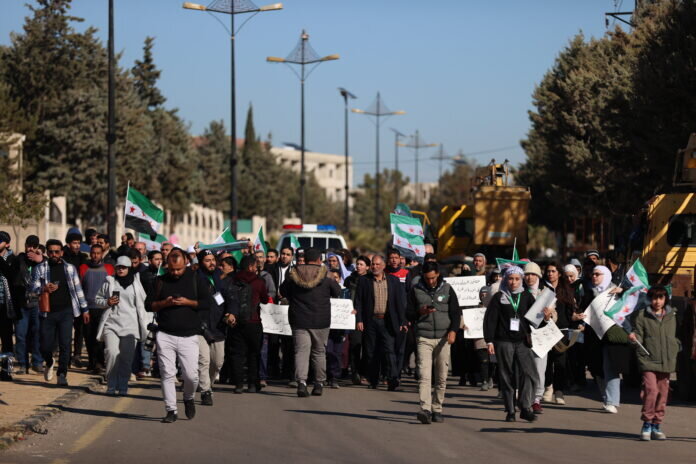
The move followed demonstrations in Sweida during which protesters raised images of Israeli Prime Minister Benjamin Netanyahu—an unprecedented act widely interpreted as an attempt to frame the province as falling within Israel’s sphere of influence.
Al-Hijri has repeatedly reinforced this perception by openly linking Sweida’s fate to Israeli decision-making, further entrenching the sense that the province is being positioned as a strategic card in a broader regional game.
In response, Syria’s transitional authorities have sought to counterbalance this trajectory by promoting alternative Druze figures aligned with Damascus.
Suleiman Abdul Baqi, appointed security chief of Sweida, has played a key role in this effort, particularly through outreach to Washington.
His US visit, supported by Syrian lobbying networks sympathetic to the current de facto ruler Abu Mohammad al-Julani (aka Ahmad al-Sharaa), coincided with a fierce media campaign against al-Hijri and the unified local factions known as the “National Guard.”
These groups were accused of involvement in drug trafficking and alleged ties to Iran and Hezbollah—claims seemingly designed to resonate with American political sensitivities, even as they sit uneasily alongside al-Hijri’s explicit pro-Israel positioning.
The arrest of Nasser Faisal al-Saadi, described by Damascus as a major drug trafficker linked to militant networks, further illustrates how security narratives are being mobilized to redraw political boundaries in the south.
To many observers, such accusations appear less an objective assessment of criminal activity than a tool to delegitimize local forces while avoiding a direct confrontation with Israel’s expanding role.
Amid this polarization, voices from within Sweida have attempted to chart a different course.
Academics and intellectuals have launched the “Third Current” initiative, calling for the formation of a civilian rescue body aimed at preventing chaos and preserving Sweida’s place within a unified Syrian state.
Advocating consensual administrative decentralization rather than secession, the initiative invokes the legacy of national struggle—most notably the Great Syrian Revolt led by Sultan Pasha al-Atrash—as a reminder that local autonomy need not come at the expense of national cohesion.
Beyond the south, Syria’s economic future is also being reshaped by external actors.
The memorandum of understanding signed between US energy giant Chevron, the Syrian Oil Company, and Qatar’s UCC Holding to explore offshore oil and gas resources represents a strategic inflection point.
Endorsed by U.S. envoy Thomas Barrack, the deal underscores Washington’s preference for economic instruments over overt political intervention, embedding influence through investment while sidelining rivals such as Russia.
Meanwhile, Israel continues to consolidate facts on the ground in southern Syria.
In Quneitra, repeated incursions, environmental damage caused by toxic herbicides, and the systematic targeting of water and electricity infrastructure suggest a long-term strategy aimed at control and demographic pressure.
These actions are reinforced by repeated settlement attempts by extremist Israeli groups seeking to expand colonial projects beyond the occupied Golan under historical and security pretexts.
Taken together, these dynamics reveal a Syria caught between reconstruction and reconfiguration, where sovereignty is increasingly negotiated through local proxies, economic leverage, and security narratives.
From Sweida’s contested autonomy to offshore energy deals and border militarization, the country’s future is being shaped less by internal consensus than by the intersecting agendas of regional and international powers.
Disclaimer : This story is auto aggregated by a computer programme and has not been created or edited by DOWNTHENEWS. Publisher: tehrantimes.com



