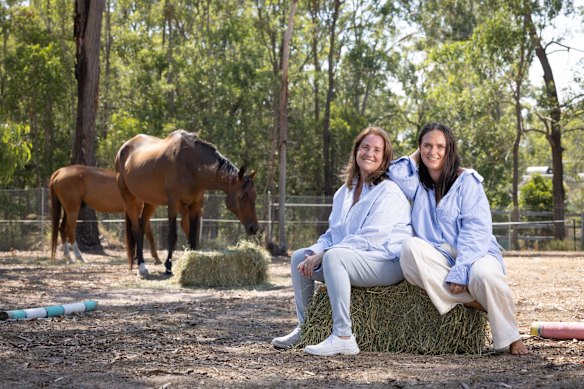

In 2018, Tahlia Isaac, 35, was sentenced to two years in jail for dealing drugs. She saw prison counsellor Denise Eagleton, 61, for weekly therapy sessions, which continued on the outside. She credits Eagleton with saving her life.
Tahlia: I was a couple of months into my sentence when I met Denise. I was desperately trying to find a way out of prison. I’d heard you could get bailed to rehab, but I needed a support letter. One day, I saw an official-looking woman sitting inside a room with the door open. I thought, “She’ll know.” I poked my head in and she said, “Come on in and have a chat.”
Denise never wrote the letter – she knew I wasn’t getting out – but when I sat down with her, it was like pulling the plug on a bath. I told her everything about my life in one session; the words just flowed out of me. I saw her almost every Monday after that. She listened, held the space for me to let it all out and taught me how to regulate my emotions. I shed 10 years’ worth of tears in 10 months.
Before prison, I’d been a daily ice user for almost a decade; for the last three years, I was dealing. My most serious charge was commercial supply of methamphetamine, but there were others, too: fraud, breach of bail, possession of utensils. I didn’t know who I was. I’d never felt enough – not smart enough, not pretty enough, not good enough. I put all my self-worth in other people. When a boyfriend broke up with me at uni – an insignificant relationship, really – I fell in with people who were using. It started with speed. Suddenly, I felt enough. Dealing became a way to take back power.
I told Denise what I’d always told myself: “I had a great childhood; I just fell in with the wrong crowd.” Denise said, “Maybe your childhood wasn’t all that great.” She didn’t judge me: she just suggested it. She’s a magician like that. I realised I had to do some really f—ing hard work on myself: it wasn’t just who I was hanging out with that was the problem.
I had no warning that I was going to be released [on parole, after 10 months]. They kicked me out of the courthouse holding cells at 7.30 on a Friday night with nothing. I could’ve jumped a train to the Gold Coast and gone straight back to my old life, but I knew I needed to stay connected to the deep work I’d been doing. I needed a stable baseline. I called Denise and started seeing her as a private client. Long sessions every three weeks. She charged me virtually nothing. After two years, she said, “You’re done. You can go out into the world now.”
Two years later, after I had my first child, I needed her again. I had postnatal anxiety. She reminded me of all the things she’d taught me in prison: regulating my nervous system, breathing, yoga nidra. When I was better, she said, “Why don’t you come and work for me?” I did her admin. Then I went back to uni and finished my degree in criminology. In 2024, when I founded Project: Herself – an advocacy and peer-support organisation for women in prison and post-release – she started working for us as a counsellor.
Working with other women now, I know how rare my counselling experience was and it makes me sad that this kind of care exists by chance, not design. More than 50 per cent of women return to prison in the first two years because there’s so little support.
Denise is a mentor, a colleague and a close friend. She’s the steady voice of reason in my life and I trust her judgment completely. I look at who I was before I met her – angry, reckless, manipulative – and who I am now and we’re not the same person. She saved my life.
Denise: I was living in northern NSW and had an idea to start a camp for kids at risk, but I didn’t know anything about counselling, so I did a master’s in Gestalt therapy in my 40s. A job came up as an external counsellor in the south-east Queensland women’s prisons. I became passionate about it; I was so moved by the women’s stories. Often, I was the only counsellor for 300 women. They’d come out of a session in tears only to be mocked by a prison guard, who’d say, “What are you crying about?”
I look for signs of engagement, insight and the potential for growth, which are indicators for a healthy recovery. Tahlia had all of those things. She spoke well, she’d had good jobs, and she’d held her life together for many years before she went downhill, which indicates strength and resilience. I saw in her a real commitment to change.
Attending weekly sessions is a brave thing to do inside a prison – therapy like that isn’t easy – but we were able to go deep. I found out that her father had gone to prison, which immediately brings up the trauma that would’ve been in the household. Tahlia was the oldest of four kids, so she would’ve had to handle a lot of responsibility. No one’s fault, just the circumstances.
I think Tahlia was probably a very smart dealer – always watching her back, being quickwitted and strategic. She’s also very relational. I taught her that these skills are transferable to other environments. She took on the strategies and her resilience grew. She started to understand that she wasn’t a bad person, that her environment had shaped her.
In prisons, I learnt to sit with the essence of a woman. I tell her: “Most of your personality and who you are is beautiful: we just have to change a few of the things that you do.” I hold that essence until she can see it herself. Tahlia did; she realised, “I’m not stuck on this road.”
After prison, she came back into therapy for a little while, got what she needed and went off to build her life. But she’d always call and let me know how she was going. Over time, our relationship became one of equals.
We talk mostly on the phone now because she’s in Townsville and I’m in Brisbane. Once, we discovered we were both going to Bali on holiday. I went early, caught up with her and stayed in her hotel for three or four days. It was the first time I got to see her as a mum; she’s a very attentive parent.
When I went into private practice, Tahlia supported me. I’m bad with admin, and she really helped me. We’re colleagues and friends now. Most of the time, our conversations come back to her work and my interest in how she’s doing. If she gets funding, she’ll refer clients to me. I try to do that at a discount.
She attributes a lot to me, but it’s 100 per cent her. She has worked so hard on her recovery.
 Erin O’Dwyer – Erin O’Dwyer is a journalist, writer and editor.Connect via X.
From our partners
Disclaimer : This story is auto aggregated by a computer programme and has not been created or edited by DOWNTHENEWS. Publisher: www.smh.com.au