State elections have sent shockwaves through the German coalition government. Now parties are scrambling to put through a series of major reforms, with the spotlight on taxes, pensions and health insurance, alongside efforts to expand the workforce.
It’s been a busy few weeks in German politics, with elections in Baden-Württemberg and Rhineland-Palatinate, along with a mayoral vote in Bavaria.
In the most recent contest on Sunday, German Chancellor Friedrich Merz’s Christian Democrats (CDU) scored a much-needed victory in Rhineland-Palatinate, securing 31 percent of the vote and knocking the Social Democrats (SPD) from power for the first time in 35 years.
Now as the SPD nurse their wounds following a string of weak results – and state governments move toward coalition talks – one word is dominating conversations at the federal level: reforms.
As well as planned projects, a number of cost-saving measures are reportedly on the table, such as raising value added tax (VAT), introducing restrictions on mini-job, cutting free co-health insurance for spouses and even getting rid of a public holiday.
However, divisions between the coalition, made up of the centre-right CDU/CSU and centre-left SPD, remain.
Wasn’t there already a season of reforms?
Yes, if you cast your mind back to late 2025, you may remember Merz making a big deal about an “autumn of reforms” that aimed to address stagnant economic growth, high energy costs and budget deficits.
Key measures included tightening welfare, focusing on bureaucracy reduction, tax reform, and adjusting pension systems to address demographic challenges.
But it has been slow to materialise. Combined with growing public frustration, a rebrand has emerged: a spring ‘reform window’ (Reformfenster).
READ ALSO: Germany’s Merz vows ‘autumn of reform’ in turbulent times
What has already begun?
Both parties have already agreed on some big changes, such as overhauling the long-term unemployment system, currently called Bürgergeld or citizen’s allowance.
The existing scheme will be renamed Basic security (Neue Grundsicherung) and restructured with a stronger focus on job placement and stricter participation requirements.
READ ALSO: German Bundestag approves tough Bürgergeld reform
The coalition has also made progress on amendments to the Heating Law, aimed at making energy systems more climate friendly.
What big reforms is the government working on?
Major tax changes
Tax reform is one of the government’s key projects, with broad agreement on providing relief for lower and middle incomes.
SPD leader and Vice Chancellor Lars Klingbeil said this week people earning around €3,000 per month should see “tangible relief” of €300 to €400 per year.
But opinions differ when it comes to higher earners. CDU General Secretary Carsten Linnemann suggests that the top tax rate should apply from €80,000 instead of €68,000.
The SPD is proposing a hike in the top tax rate to 49 percent – a deal-breaker for many in the Union, though a few have hinted at a willingness to compromise on the issue.
Meanwhile, according to German business newspaper Handelsblatt, Klingbeil wants to make a push to scrap joint taxation for married couples, known as Ehegattensplitting.
READ ALSO: Why Germany’s tax system could be putting women off marriage
German newspaper Bild reports the coalition is also considering raising VAT from 19 to around 21 percent to finance tax relief, while lowering the reduced VAT rate on basic foods (vegetables, pasta, meat, milk) from seven to four percent.
Pension disputes
Germany’s pension system is facing breaking point as the workforce shrinks due to the baby boomer generation retiring.
The government has already passed a controversial pension package, but criticism – including from the Junge Union group within the conservatives – has been sharp. They said the package results in a “burden of billions on the shoulders of the younger generation”.
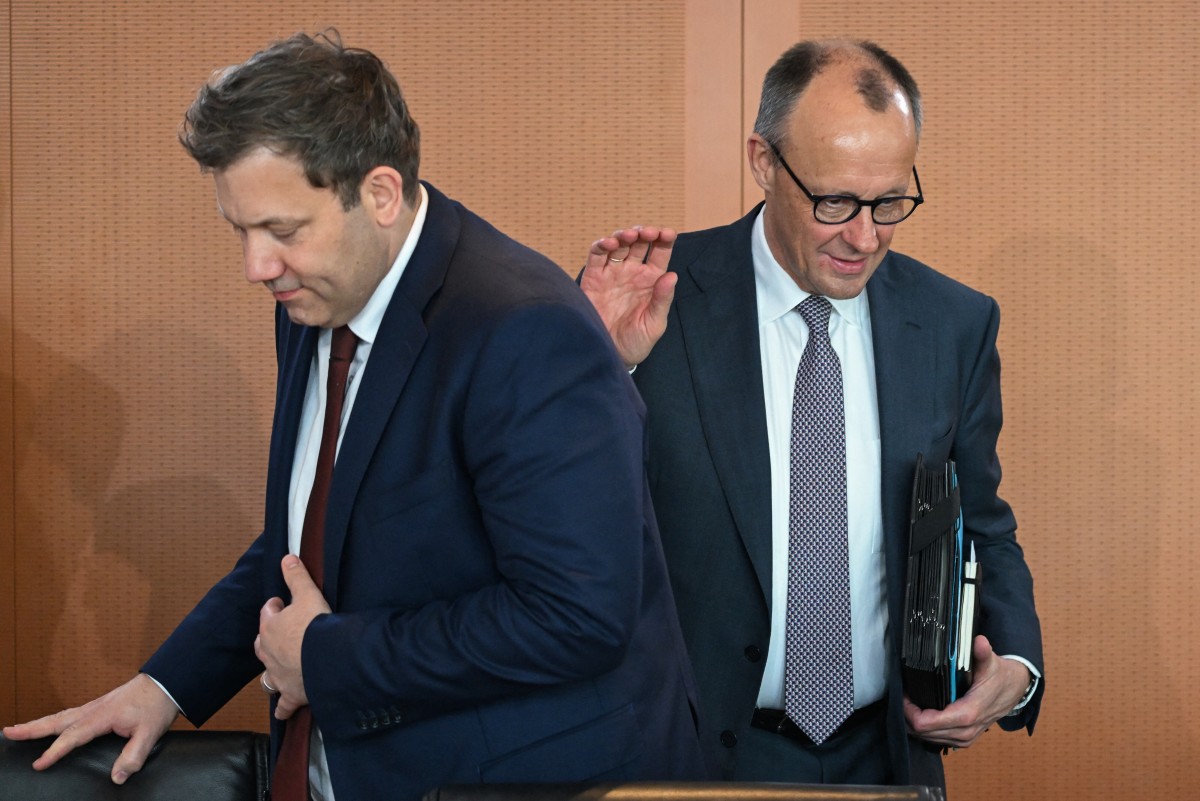
Chancellor Friedrich Merz and Finance Minister and Vice-Chancellor Lars Klingbeil take their seats prior to the weekly cabinet meeting, on March 11, 2026 at the Chancellery in Berlin. (Photo by RALF HIRSCHBERGER / AFP)
Under the plans, the pension level would be one percent higher by 2039 than the current rules provide for.
A commission on pension insurance is drawing up proposals on how the system can be reformed and financed in the long term. Whether these proposals can be turned into legislation remains to be seen.
And there’s another sticking point – how parties want to solve the underlying problem. The SPD is in favour of encouraging more skilled immigration to Germany to fill vacancies, while the CDU/CSU want to see workers in Germany retire later.
READ ALSO: Why do skilled immigrants leave Germany?
Health insurance
The government is also leaning on expert commissions to propose reforms to healthcare and long-term care.
Options on the table include higher contributions or reduced benefits in health insurance, ending free spousal health insurance, and, in long-term care, introducing higher co-payments for those who earn more.
These are politically sensitive and likely unpopular. A commission is set to propose long-term reforms by summer but it is unclear whether reform will follow quickly.
Regardless of what is decided, the government’s main concern will be presenting itself as capable of taking action.
READ ALSO: What does public health insurance really cover at the dentist in Germany?
What is still being talked about?
Handelsblatt reports that the “possible removal of a public holiday is also being discussed as part of a wider package” to save money, but this would be extremely unpopular with voters so seems an unlikely route.
Other potential measures include tightening the rules around mini-jobs. Under such changes, only pensioners, students and individuals who already have a primary job would be allowed to earn up to €603 tax-free and without paying social security contributions. Everyone else would be required to move into part-time or full-time employment subject to standard social security contributions.
READ ALSO: The rules in Germany around mini and midi jobs
On several other topics, compromise appears to be a long way off.
The SPD is pushing to reform the debt brake, as outlined in the coalition agreement. But this is a sensitive issue for the CDU/CSU, particularly after backlash from its supporters over last year’s €500-billion special fund.
Climate change is another sticking point. The Federal Administrative Court has warned that the government must step up efforts in this area but no deals have been struck by the coalition.
And migration topics remains contentious. The CDU/CSU wants to roll back the 2024 citizenship reforms by raising the residency requirement from five to eight years.
Yet the SPD stands by its reform. Social Democrat Bundestag member Sonja Eichwede told The Local last November “no further changes are planned” to the nationality law.
READ ALSO: How the CDU aims to tighten Germany’s citizenship rules in 2026
Disclaimer : This story is auto aggregated by a computer programme and has not been created or edited by DOWNTHENEWS. Publisher: thelocal.de