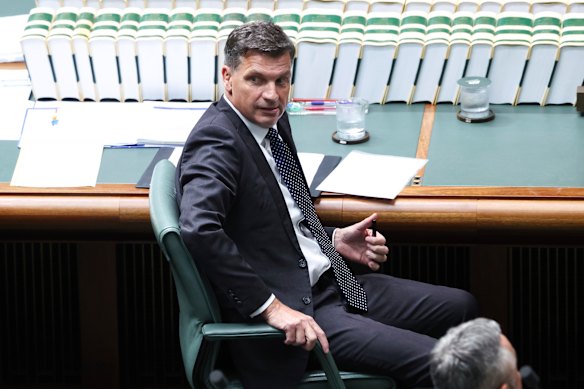

An average Australian will be $35,000 worse off over the next decade as the nation’s productivity forecasts are downgraded, Opposition Leader Angus Taylor will warn, as Nationals leader Matt Canavan calls for the government to embrace tariffs against China.
In duelling speeches to the Business Council of Australia, Taylor and Treasurer Jim Chalmers will both shine a light on the nation’s lower growth limit of about 2 per cent, above which the economy runs too hot and fuels higher consumer prices.
Chalmers, who has staked his authority on a reformist budget in May, promised action on productivity in coming weeks and deals with state governments to drive competition, with Productivity Commission research that will lay the groundwork for a new instant asset write-off scheme.
“The productivity package will be substantial and it will be all about making it easier and faster to build, more attractive to invest, and to try and get some of your compliance costs down,” Chalmers said at the business lobby event on Tuesday night.
Taylor, in his first major speech to rebuild the Coalition’s economic agenda, will on Wednesday set up his attack lines as Chalmers prepares a budget in bleak economic conditions fuelled by an oil crisis and stubbornly high inflation.
A former management consultant who holds traditional free-market principles on economics, Taylor will claim Labor is turning Australia into a “government-directed” economy in which public spending has crowded out the private sector, with Australians only getting ahead by working longer hours.
Last week’s announcement from Chalmers that it would take an additional five years to revive Australia’s paltry productivity rate to the long-term average means Australians will endure a “lost decade” of economic malaise, Taylor will say, citing analysis from his office that showed “$35,000 of lost national income for every man, woman and child in Australia”.
The Coalition lost its historic advantage over Labor on economic management at the last election for the first time in the decades-long history of the Australian Election Study. Last term, then opposition leader Peter Dutton proposed state-subsidised nuclear power and sometimes antagonised big business. Taylor was involved in the decision to oppose Labor’s small income tax cut just before the election campaign, but has since described that call as a mistake.
“Since Labor was elected Australians’ standard of living is 10 percentage points lower when compared to the growth seen in peer countries. This is the worst collapse in living standards in the developed world,” Taylor will say.
In his remarks, Chalmers pushed back on the notion that Labor’s policies to pump billions into re-industrialising blue-collar sectors were at odds with the need to pare back spending to allow the private sector to thrive.
“This is not about resilience or reform, it’s about resilience and reform. Reform is all about resilience, they’re the same thing,” Chalmers said.
Chalmers responded to Taylor’s critique, saying: “Angus and the Coalition presided over the worst decade for productivity in 60 years, Australians are paying the price for that, and that’s one reason nobody takes them seriously on the economy.”
Australia, Europe and other developed economies are all attempting to rebuild state capacity while improving productivity, a challenge as massive Chinese subsidies make manufacturing uncompetitive.
European leader Ursula von der Leyen warned Australian parliament on Tuesday about Chinese overcapacity, saying that the superpowers’ $1.2 trillion trade surplus with the rest of the world was hurting industries across the globe.
“Getting China right is a strategic imperative,” von der Leyen said. “We cannot and will not absorb China’s export-led growth model and its industrial overcapacity.”
Canavan savaged the Australia-EU free trade deal struck on Tuesday and has supported protectionist causes, a potential point of tension with Taylor.
The Nationals senator told this masthead that Australia should accelerate anti-dumping cases to counter China from pumping cheap steel into the country. “At the moment a decision is not due until Christmas, but that could be too late,” he said.
“While I don’t agree with Donald Trump that ‘tariff’ is the most beautiful word in the English language, it is not a dirty word either. It is just a tool and we need all tools at our disposal to save our steel industry.”
Cut through the noise of federal politics with news, views and expert analysis. Subscribers can sign up to our weekly Inside Politics newsletter.
 Paul Sakkal is Chief Political Correspondent. He previously covered Victorian politics and won a Walkley award and the 2025 Press Gallery Journalist of the Year. Contact him securely on Signal @paulsakkal.14.Connect via X or email.
From our partners
Disclaimer : This story is auto aggregated by a computer programme and has not been created or edited by DOWNTHENEWS. Publisher: www.smh.com.au