America’s fiscal outlook continues to enter uncharted territory, with the Committee for a Responsible Federal Budget (CRFB) projecting the era of trillion-dollar annual interest payments has arrived. In a grim fiscal milestone first breached in fiscal year 2025, the costs to service the nation’s ballooning debt have spiraled, creating a financial pickle that threatens to squeeze the federal budget for decades to come.
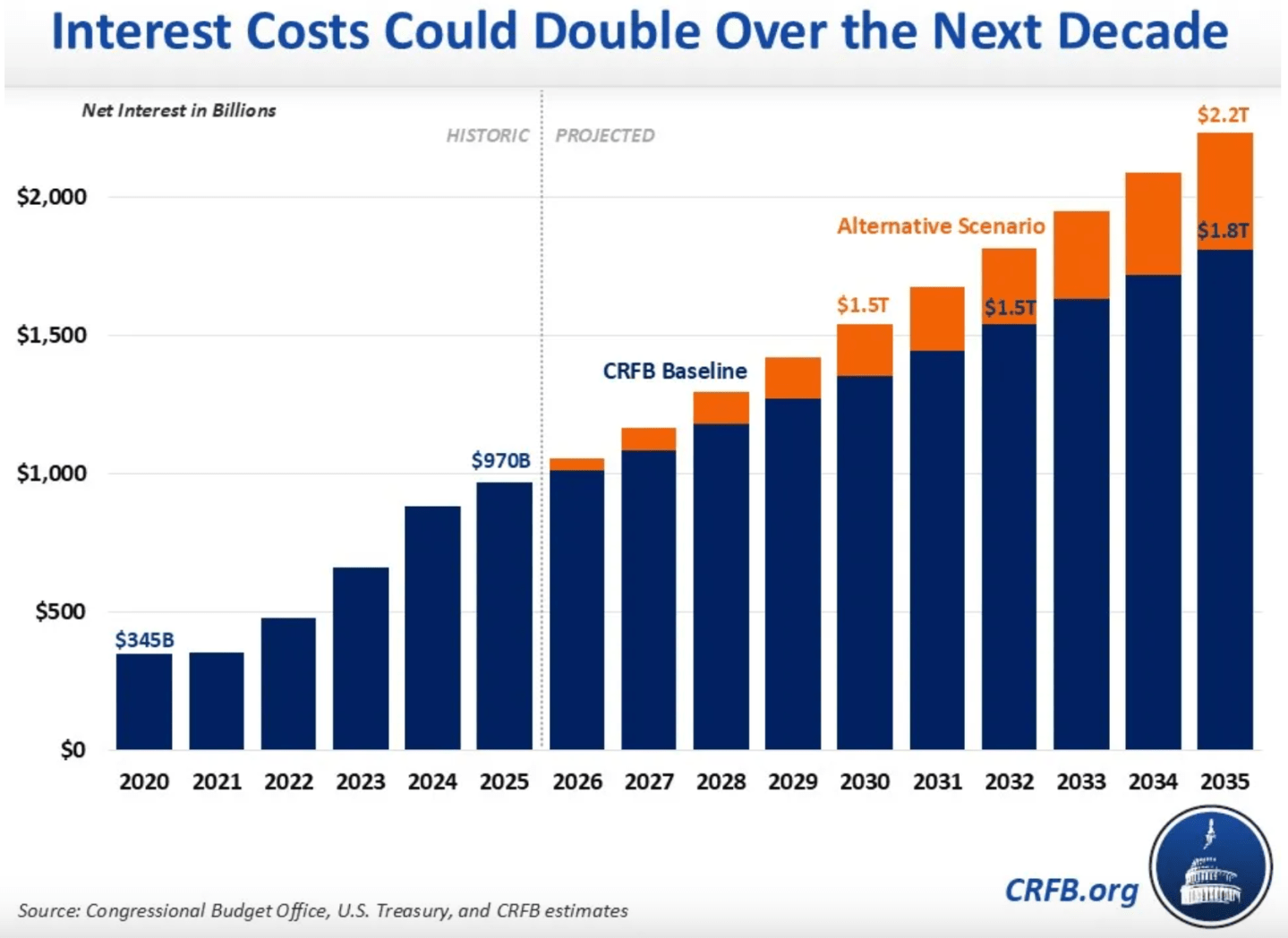
According to an analysis released by the nonpartisan budget watchdog on Dec. 16, the $38 trillion national debt is “largely to blame for these high interest payments,” having climbed to equal 100% of the nation’s gross domestic product (GDP). While the specific line item for net interest in the federal budget totaled $970 billion for the fiscal year, the Congressional Budget Office (CBO) indicates actual spending for net interest payments on the public debt broke the barrier of $1 trillion for the first time in FY 2025. Over the coming decade, the CRFB projects these figures will increase, surpassing $1.5 trillion in 2032 and $1.8 trillion in 2035.
If (as looks increasingly likely) the Supreme Court finds many of the Trump administration’s tariffs illegal, and provisions in the One Big Beautiful Bill Act are made permanent without offsets, the CRFB estimates interest payments passing $2.0 trillion in 2034 and $2.2 trillion in 2035. The watchdog noted with alarm just five years ago, in FY 2020, net interest costs were a relatively manageable $345 billion, but have roughly tripled since then amid a flurry of pandemic-related emergency spending. Furthermore, the CRFB outlook suggests this is not a temporary spike, but the “new norm.”
The projections come nearly simultaneous with a warning from the American Action Forum this borrowing trajectory will end up placing an “undue burden on future generations.” The economic think tank argued younger generations are likely to face a higher interest rate environment, slower economic growth, and stalling wage increases as a result.
Prominent economic voices such as JPMorgan CEO Jamie Dimon and Federal Reserve Chair Jerome Powell have warned about this dynamic as well. Bridgewater Associates founder Ray Dalio described one possible result as an economic “heart attack,” with government investment squeezed out by the need for the country to maintain debt obligations.
When the debt first exceeded $38 trillion, just a few months ago in late October, the Peter G. Peterson Foundation calculated it had only taken two months to grow from $37 trillion, the fastest rate of growth outside the pandemic. It’s “no way for a great nation like America to run its finances,” foundation CEO Michael A. Peterson said in a statement to Fortune at the time.
The CRFB argues the only way to escape this feedback loop is for policymakers to “work on a plan to put our national debt on a downward, sustainable path.” Without intervention to control the rising costs, the federal government faces a future where servicing the past consumes an ever-growing share of the future.
Disclaimer : This story is auto aggregated by a computer programme and has not been created or edited by DOWNTHENEWS. Publisher: fortune.com