Up to $400 million of the total raised from the prospective sale of stakes in the eight Big Bash League clubs may be used to repair Cricket Australia’s budget and reinvest in the game’s lower levels around the country.
Slowly but surely, Australian cricket is moving towards a decision to inject private capital into the BBL, and while the ultimate value of the sell-off remains to be seen, CA and the states are closing in on consensus on where money is most urgently needed.
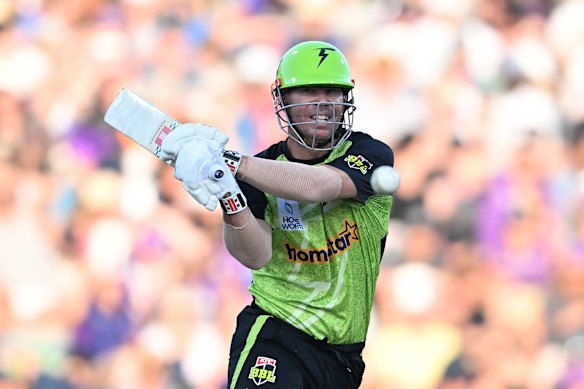
David Warner in action for Sydney Thunder.Credit: Getty Images
Estimates of the value of a sale – based around the concept of selling 49 per cent stakes in six clubs and 100 per cent stakes in one each of the two Melbourne and Sydney-based teams – have ranged between $600 and $800 million.
But the strategic imperative of budget repair ahead of the next round of domestic broadcast deals in five years’ time has been a key focus of negotiation between CA chief executive Todd Greenberg, the state associations and the players.
According to three senior Australian cricket sources, speaking on the condition of anonymity, modelling for budget repair and investment in the game at all levels has been based around a total figure of about $400 million. Cricket Australia declined to comment.
Under the mooted model for distributing funds, to be discussed again at a meeting of CA and state CEOs in Adelaide ahead of the third Ashes Test, $100 million would go to CA balance sheet repair, following six consecutive years of deficits.
Another $100 million would be committed to enhancement of the BBL: topping up player payments, investment in marketing and driving up the value of the tournament.
Some $50 to 60 million would be committed to investment in grassroots levels of the game, community and club cricket across the states and territories.
And $150 million would be set aside for a “future fund”, to be kept as a strategic reserve and providing ballast to the game’s financial position ahead of the aforementioned broadcast rights talks.
Cricket Victoria, which has been vocal in its hesitance about “selling the farm” in terms of the BBL, is open to current discussions, but like other states, is seeking more detail for its board to consider.
The CV chair Ross Hepburn created a stir at the CA AGM in October, when he read a prepared statement attacking CA over the state of its budgets.
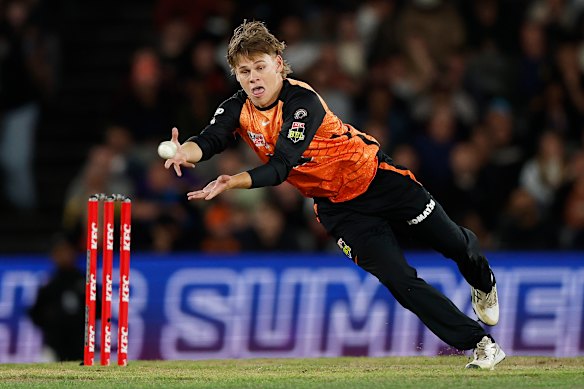
Cooper Connolly makes a diving attempt for the Scorchers. Credit: Getty Images
“CV is very supportive of the current strategic considerations to reset the BBL competition and strengthen the CA balance sheet,” Hepburn had said. “However we believe all other options need to be diligently canvassed before resorting to selling off member assets.”
One possible sticking point among the six states is that while all are considered joint members and owners of Australian cricket, the presence of two BBL clubs in each of Victoria and New South Wales has raised the prospect of a different distribution.
Namely, CV and CNSW may be seen as wanting two eighths of the value of the clubs, rather than one sixth.
That picture would be complicated further if any of the four states with one BBL club within their borders expresses a desire to sell 100 per cent of their club rather than 49 per cent.
It has long been assumed that the “second” teams in Sydney and Melbourne (the Thunder and Renegades) would be most suitable for selling off in full, but the experience of the Lord’s-based London Spirit in the UK suggests the Sixers and Stars would be more valuable to prospective buyers looking for outright ownership because they are based at the iconic SCG and MCG, respectively.
CA’s recent transparency with the states about the overall financial picture and the need for budget repair has brought a positive response, generating greater sense of urgency about the need to make a sale.
In September, the CA chair Mike Baird made his case for why an injection of private capital was needed.
“Australian cricket is at a critical juncture, there are significant opportunities for us that could set the game up for a generation,” Baird said. “There is a very constructive discussion being taken by chairs and CEOs across cricket.
“In terms of a decision, the only way we would make a positive decision is if every part of cricket benefited. That starts at grassroots, infrastructure and participation, it provides opportunities for players, for high performance, it gives fans increased experiences in ways currently not imagined, and it provides an engine for growth for long-term investment in the game.
“That’s the only way you would consider this, that there’s significant benefit for the whole of the game. Our ambition is not just to tread water. It’s how do we grow the game.”
Greenberg, meanwhile, has spent much of the year warning that the current financial model is unsustainable for cricket without structural changes.
“We can’t stand still,” he has said. “We’ve got to keep an eye on what’s happening. Of course, we want to protect everything that’s sacrosanct about what’s been great about Australian cricket over generations, but we’ve got to have an eye to the future.
“And we’re not talking about in six months or 12 months. We’re talking about long-term generational change, and it’s incumbent on us as leaders of the sport to make sure we explore all of those things, and that will get uncomfortable for people, and it will challenge people.”
News, results and expert analysis from the weekend of sport sent every Monday. Sign up for our Sport newsletter.
Most Viewed in Sport
Disclaimer : This story is auto aggregated by a computer programme and has not been created or edited by DOWNTHENEWS. Publisher: www.smh.com.au