This is a sit-down interview of a different kind with Sydney FC’s star recruit Victor Campuzano at Sky Park, the club’s Macquarie University headquarters. He speaks very good English, but for the purposes of this exercise, he is talking to me in Spanish, which I don’t understand.
And yet, this reporter now does.
Thanks to these miraculous little things we each have in our ears, we can hold an essentially seamless conversation: I talk to him in English, he answers me in Spanish, but we are hearing each other in our native tongues.
“This app is great,” Campuzano says. “It’s truly spectacular.”
I am always reluctant to insert myself into a story, let alone write in the first person. But when I heard about what was going on at Sydney FC – that their foreign players were using AI-powered earpieces to break down language barriers in real time – I had to try it out.
For the past few weeks, the Sky Blues have been trialling gadgets from a Chinese tech brand called Timekettle. They record speech, digitise it, process it through an AI translation model that understands context and meaning, and then deliver the translated audio through the earpiece.
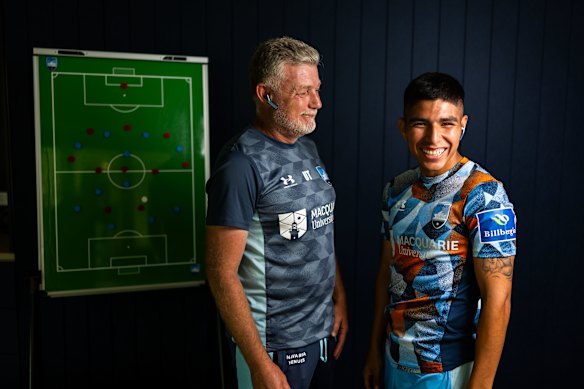
Sydney FC player Piero Quispe with coach Ufuk Talay and the translation earpieces.Credit: Sam Mooy
We can’t be certain, but as far as the club and I can tell, this might be the first time such consumer AI has been used systematically inside a professional team environment anywhere in world sport.
They can be used in two ways. Firstly, one to many: in team meetings, coach Ufuk Talay will stand in front of the room while wearing an earpiece and talk players through the tactical plan for their upcoming game. Players can scan a QR code and listen to him in up to 43 languages (and decode 96 different accents) through their own headphones off their own devices.
Secondly, one-on-one: Talay and whichever player he is catching up with will each wear an earpiece, enabling them to talk to one another directly, without a third-party interpreter – as I am doing with Campuzano.
Timekettle is not a Sydney FC sponsor, nor are they the only company making these devices. There is no commercial arrangement here. Alexander Baumjohann, the club’s head of player management, came across the technology himself, thought it was worth a look, got in touch with the company and a unit soon arrived at Sky Park.
Minds have been blown ever since.
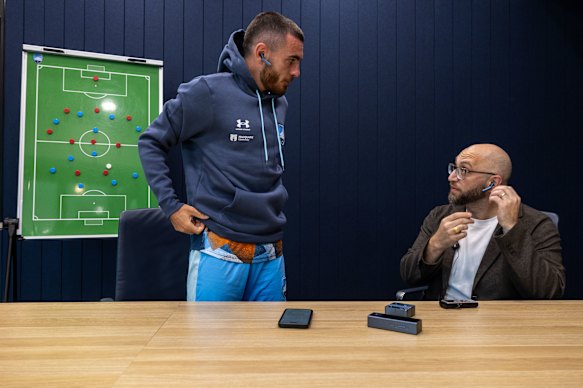
Sydney FC’s Victor Campuzano and Herald journalist Vince Rugari test out the earpieces.Credit: Sam Mooy
“We first tried it with Alex – he was speaking German and I was speaking Turkish into it – and it was unbelievable, the conversation that we were having,” Talay recalls.
After a bit of fiddling with the Bluetooth settings, the club’s media manager David Warriner puts his phone down on the table, and as Campuzano and I talk, the Timekettle app does its magic. Others in the room watch on in amazement, as if they are seeing the future, right in front of them.
“Were you saying we can hack Dave’s phone, now that he doesn’t understand us?” Campuzano asks me in Spanish.
I remind him that, since I’m speaking English, Dave can understand me, so I have to be careful.
“Only I have freedom,” Campuzano says with a laugh.
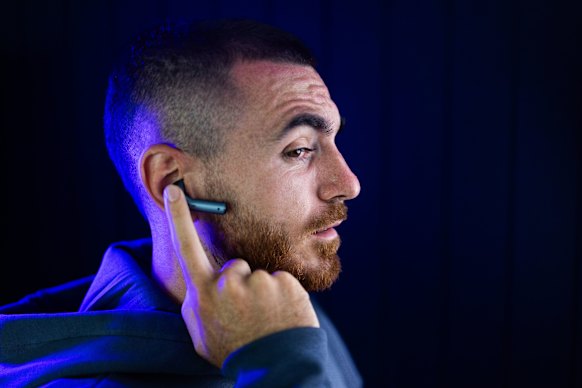
Sydney FC’s Spanish import Victor Campuzano with the translation earpiece.Credit: Sam Mooy
It works. Pretty much perfectly. Our conversation feels smooth and natural, and we joke about how he suspects teammate and Peruvian international Piero Quispe secretly spends his team meetings listening to the Puerto Rican rapper Bad Bunny instead of the Spanish translation of Talay’s speeches. We speculate about whether, one day, I could take one of these things to a Bad Bunny concert so I could actually understand his lyrics.
By the end of our chat, I feel like I’ve built much more of a rapport with Campuzano than I would have if we both spoke in English. I imagine he feels more comfortable expressing himself this way, and can say the things that come naturally to him, rather than having to reach for the right English words in his brain. He can simply be himself.
“I think it creates a much more intimate atmosphere,” Campuzano says. “I think the future is bright with these things, and we’ll use them for everything. You’ll also be able to travel to any country in the world, literally, and talk to anyone … and I think that’s really nice, because you’ll be able to share experiences with the whole world, and there won’t be a language barrier.”
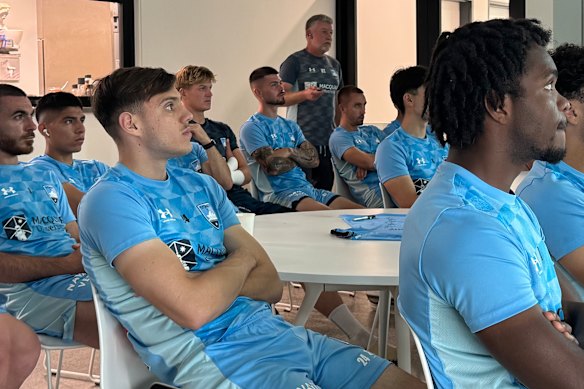
Sydney FC coach Ufuk Talay delivers a team meeting wearing the Timekettle device, while Peruvian import Piero Quispe (second from left) listens to the Spanish translation.Credit: David Warriner
Since he can speak English and Spanish, I ask him for his judgment on accuracy.
“Almost 100 per cent,” he says.
The only major snag is that it takes three to five seconds for the audio translation to come through, which is a little bit awkward, but not a deal breaker. The app on Warriner’s phone also provides a transcription in both languages, so we spend a fair bit of time leaning forward and reading what’s on the phone while waiting to hear the spoken version – which, if we’re searching for negatives, does sound a little bit wooden, like Apple’s Siri.
Give it a couple of years, I reckon, and it’ll be instantaneous.
There are many ways that this technology could revolutionise the way we work and live, but I was fascinated by its use in sport, and particularly football.
Having covered the world game for this masthead for the past seven years, I am all too aware of the challenges of cross-cultural communication. At major tournaments such as the World Cup, earpieces are given to players and coaches for official press conferences; through an app, journalists can select the language they would like to hear the questions and answers in.
But those translations are delivered in real time by a human interpreter in a nearby booth, who is under immense pressure to operate with speed and precision, at risk of embarrassment, defamation, or even diplomatic friction if they don’t reflect the full meaning accurately.
I vividly recall, at the 2019 Asian Cup in the United Arab Emirates, hearing foreign journalists ask questions in Arabic of then Socceroos boss Graham Arnold, and then getting the English version through an earpiece – except the translation lasted for about a third of the time that the journalist was actually speaking.
All nuance is lost, and by the time the English versions of the questions got to Arnold’s ears, they were surely mangled beyond recognition, rendering the experience largely a waste of time for all involved. It was like Lost in Translation, but set in Abu Dhabi.
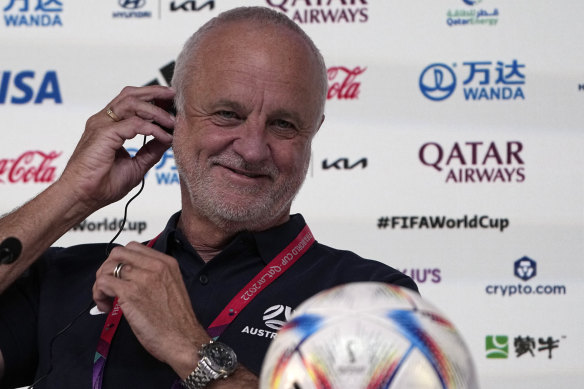
Graham Arnold fiddles with an earpiece at the 2022 World Cup, where the translation he was hearing was delivered by a human interpreter, under pressure.Credit: AP
Inside team environments, there are other pitfalls. Let’s use Ange Postecoglou’s time at Yokohama F. Marinos as an example: he would deliver speeches to his players in English, which would be translated into Japanese by an interpreter for the majority of his squad. But then another interpreter would translate from Japanese into Portuguese for the Brazilian players, and another would translate Japanese into Thai for their other import.
So while Postecoglou was trying to inspire his troops, there was all sorts of murmuring going on at the back of the room, which must have been very distracting.
“I haven’t had any very clear examples like the ones you describe,” Campuzano tells me.
“But I have a friend who played for a team called Grenada. I think that year there were 26 players, and 21 of them were of different nationalities. So imagine the mess it was for the coach to explain it in a way that everyone could understand. It was chaos. With this, it would be very easy, because the coach would speak and everyone with their tongue would understand it the first time.”
Timekettle’s grasp of specific football terminology isn’t perfect, but it’ll get there.
When Talay was playing for Avispa Fukuoka in Japan, he had an interpreter who he said practically man-marked him during training sessions, telling him what his coach wanted from him in his specific midfield role.
That’s one setting the Sky Blues haven’t experimented with: on the field. In a match, that wouldn’t be allowed, anyway. Yet.
The world’s biggest clubs have endless resources, enabling them to employ as many interpreters as they need. Clubs such as Sydney FC cannot. For them, Timekettle is a cost saver, a noise reducer and a cultural accelerator all at once.
Talay’s assistant coach John Maisano can speak Spanish, as can Baumjohann, so they could get by without them. But with them, they can speed up the process of helping integrate a player such as Quispe, who is playing in a non-Spanish-speaking country for the first time in his career, and is nowhere near conversational with his English.
Talay and Campuzano are sure this tool has helped him feel more comfortable in his new surrounds, and trust the people around him, sooner than he otherwise would.
“You’re able to connect a lot quicker with the individuals,” Talay says. “You always question it – how good will it actually work? But I think it’s been working quite well. This device makes life a lot easier, a lot simpler. It’s better than having more bodies in the room.”
The sceptic in me can see an obvious drawback: what if this makes us all too lazy to learn other languages? Quispe is taking English lessons and is eager to learn, so credit to him; he might be an exception. But won’t we lose something beautiful about the world? These are questions we will all have to reckon with one day, and they are much bigger than sport.
For now, my head is spinning. Football has always been a universal language. That’s more true now than it has ever been.
Most Viewed in Sport
Disclaimer : This story is auto aggregated by a computer programme and has not been created or edited by DOWNTHENEWS. Publisher: www.smh.com.au