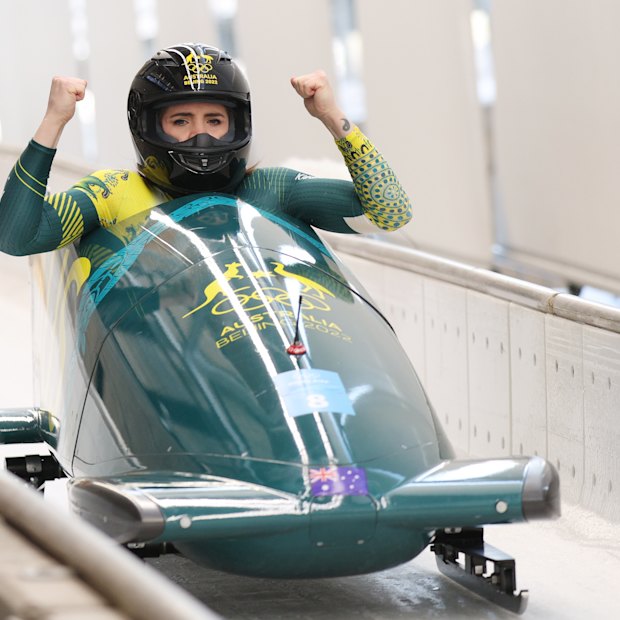
Australian Bree Walker is a favourite to win gold in the women’s monobob at the 2026 Olympics.Credit: Getty Images
Bree Walker began her Olympic journey a decade ago wearing op-shop snow gear, hand-me-down Canadian race suits and inside a second-hand sled too big and too heavy for her.
It was a different world to the one in which the 33-year-old Australian now lives in, as she heads to Milano Cortina as one of the favourites to become Olympic champion in the monobob – the female-only solo bobsled event.
“There was no way I could foresee what I have now achieved,” she says. “But there was a part of me that knew I could be successful in this sport. It was just finding a way to make it happen.”
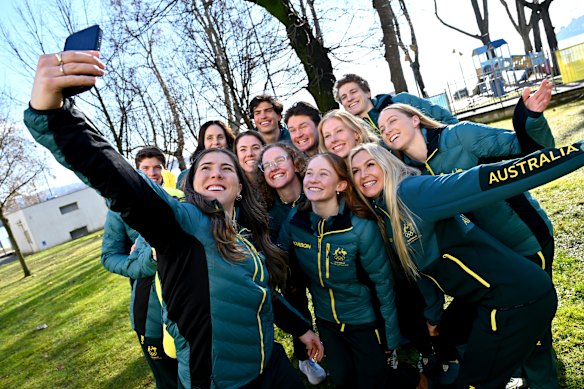
Monobob athlete Bree Walker takes a photo with other members of Australia’s 2026 Olympic team. Credit: Getty Images for AOC
Walker spoke to this masthead from Calgary, Canada in October – just before heading to Europe for the World Cup season.
In the three months since, Walker has dominated the circuit, winning three world cup gold medals, a silver and a bronze.
The 2026 Winter Olympics will be her second, after debuting for Australia at Beijing in 2022 where she finished 5th overall in the monobob and 16th in two-woman bobsleigh.
Milano Cortina will also mark a decade since Walker, a former track and field athlete, declared her grand plan to become a Winter Olympian.
“My own mum was like, ‘Are you sure you want to do this?’” recalls Walker.
“I was the kid who always had crazy ideas … but I think this was a little bit of a shocker to them. They were like, ‘This? This is what you’re going to choose to do now?’”
For Australian athletes, the cost of competing internationally is often higher due to travel, accommodation and equipment. Even more so when you’re competing in a sport that only exists in the northern hemisphere, in which a two-person sled costs about $110,000 and a single sled $42,000.
But against the odds, with one of the smallest teams in the game, Walker arrives in Italy with a podium finish within her grasp.
The team behind Bobsled Bree
Walker left Beijing in 2022 wanting more. She knew she was capable of mixing it with the best, but needed the right coach to get her there.
Enter Pierre Lueders, or, as Walker describes him, the “Tom Cruise of the bobsleigh world”.
Lueders was Olympic champion in the two-man bobsled at the 1998 Olympics in Nagano and a silver medallist in Turin in 2006, before coaching the Russian, South Korean and Chinese teams to Olympic success between 2011 and 2022. He was the best in the business, and the guy Walker – and everyone else – wanted as her private coach for the Milano Cortina Olympic cycle.
“After Beijing, I was very determined to have him as my coach, so I stayed in touch with him in the months after Beijing,” Walker said. “Everyone was like, ‘Bree, there’s no way that you’ll be able to get Pierre Lueders as your coach’. I was like, ‘No, I’m pretty sure I’m going to be able to do this, I just need to find a way to make it happen’.
“I was a big enough pest that he eventually came around, and we’ve been working together ever since. It’s really been quite a journey building up to this point. He always says that he had a plan when we began, and it was just a plan to grow and develop across the years. We’ve done a pretty good job of that so far. It’s all coming together this year.”
Lueders says Walker’s campaign to recruit him pre-dated the 2022 Olympics.
“Actually, Bree had already spoken to me prior to the China Olympics in 2022 at the last world cup event,” Lueders told this masthead.
“I said, ‘Let’s talk again in the summer coming up in 2022’, and that’s what she did. She was very persistent in terms of trying to get me on board, and I was actually speaking with another team. Finally, I just said to them, ‘That’s enough, I’m not going to wait around for you guys’, and I just decided that I would try and help Bree achieve her goals.”
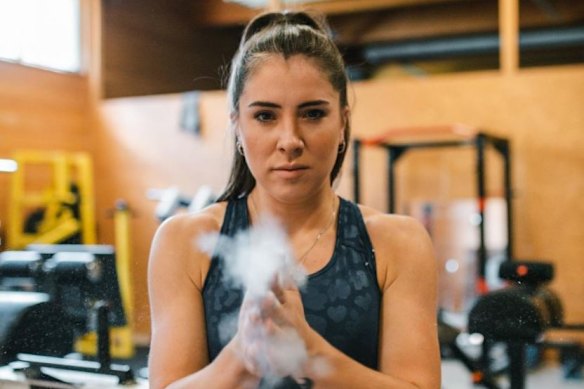
Bree Walker in the gym.Credit: Instagram: @a_sto
Lueders is Walker’s head coach, but he is one of many who have helped her get this far.
“I have physios, I have mentors, sport psychs, dietitian,” Walker says. “It really is a village.”
Her physical coach, Will Morgan, is based in Australia and dictates her running, sprinting and lifting training.
Then there is Lydia Lassila, the aerial skier who won gold for Australia at Vancouver in 2010 and bronze in Sochi in 2014, who has been mentoring Walker. “I like to collect my Olympic champions,” laughs Walker. “If you want to be one, you learn from the best, right?”
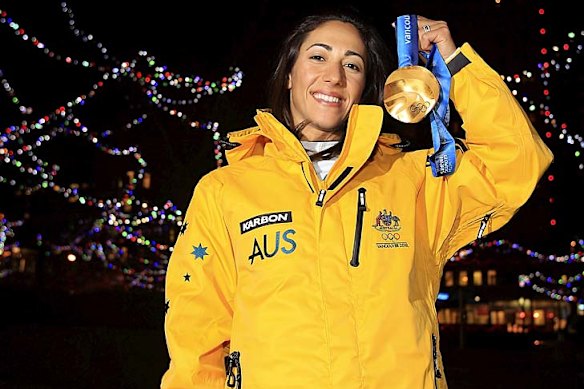
Former Olympic champion in aerial skiing Lydia Lassila.Credit: Getty Images
The final piece to the puzzle was push coach Olaf Hampel. Another Olympic champion, from the Lillehammer 1994 and Nagano 1998 Games, Hampel approached Walker about helping her in this Olympic cycle. Originally, she knocked him back.
“He kept coming back each year, and I admire that because that’s kind of what I did in order to get [Lueders] on board,” Walker says. “He just kept in contact with my head coach and was like, ‘I can see potential in Bree, I really would like to be able to help her reach that’.
“This year, I was like, ‘We have nothing to lose – let’s get this guy on board and see if he can make a difference in my push starts’, and I believe that he has.”
From pre-season to world cup
During the off season and pre-season, Walker’s training regimen includes plenty of work on the running track. There’s plenty of sprinting, but also power lifting and strength training in the gym to build the muscles used at the start of bobsled run.
Walker does her pre-season training in Calgary, Canada, where Lueders is based. Key to the location is the presence of a push track facility, which is critical for sliding athletes.
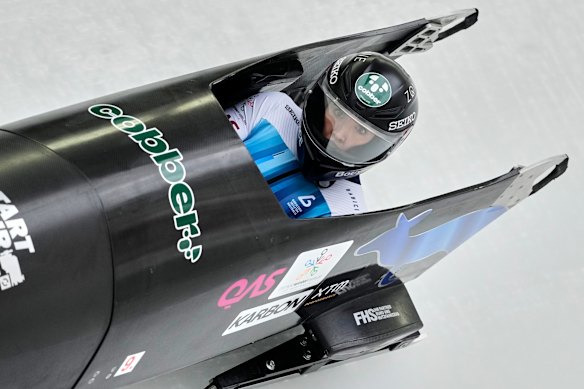
Bree Walker in the monobob at a World Cup event in Austria in November.Credit: AP
A push track is 120 metres in length and simulates the start of a run for sliding athletes in bobsleigh, skeleton and luge. The track starts on a hill with a descent like that on a sliding track, with a ramp back to the top. This allows athletes to practice and refine their push starts before they head to an ice track.
With Hampel overseeing training, the push track practice was even more critical heading into the world cup season.
“This season we’ve made a lot of changes to my technique,” Walker says.
“Normally, you don’t want to switch it come Olympic year, but we felt it was necessary in order to take the next step and really fill a hole that we felt that we had across the last few years.”
How you master a track
Walker’s first world cup event this season was at the Olympic track in Cortina, Italy.
Lueders had the advantage of visiting the track ahead of the world cup season, when they were doing testing for the Olympics.
“The track is very well suited to Bree’s style,” Lueders says. “It’s long, very long, [with] open corners, which will suit her style well because she doesn’t like to drive. She’s not really the most suited with her style of driving for tight radius corners.”
The track in Cortina, which is used for bobsleigh, luge and skeleton, is 1730 metres long with 16 corners.
The corners are the first thing you study on a new track, says Walker. When it comes time to practice, athletes only get about three runs on the track.
“A lot of the practice is actually done off the track, in visualisations, discussions with coaches, viewing video,” Walker says. “And then just being able to self-coach.
“Pierre is only one coach. He can only be in one corner, so I have to tell him what’s going on in the other corners.”
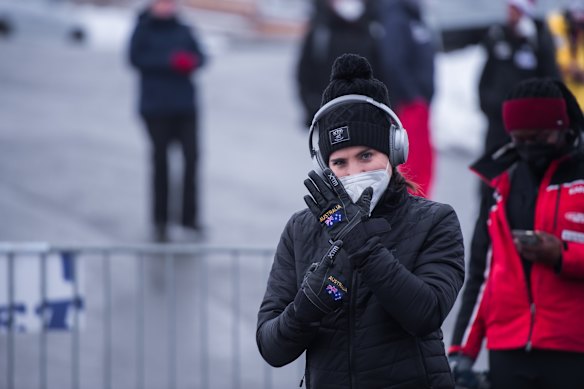
Australian Bree Walker at the 2022 Olympics in Beijing.Credit: Nine
Luckily for Lueders, Walker self-coaches very well.
“Generally, when she gets to the bottom … she has a pretty good idea of what she’s done wrong, and then we can confirm that if I was standing in a particular corner with video – or with no video, we can discuss that,” he says.
The most crucial part: the push
Bobsleigh is broken into three parts: the push start, the drive and the equipment.
In monobob, the sleds are standardised, although the runners – the metal skates under the sled– are customised and expensive. One set of runners can cost about $13,500.
The Cortina track has longer, more open corners, so driving plays less of a part – which means the push start is crucial.
“The push start is very important and it’s definitely going to be very important in Cortina because it’s quite a steep ramp at the beginning,” Walker says. “It’s such an integral part, hence why we do so much training for it throughout the summer.”
The difference between a gold medal and missing the podium can be hundredths of a second – and those are likely to be lost, or gained, at the push.
“If you’re not within one per cent of the best starters, then it makes it very, very difficult to get into the top three,” Lueders says.
“On a track like this one [Cortina], I guess you can call it more of a gliding track, not a high-pressure [track]. I think you’ll definitely have to have the start [perfect], and I think the big thing that we will see there is that you don’t want to be over-driving because once you lose time there, you won’t make it up.”
All of which is why the addition of Hampel has been so important this season. He analyses if Walker is running too far at the start, or not far enough, before she gets into the sled, along with her hand placement and how she accelerates.
The point at which an athlete hops into the sled varies from competitor to competitor.
“If you are a slower athlete, that point might be sooner because you can’t keep up with the sled and if you just keep running, you’re going to be slowing the sled down,” Walker says.
“That’s why having our own push coach there who knows us very well [is crucial.”
You know straight away if you haven’t nailed your start, Lueders says.
“Something that’s improved this summer [with Walker] is she can tell you right away, ‘I wasn’t in the right position here, and I didn’t have my foot in the right position there, and my hip was too high and my head was too low’,” he says.
“So, that’s all self-coaching, is very important as well.”
From the world cup season to Milano Cortina
Walker has had a phenomenal world cup season and heads to Cortina as a genuine podium contender for the monobob on February 15.
Walker finished third in Cortina in the season opener, and has gained momentum since that event in November. She placed first in Lillehammer in mid-December, and then again a week later in Sigulda.
After a slow start in Winterberg to start the new year, she won gold again in St Moritz in January and finished her season with a silver in Altenberg.
Walker knows she is in career-best form and right in the mix to win gold.
“I can confidently say, hand on heart, I’m in the best shape of my life and best headspace of my life, and I’m really excited to go out there and see what it produces,” she says.
Lueders, always honest, agrees. Walker can become Olympic champion in Cortina.
“Definitely, there’s medal potential and beyond,” he says. “Of course, that’s obviously what you’re working for.
“Every athlete and every coach will say they’re gunning for a medal, but that’s not necessarily the case. It is the case with Bree.”
The Winter Olympic Games will be broadcast on the 9Network, 9Now and Stan Sport.
News, results and expert analysis from the weekend of sport sent every Monday. Sign up for our Sport newsletter.
Most Viewed in Sport
Disclaimer : This story is auto aggregated by a computer programme and has not been created or edited by DOWNTHENEWS. Publisher: www.smh.com.au