The AFL is planning to introduce what could be dubbed “the Bailey Smith rule” amid a raft of match review, tribunal, gambling and powers-of-investigation changes ahead of the 2026 season.
New chief operating officer Tom Harley and football operations boss Greg Swann have sent a seven-page memo to clubs, read by this masthead, seeking feedback on guidelines, regulations and rules, with feedback to be given by January 22.
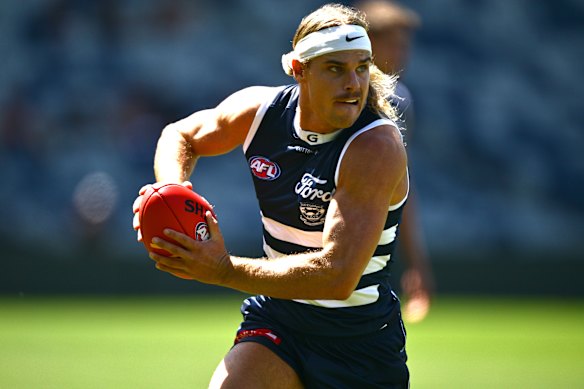
In focus: Bailey Smith courted controversy for wearing a Nike-branded headband during a practice match against Hawthorn.Credit: Getty Images
Smith, the controversial Geelong star, hasn’t been far from the headlines this season and has now inadvertently found himself, although not named, in a refining of league laws. Smith was banned by the AFL from donning his mullet-taming white Nike headband after a practice match against Hawthorn. The league’s ruling in February stated that “headbands worn during a match must be unobtrusive and hair or club colour”.
But in a tightening of the rules, the league plans to state that “headbands cannot feature any sponsor branding, to reflect the position in the AFL commercial operations guidelines and the AFL match day guidelines”.
Meanwhile, in a potential move linked to a controversial three-match suspension handed to North Melbourne’s Paul Curtis in April, the AFL is proposing greater flexibility when it comes to grading concussions. Rather than an incident deemed to be careless and severe automatically resulting in a three-match ban, greater nuance can be shown – if warranted.
“These exceptional incidents typically involve the ‘victim’ player suffering a concussion, but the observable force that caused the concussion is more consistent with a lesser impact grading. Stakeholders have expressed concern that a line-ball assessment could therefore lead to a vastly different outcome of either no charge or a three-match suspension,” the memo said.
“The AFL has considered this feedback and is proposing to introduce a limited degree of flexibility to be exercised by the MRO to ensure that the sanction imposed in these exceptional cases more accurately reflects the nature and circumstances of the incident.”
The level of force will potentially be a major factor which, if more applicable as high or medium impact, could result in a shorter ban.
Curtis was suspended for three matches because of rough conduct on Port Adelaide’s Josh Sinn, the AFL tribunal upholding the ban despite the Kangaroos’ challenge, sparking debate on tackling rules.
Players appear to have had a win when it comes to fines, the league seeking to restrict the “loading” on fixed financial sanctions and low-level offences to within one season, and not over two years, as is the case now.
The AFL has backed its mid-year rule of fines and suspensions for multiple offences of careless contact with an umpire, declaring umpires must have a safe workplace.
The league says there was a 50 per cent drop in charges per round after the rule changes, and has now proposed a fine of up to $50,000 on a club should it have at least four player offences through a season. If a player has been charged four times for illegal contact with an umpire, that player will be suspended for a week.
The AFL also plans to toughen its stance on intentional strikes to the body or head, declaring “the number of intentional strikes committed by players has remained at a consistently high level in recent seasons”.
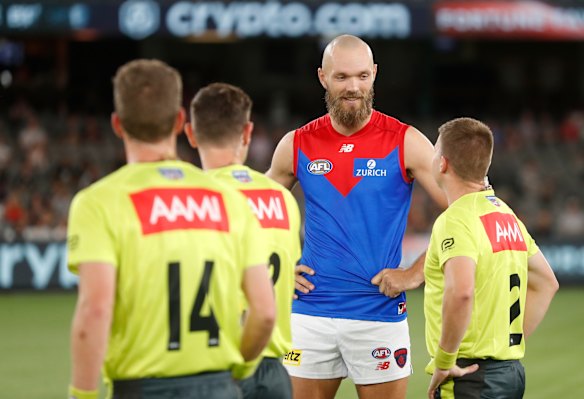
No contact: The AFL continues to toughen its rules on careless contact with umpires.Credit: Getty Images
Where these strikes, which may not have had any major impact, had been graded as intentional conduct, low-impact and body contact, resulting in a fine, the AFL wants to have these now graded as “medium impact at a minimum”, resulting in a one-week ban.
In a year when the reckless pushing in the back of an opponent into oncoming traffic caused injury, the AFL wants the tribunal guidelines to clearly state this as rough conduct. The league also wants tribunal guidelines to consider the potential for further or greater injury in its deliberations of a charged player’s conduct.
There is a planned tightening of the anti-gambling rules, declaring “players, coaches or club officials must not be in a betting group or pooled betting group that places a bet or wager on an Australian Football contingency”.
The memo states that “a player, coach, club or club official must not encourage, induce, advertise or promote betting on any Australian football”.
When it comes to investigating players, coaches or a club, league chiefs propose to clarify the definition of an “associate” of a player or club, and that the club is liable for any breaches by that associate.
The AFL wants its investigation’s manager to be able to interview club officials as part of any enquiries, amend the scope of information that can be requested as part of any audit to include “all payments, consideration, advantages or other benefits received directly or indirectly by a player”, and scrap the need to sign a confidentiality deed with the AFL Players’ Association.
There is a planned amendment to introduce a “Wildcard Finals Round”, including changing the AFL finals to a “final ten system”.
The All-Australian team will now consist of 23 players, while there is even expected change ensuring all sports tape used by players is a neutral, beige colour.
Most Viewed in Sport
Disclaimer : This story is auto aggregated by a computer programme and has not been created or edited by DOWNTHENEWS. Publisher: www.smh.com.au