Behold the Zodiac. No, not the signs of the zodiac, up above in the stars, but the boats built by Zodiac, right here in the water – the wonderful, nimble craft created by the French. The company first made airships, then turned its talents to boats. Zodiac is now to inflatable boats what Doona is to continental quilts. It’s as capable as it is comfortable, with your bum bouncing nicely along on the air-filled rubber pontoons. Want to poke around among the mangroves at high tide? Want to get a spray from a Kimberley waterfall? The Zodiac will get you there. Want enough clearance to stay clear of the crocs? The Zodiac has it.
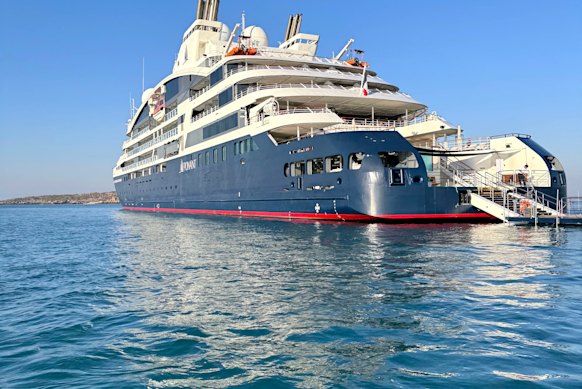
Appropriate, then, that we’re aboard a French ship, Ponant’s luxurious Le Jacques Cartier, which carries a fleet of Zodiacs on its top deck to be lowered to the water by crane and boarded, first by a driver who doubles as an expedition guide, and next by a payload of passengers bent on some exploring.
Of course, with its formal and casual restaurants, its bars, lounges and restaurants and its luxurious cabins, all with 24/7 room service and balconies to watch the world go by, you could be forgiven for never leaving the ship. But where to go if you do? Here in the Kimberley, there are endless natural and native wonders to satisfy your curiosity.
The waterfalls
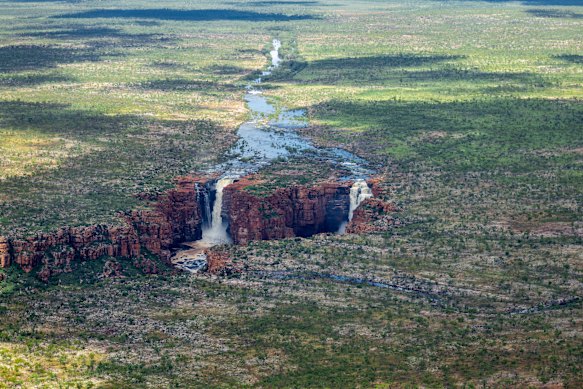
First stop out of Darwin, and we’re into the Zodiacs and cruising up the King George River, flanked on either side by huge cliffs of Kimberley rock in all shades of rust red from the iron they contain. It forms in layers like a massive mille-feuille, although where that’s fresh on board at the ship’s dessert station, this rock is more than a billion years old.
Sign up for the Traveller Deals newsletter
Get exclusive travel deals delivered straight to your inbox. Sign up now.
At the end of the upriver ride there are twin falls – according to legend, they were made by the Rainbow Serpent, one of the falls male, the other female. We’re here towards the end of the dry season, so the falls have slowed but are no less admirable for the water tumbling down the cliff face. Nearby, our hosts have tied up in a small cove and set up a champagne bar on the crew’s Zodiac – another French application for the craft.
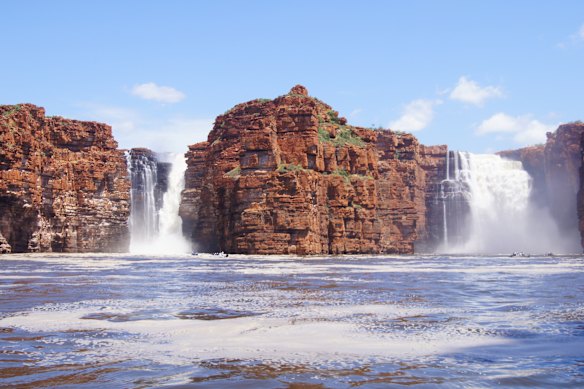
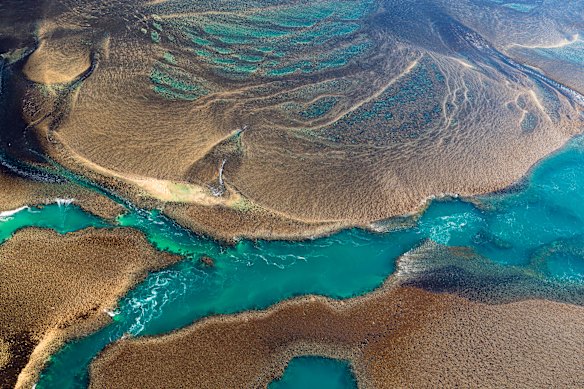
Where the King George Falls have water tumbling from inland rivers, at the vast Montgomery Reef – the world’s largest inshore reef – the huge falling tides create cascades of water, tumbling into the lagoon we’re watching it from.
The reef seems like the shell of a giant turtle (at 400 square kilometres, that’s quite a turtle) and in the clear water all around are its offspring, green sea turtles that bob up every now and again, spy us in the Zodiacs and dive for their lives, flippers and a little stub of a tail following them down.
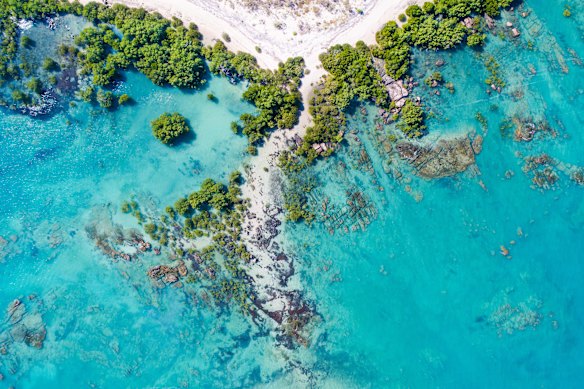
Maybe the most memorable waterfall is the humblest. After lunch (seafood paella from the chef’s station on the pool deck), we’re back in the Zodiacs for a short ride to Langgi, and it’s like cruising through a garden. The tide is high, and the mangroves are half in, half out of the clear water, fish darting here and there below.
We poke the boat into a small inlet to see a freshwater waterfall flowing down over rocks and into the inlet. Easy to imagine life here – fresh water on hand, and food plentiful, with kangaroos and wallabies on the shore and fish from the sea.
That’s how it is for Neil Maru, who meets us on the beach, burning some gum leaves for the smoke to cleanse us both on the way in and the way out. Neil is part of Wijingarra Kimberley Tours, and camps here with his family occasionally, where they still find the food plentiful.
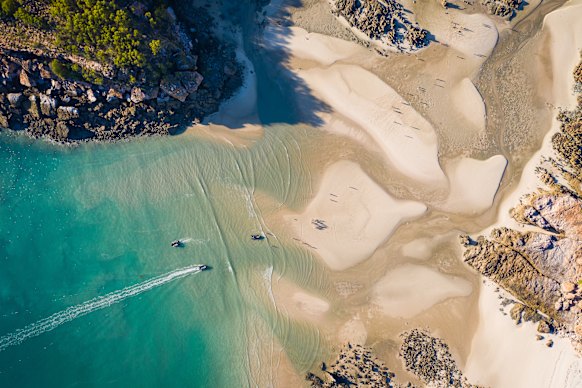
Our final falls come with controversy – driven by the tides and the narrow gap that the water is forced to rush through, Horizontal Falls, in Talbot Bay, has become a major tourist attraction. This is also an important part of the creation story of the Dambimangari, whose country it is.
Their belief is that the falls were made by the Rainbow Serpent as it moved around, creating the waterways and the land alongside. The rushing tide is the snake itself. For the power of the water and the significance of the location, the area commands respect.
We first reach the falls on a falling tide and motor across whirlpools and head into the current, holding our position against the rushing water, our 70 horsepower motor revving. We back off and a tourist boat with three motors to our one goes through the gap. They have a permit to do this, but it will soon expire and won’t be renewed.
The art
The ship anchors in Vansittart Bay and a short ride in the Zodiac brings us to the beach. But we’re not the first here. From the 1700s, Macassans sailed here to harvest sea cucumbers to sell in Asia. For ballast on the way down, they’d use earthenware pots – or jars – and discard them on the beach. Hence the name Jar Island, where we are now walking.
But they, too, were not the first here by any stretch. Before the island was even an island, when it was joined to the continent 12,000, maybe 17,000 years ago, artists were at work on the sheltered rock faces here.
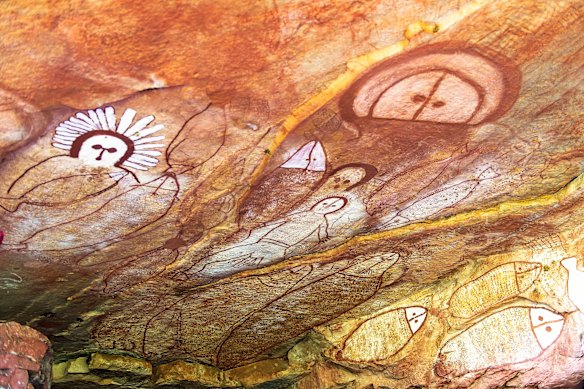
The art known as Gwion Gwion is there in front of us – faded but still clear and recognisable figures, some with tassels, head dresses and boomerangs. Some seemingly ceremonial, some poised for action.
“They didn’t write contracts, this is how they expressed their law and their lore,” says Bec, our guide. “These are possibly 17,000 years old – think that the relics of Ancient Egypt are 5000 years old. It gives me the shivers.”
A few days later, we contrast lunch on the ship’s pool deck – fresh pasta served from a huge cheese wheel and a buffet of fresh salads – with another art tour, this time at Swift Bay, where the main image is of the Wandjina Spirit, the creator of all things. These are maybe 6000 years old, and flanking Wandjina are birds, a family and some animals – lunch, maybe, for those that came before.
Crocs, rocks and birds
Not long into the cruise we point towards Ashmore Reef, 300 kilometres off the Kimberley Coast and closer to Indonesia than Australia. There’s a dark and imposing Australian Border Force patrol boat moored near the reef, positioned, they say, to deal with illegal fishers, but also, you’d suspect, illegal arrivals.
“You see that Border Force boat out there?” asks our Zodiac guide, Jacky Yu, who doubles as a marine scientist. “That’s your Australian taxes at work. They apprehend illegal fishers and sometimes destroy their boats. They are protecting Ashmore Reef.”
Speak to bird lovers and their eyes light up at the mention of Ashmore Reef. Little wonder – it’s only about a kilometre long and less than that in width, yet it hosts huge breeding colonies and supports about 100,000 birds.
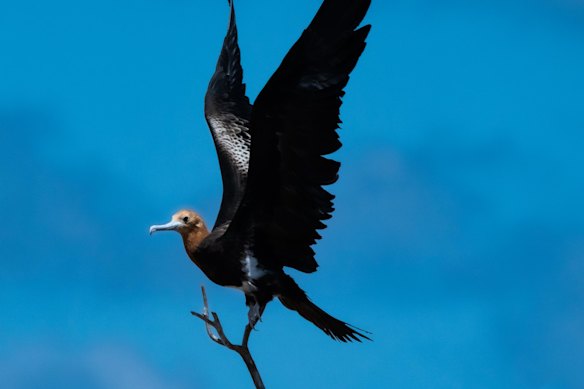
As we approach the reef, our first birds are brown boobies, curious and close. They were named by sailors centuries ago for their clown-like looks and the fact that they have no fear of humans, making them easy targets. Then a lesser frigate bird comes to see what we might bring – they’re a kleptoparasite, a cunning creature that lets others do the work in catching or collecting food and then steals it. Not sure how they’re regarded in the colonies.
Later in the cruise, we anchor off the Lacepedes, four low-lying islands with sandy shores, some rocky points and a fringe of vegetation above the sand. It’s a sparkling clear day, seas calm and the Zodiac zipping along. Here we see green and flatback turtles below and masses of brown boobies above.
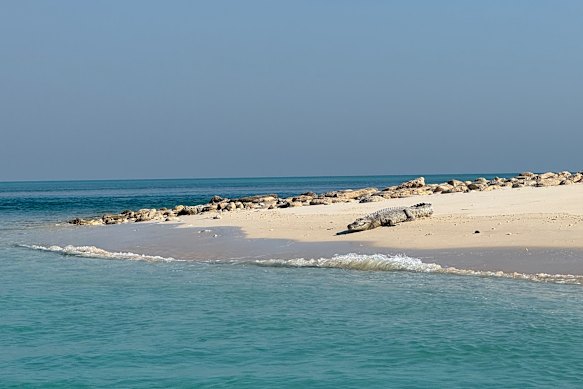
And there, around the point, is a 3.5 metre saltwater crocodile, on the sand and as still as a statue, looking every bit like it has swallowed a shark and is digesting it in its own good time.
Back on board and towards the end of the cruise we have the captain’s farewell cocktails and gala dinner. This is a meet and greet, not just with our captain, Sylvain Lenormand, but the entire ship’s crew – the deckhands who help us in and out of the Zodiacs, the expedition guides who show us the way and give their expert talks onboard, the housekeepers, the bar staff, the engineers, the wait staff and the chefs.
The captain thanks us for our smiles and wishes us “fair winds and following seas”. I’ll take that, but I’d also like one of his Zodiacs.
THE DETAILS
CRUISE
Ponant sails the Kimberley Coast from May to September, either from Broome to Darwin or Darwin to Broome. A 10-night Kimberley expedition cruise aboard Le Jacques Cartier from Darwin to Broome in June 2026 costs from $15,430 a person. Included are Zodiac expeditions, guided shore excursions, entertainment and expert presentations, all meals and drinks, unlimited onboard Wi-Fi, return domestic flights, transfers and one-night accommodation before or after the cruise. See au.ponant.com
WHEN TO GO
The season runs from May to September. Go early and there’ll be more water flooding off the coast on the tail of the wet season. Go later and the days will be getting longer, but there’ll be less water falling from the cliffs. Anytime is a good time to see this extraordinary coast. See westernaustralia.com
The writer was a guest of Ponant.
Disclaimer : This story is auto aggregated by a computer programme and has not been created or edited by DOWNTHENEWS. Publisher: www.smh.com.au