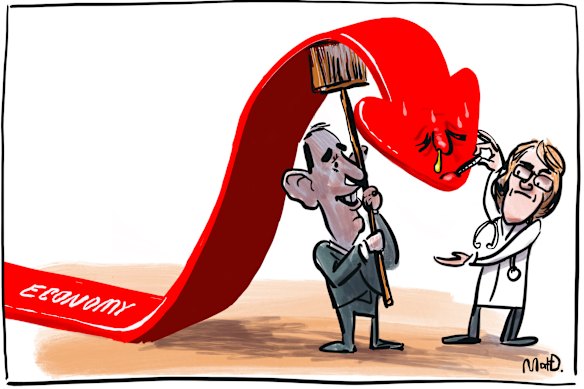

Don’t be fooled by the latest numbers. The economy might be recovering but it’s still got some bad symptoms.
Treasurer Jim Chalmers insisted on ABC radio on Thursday morning that the latest snapshot of the Australian economy showed a set of “outstanding” outcomes.
But anyone who has been sick or injured knows that kind of exuberance can land you, quite quickly, back in bed rest.
The “national accounts” – a set of data which is gathered and shared every three months by the Australian Bureau of Statistics – gives us one of the best pictures of how our economy has been tracking.
The latest release, which looks at the three months to December last year, tells us things are getting better in some ways, but that there’s still some weakness and possibly a fever.
Australia’s gross domestic product (GDP) growth is a rough measure of how much more (or less) we’re producing, earning and spending — and generally the go-to indicator for how our economy is performing.
In the December quarter, the country’s GDP grew 0.8 per cent, taking growth of the year to 2.6 per cent. That’s a bit stronger than the 2.3 per cent the Reserve Bank was forecasting, although the difference largely comes down to some revisions our statisticians made to growth in previous quarters (sometimes they tweak previously reported figures because they’ve got access to fuller data or have improved how they measure things).
It’s the strongest yearly reading in nearly three years — and shows the economy might finally be starting to find its feet after several years of anaemic growth.
Even GDP per person, which is generally a better gauge of changes in living standards because it strips out the effect of population growth, came in stronger than it has for some time at 0.9 per cent over the year.
But look a bit more closely and it’s clear there are still parts of the economy that haven’t yet regained all their strength.
The household sector is, by far, the biggest chunk of our economy. Comprised of all of us, it’s like the heart of the economy — without households, there simply wouldn’t be anything happening because no one would be buying things and pumping huge amounts of cash through the economy.
Fortunately, the heart is still beating: households are still buying things, spending 0.3 per cent more in the December quarter than in the previous three months. Some of this spending was on essentials such as health during what turned out to be an extended flu season.
But there was also a bit more spending on less essential (arguably more fun) things: tourism, cafes and restaurants, and recreation and culture. Black Friday sales helped drive some of the ramp-up in spending, but live gigs such as AC/DC and Oasis, and the Ashes, also coaxed people to splash more cash.
That must mean households are feeling pretty good, right? Well, not exactly. The household saving ratio – the amount of income (after tax) that people are saving – climbed to 6.9 per cent: the highest it has been in more than three years.
When people are saving a bigger proportion of their income, that usually means they’re a bit worried about their finances or what might happen in the future, and therefore want to squirrel away more to build a safety buffer.
The other big contributor to GDP growth was government spending, which rose 0.9 per cent and added 0.2 percentage points to overall growth. While Shadow Treasurer Tim Wilson’s claim that prices are rising because Chalmers “keeps pouring debt petrol on his inflation fire” is overkill, it’s true that government spending — at state and federal levels — is still pushing the economy along faster than what many economists reckon is the “speed limit”.
The Reserve Bank, for example, has often said in recent times that the economy is “running hot”. But if economic growth has been crawling along, how is it possible that the economy is also “running hot”?
Well, the economy’s growth has been quite slow: even the latest annual growth of 2.6 per cent is not that high by historical standards. The problem is that productivity growth – which allows us to make and do more with our limited resources — has been remarkably stagnant.
That means that when we do grow, for example because we’re demanding more things, we’re putting more pressure on the limited number of workers, machines and materials we have to use.
As you know, when demand outstrips supply, and we’re not becoming better at getting more out of our resources, that pushes up prices: from costs such as wages and building materials to the final prices we pay for our goods and services.
The problem is that while economic growth hasn’t been very strong, our ability to meet our growing demands hasn’t improved much either, keeping prices growing faster than we would like.
If the Reserve Bank was a doctor, it would probably say the Australian economy is still a bit sick with sluggish movement and a bit of a fever.
The federal government isn’t going crazy with its spending, and Chalmers has been under pressure from the business press to rein it in by the time the federal budget lands in July.
But spending by state and local governments in particular has grown to fund hospitals, schools and police as well as electricity rebates in states such as NSW and WA. Social benefits from major programs including Medicare and the National Disability Insurance Scheme have also continued to climb along with spending on defence.
Neither household demand nor government spending are out of control, but especially taken together, they are putting the economy through its paces.
With inflation still above the Reserve Bank’s target band of 2 to 3 per cent, the latest figures will probably have governor Michele Bullock and her board on edge. One of their worst fears is having people’s expectations for inflation become stuck at a high level. Why? Because when people believe prices will continue rising, they act accordingly, pushing forward purchases and ultimately contributing to higher prices.
The problem with having the Reserve Bank as a doctor is that they only have one official type of medicine they can dispense. By raising interest rates, they can slow the economy down. That, of course, helps to dampen inflation, but also hamstrings growth.
The bank, over the past week, has been dispensing its other, less well-known medicine, too: some tough love, spelling out how many people might need to lose their jobs if they’re to crack down on inflation, and making sure everyone knows how seriously they are taking the inflation problem. That, it hopes, will scare people into reining in their spending a bit.
Neither the government nor the Reserve Bank are necessarily wrong in their approach. Government spending is essential for making sure our essential services are properly funded. And the Reserve Bank is far more concerned about persistent price rises than the possibility of more people than necessary losing their jobs because the economy, at least when looking at the big picture, seems to be growing at a decent clip and unemployment remains near historical lows.
Things are looking better for the economy than they have for a while, especially when it comes to growth. But too much of anything — whether it’s tightening interest rates or loosening public purse strings — could worsen some of the symptoms we’re seeing.
The Business Briefing newsletter delivers major stories, exclusive coverage and expert opinion. Sign up to get it every weekday morning.
 Millie Muroi is the economics writer at The Sydney Morning Herald and The Age. She was formerly an economics correspondent based in Canberra’s Press Gallery and the banking writer based in Sydney.Connect via X or email.
From our partners
Disclaimer : This story is auto aggregated by a computer programme and has not been created or edited by DOWNTHENEWS. Publisher: www.smh.com.au