Throughout year 12, North Sydney Girls students wrote thousands of pages of assignments and exams. But their success in HSC English this year lay in just five letters: IQTVE.
The public selective school’s deputy principal, and HSC English marker, Jane Stocks said the cohort’s perfect-scoring essays shared a common structure: “idea, quote, technique, verb and evaluate”.
She believes this formula – known as “IQTVE” – is the reason North Sydney Girls recorded their best result for English advanced and extension in a decade, with top band results in 72.4 per cent of their attempts at these subjects, more than twice their 2016 success rate.
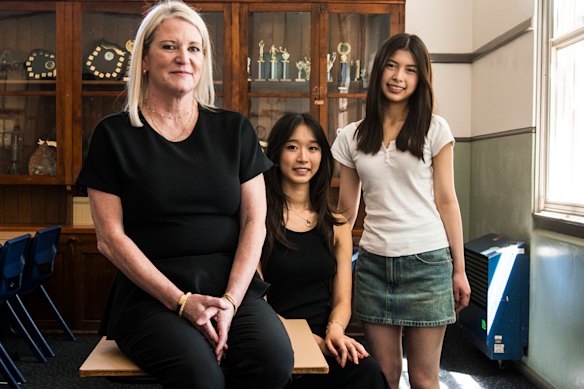
North Sydney Girls High deputy principal and English teacher Jane Stocks with top students Emily Phi (centre) and Valery Lin, who co-topped the state in advanced English.Credit: Andrew Quilty
While North Sydney Boys may have reclaimed the top spot in HSC English from eastern suburbs private girls school Kambala this year, North Sydney Girls recorded the most dramatic jump up the rankings, moving from 33rd in 2024 to second when results were announced on Thursday.
The school has been using IQTVE for three years, and implements the structure from year 7.
Stocks first trialled the technique in 2019, when she was a teacher at North Sydney Boys. The growth was “phenomenal”, she said. The strategy has also spread to Normanhurst Boys, and she is teaching the technique to opportunity class primary school educators.
She said the IQTVE approach helps students get their ideas on the page, and students can vary the order, provided all the elements are covered.
“It’s a way of structuring your sentences and having the ideas and concepts at the beginning. The reason that I found it to be so successful is it is not limiting,” she said.
The most important part of the technique is the “V” – the verb. Stocks said it is what makes the difference between a band 5 and band 6, and gives students an authorial purpose.
“When you’re looking for a really quality piece of writing, particularly in English, you’re looking for evaluation … And what the verb does is it forces the students to then actually have to do something with the information because otherwise they can just become quite recount or descriptive,” she said.
Among non-selective public schools, Killarney Heights recorded the best HSC English results, however Ashfield Boys showed significant improvement, with its rank soaring from 14th place among public comprehensives to second this year.
Kambala was the best independent school for English for the fifth year in a row, followed by Illawarra Grammar, which leapt from 14th to second.
At Parramatta Marist College, which this year ranked first among Catholic schools, ninth among non-government schools and 15th overall for its English results, there is no magic bullet to success, rather a series of small changes, English teacher Dean Jacobson said.
The all-boys school had struggled to attract students to English advanced, but has seen steady growth. Their success rate in English has climbed from 28.2 per cent in 2021 to 45.3 per cent this year.
“As boys, they like structure, and they like routine, and they like seeing a right answer and a wrong answer. Whereas, in English, it’s a little bit more open-ended, so it’s a very different way of thinking, reasoning and expressing themselves,” said Jacobson.
When he started at the school three years ago, Jacobson focused on providing students with a structure to form their writing to build confidence.
“Once they know what a good piece of writing looks like, according to the structure, that real success comes from [students thinking] ‘How can I put my own spin on it? How can I take this structure and do something unique with it? How do I inject my personality into my writing so it becomes a little bit more of my own?’”
Jacobson said, each year, the school has found one thing it can do improve 1 per cent. This year, that was encouraging reading and comprehension.
“If you put in time every single day, thinking, reading, engaging with texts, expressing possibilities, then that creative muscle in the brain starts to work, and then it becomes easier over time,” he said.
“I think that one of the biggest challenges that we’ve faced is that kids these days simply aren’t reading. We’ve tried many different things to encourage reading and promote reading, but the fact is that these kids just don’t want to do it.”
The school even shows them TikTok videos of authors reading snippets of their text.
“Over time, what we’ve seen is this osmosis has allowed them to be a little bit more confident in expressing [their critical analysis],” Jacobson said.
Read more of our HSC coverage
Start the day with a summary of the day’s most important and interesting stories, analysis and insights. Sign up for our Morning Edition newsletter.
Most Viewed in National
Disclaimer : This story is auto aggregated by a computer programme and has not been created or edited by DOWNTHENEWS. Publisher: www.smh.com.au