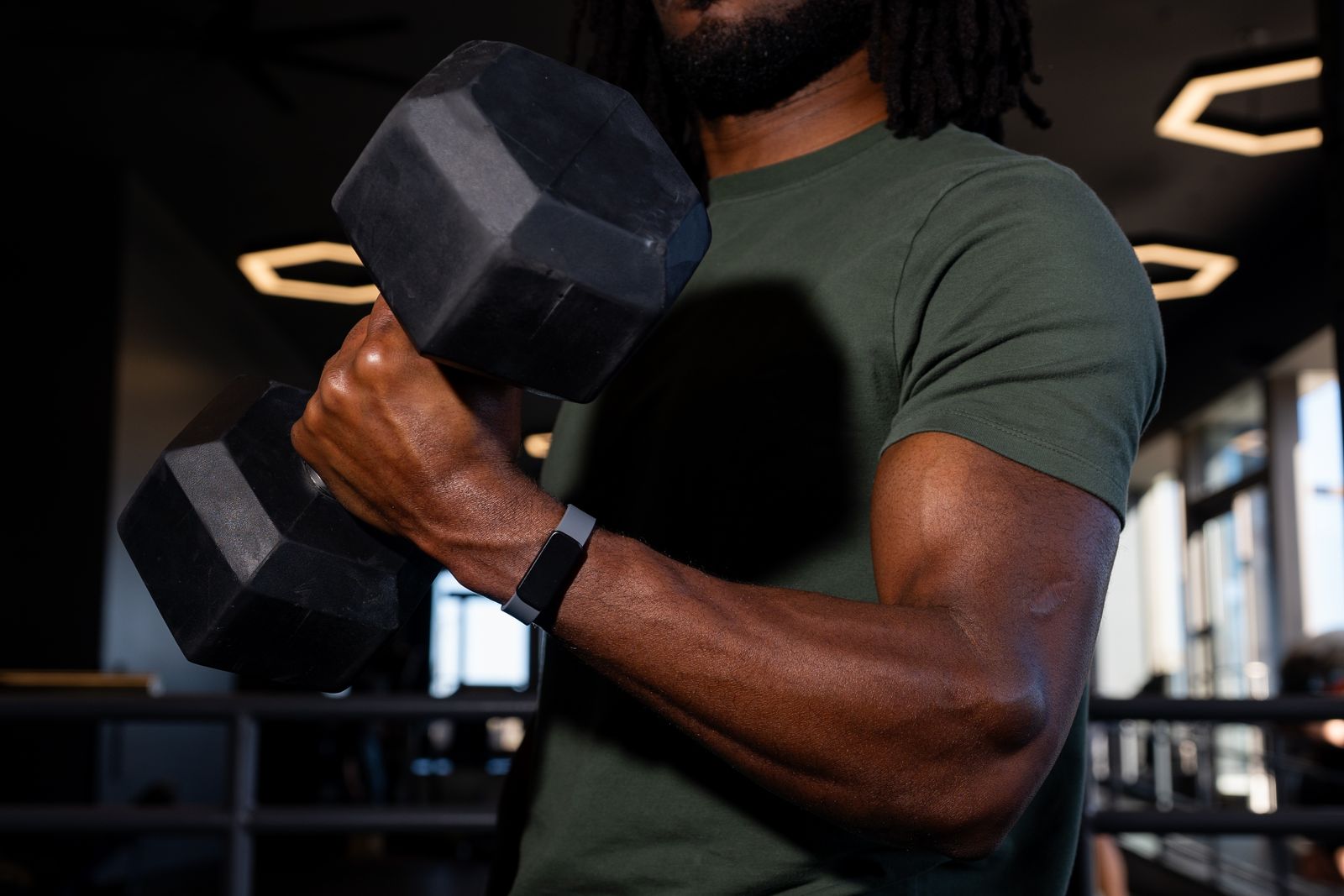
Strength training is the new cardio. In the 1990s, everyone sweated in spin classes; in the 2000s, James Park at Fitbit turned us all into step-counting Tamagotchis. Now we’re all weight lifters. In its year-in-review data, Garmin reported that this is the fourth year in a row in which strength training has increased more than 20 percent (the majority of those users were women). Oura also reported that the number of male users who tagged strength training workouts has doubled.
So it’s annoying that logging your leg presses is still so fiddly. Half the time I start a workout on a fitness tracker, I trigger the start of the workout and then have to poke at my watch face to type in all the little reps and weights. Or my fitness tracker doesn’t auto-track any activity at all, because my heart rate never went over 100 beats per minute. While Garmin and Amazfit now purport to offer strength training with auto-recognition, I’ve found them to be pretty inaccurate unless I’m using the company’s own proprietary workouts.
Now there’s the Fort. This slim wearable is the first of its kind that purports to offer hands-free weight-lifting tracking, along with full strength-training analytics and sleep, stress, and step tracking. Today, Fort launches with its final production hardware and system. It is available for preorder for $289 (the first year of the $80 subscription is included). It will ship later this year.
Speed Up
Fort was started by Miranda Nover, Zac Valles, and Paul Schneider in January 2025. The three met while working at Tesla—Nover, a mechanical design engineer; Schneider, in sensor systems for the autonomous Semi; and Valles, on the body and powertrain systems for the Cybertruck. Don’t worry, none of them worked on the doors. They eventually bonded over a shared love of sweating at the gym.
You might not agree with everything that Tesla’s CEO has said or done, but there’s no disputing the company’s pedigree when it comes to attractive hardware. The Fort looks like a bracelet, weighs less than 30 grams (so, about the same as a Whoop MG), is waterproof, and has a decent battery life of around a week. The body of the unit is made from aluminum, and it will have a quick-release strap made from silicone, sport weave, and leather. The app will be compatible with iOS and Android.
While the sensors the Fort packs are common—a body temperature sensor, an optical photoplethysmography (PPG sensor), an accelerometer, a gyroscope, a magnetometer—the Fort’s proprietary tech is not.
In order to understand why the Fort is so innovative, you should be familiar with the concept of velocity-based training. A barbell velocity tracker measures how hard and fast you lift a weight and reports metrics like how tired you are, your range of motion, or what your max weight might be. There are a lot of smartphone apps that do this by aiming your phone camera at the weights while you lift (no, not all weight lifters are making TikToks) or you might use an app like Motra for the Apple Watch. The traditional method is to attach the tracker to the bar itself, but carrying that around a gym is even more annoying than typing numbers in a watch.
Assuming it works, the Fort would be the most attractive and easy-to-use velocity tracker on the market by far. “We use the IMU sensors to detect which exercise the user is performing and identify the period engaging in concentric, eccentric, or isometric hold,” says Nover, demonstrating as best she can within the confines of a Zoom screen. (These are the three main types of lifting exercises; you might know them as contracting, lengthening, or static exercises.)
The Fort uses the wrist as a proxy for bar velocity. Common sense would suggest this might not produce accurate results—after all, your wrists move at different speeds and angles than the barbell does—but Nover assured me that the company is seeking FDA clearance and will also be pursuing large, third-party studies from independent labs.
You can also detach the Fort from its strap and put it in its included magnetic case, which has its own IMU sensor. You then stick that sensor on the barbell or other equipment to use as a more traditional velocity tracker.
It’s for Everyone
When it ships, the Fort will evaluate a wide range of strength-training metrics that include not only auto-tracking reps and exercises and velocity, but also per-volume muscle breakdowns, proximity to failure, and time under tension. It will also check heart rate zones, your VO2 max, sleep stages, recovery scoring, overnight heart rate variability (HRV), and real-time stress detection.
In the meantime, the Fort has beta testers manually inputting activities. Nover told me that the company aims to create the largest clean data set on the market. It will ship with around 50 popular weight-lifting exercises auto-recognized, like barbell squats and pull-ups, and also include a number of variations.
After you purchase the hardware, the subscription costs $80 per year. This is much more in line with the yearly subscription costs for other fitness trackers and much more reasonable than a Whoop subscription, which starts at $199 a year and includes the price of the hardware.
As a woman who lifts, it’s hard not to see the Fort’s appeal. It’s so easy to get in 10,000 steps just by getting on a walking pad or walking around the block—it would be so motivating for a lot of people to be able to see that 15 pushups or glute bridges before bed are adding measurably to their fitness.
Also, the Fort is just pretty. “You don’t have to be this gym bro archetype,” to lift, says Nover, who is also not a bro. Strength training benefits almost everyone, especially women. It lowers your blood sugar; it can keep you mobile as you age. But also, if you are a bro and just want a very wearable tracker that will go with your duffel bag and protein powder, this one looks like it will work for you too.
Disclaimer : This story is auto aggregated by a computer programme and has not been created or edited by DOWNTHENEWS. Publisher: wired.com