When Melissa Auf der Maur was 19, a terrifying demon gave her the title of her future memoir. “Even the good girls will cry,” the lank-haired beast hissed as it pressed her to her bed in her Montreal home. As she would write in her book of that title in 2026, she understood her calling. “To believe in the unseen.”
Yes, OK. In the golden light of this early spring evening in upstate New York, the 54-year-old mother and grateful grunge survivor knows that others may be less believing. But her conviction that she had been visited by “the spirit of romantic, dark, mystical, dangerous music” is unshakeable.
In any event, this and other nocturnal visions – one dream of communal ecstasy predicted music entering the blood to unite humanity – were effectively self-fulfilling. At 22, much against her rational judgment, the good Canadian girl followed her cosmic inner voices into the baddest band in the USA. Hole.
“Chaos incarnate,” is how she describes her sudden entry into the spiralling storm system that was Courtney Love: heroin addict, single mother, grieving widow to generational icon Kurt Cobain and, by virtue of all this, one of the most reviled women on the planet.
“My camera and my diary and me were just sort of capturing right there in the dressing room with the pain and the drugs and the crying little girl … like, who’s going to be her father? How is this going to work?” she recalls of her trial by fire at the 1994 Reading Festival.
“I was so siloed in the absolute devastation and outrageous existence of these fragile, powerful people that I did not perceive anything. It was the ultimate, in-the-moment being, which is why I was documenting obsessively, because I had no clue. Like, I’m not going to be able to figure this out for 25 years. I have to pack it away.”
What the bassist-photographer and formerly silent witness unpacks in Even the Good Girls Will Cry is not just a decade of rock mythology but a warning. From scary teen premonitions to “the rise of the digital soul-sucking monster” that is the modern world, her book reads like an epitaph for the last great wave of creative freedom.
“The ’90s was the last moment where we believed it was getting better,” she says. “Our generation – these particularly visceral, music-sensitive beings – experienced the very painful birth canal of the 21st century.” Her hands move to encircle not just the Love-Cobains and dead and ruined members of Hole but her mentor Billy Corgan, former lover Dave Grohl and bit-players in her story, such as Marilyn Manson and Trent Reznor.
“We had simultaneous mourning for what we loved and what we were losing, and a terror: a warning that this was going to end up badly. We were all going to be bought and consumed by these tentacles watching to suck us up. We were the last gasp of a counterculture [pleading], ‘Please, please, please don’t steal our souls! Don’t stop us from being free-willed, freaky, wild beings!’”
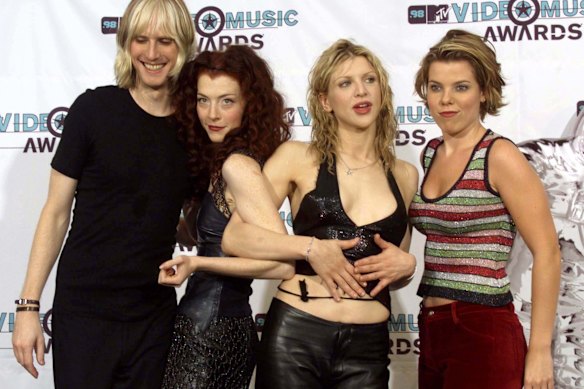
Freaky-wild was very much the young artist’s default, growing up between a “dreamy frontline feminist” mother and “beatnik poet” father in Montreal. They were civic-minded journalists and intellectuals who, though mostly estranged, were hugely influential on their cosmic-hippie progeny’s worldview.
Auf der Maur’s book describes the thrill of the dawning alt-rock era in Montreal, where a visit from Corgan’s fledgling band, Smashing Pumpkins, inflamed her sense of the liberating power of creative community. But as a healthy, happy and loved child of Canada, she would bring a clear-eyed perspective to America’s grunge revolution, its horribly damaged players, and what it all meant.
“The people who struck the chord in the youth of that moment were tortured people. And this is the question: What was our generation’s pain?” she asks, still aghast. “Mental instability, drug addiction, neglectful families, absent parents … What a horror!”
Thank Satan for rock’n’roll. “Courtney, for example, could have just died at home on drugs, or she could be out on the stage trying to get through the whole hell of it.” As shocking and repulsive as her on-the-road behaviour could be, Auf der Maur’s admiration for the rock widow’s strength and resilience is key to her book.
“There were very clear things I needed to keep a constant arc on, and one of them was the reframing of Courtney’s nobility, and her actual, obvious brilliance,” she says. “Nobody with half a mind can deny her power and talent. To this day, no other woman can literally throw themselves into a crowd like that, with that level of hate and scrutiny and knowing that people actually wanted her dead.

“That power,” she says. “That’s what I saw, and I still see in this woman who I am closer to now than I’ve ever been.” Many years of silence followed her 1999 departure from Hole, but Auf der Maur recently sang on Love’s forthcoming album. “I needed space to heal; she needed to be a destroyed drug addict and go into mourning and disappearance. The real reward now is that she is not dead. I witnessed her survival.”
She’s less effusive about another, more visible survivor who happens to be Love’s nemesis. Auf der Maur split with former Nirvana drummer Dave Grohl just as his new band Foo Fighters was ascending, “playing the game of power” that the corporate rock monster requires.
TAKE 7: THE ANSWERS ACCORDING TO MELISSA AUF DER MAUR
- Worst habit? Avoiding being human.
- Greatest fear? Not death.
- The line that has stayed with you? ”No man is going to define who I am” – my mother, Linda Gaboriau.
- Biggest regret? I don’t believe in mistakes or accidents.
- Favourite book? The Heart is a Lonely Hunter by Carson McCullers.
- The artwork or song you wish was yours? The entire body of work by the British-Mexican surrealist painter and novelist Leonora Carrington.
- If you could time travel, where would you choose to go? Well, I am a woman who has time travelled. I have most certainly had some of my greatest past lives in 1880s Vienna. We all have access to all of it, whether it’s through literature or art or dreams or just closing our eyes.
“I was in love with Dave,” she says. “I was someone who cared about his soul. I didn’t care about his success. When I broke up with him, I had fear for him because I could see the ambition. I don’t necessarily think that Dave is well balanced. I think that he’s a nice person who has, due to fame and all of the things that drive people to it, probably lost his way quite a few times. It’s a vicious circle and I think he’s a victim of it. I think he paid a price.”
Auf der Maur joined Corgan, her “fairy godmother”, to play bass on Smashing Pumpkins’ world tour in 2000. She released a solo album in 2004 and another in 2010, though her book doesn’t dwell on either.
“I needed to feel the power of music uncorrupted, and feel my own desires addressed and my own inspiration, not being part of a band of very dysfunctional families. So being a solo artist was a way for me to elevate myself musically and find great joy in being in the studio with collaborators.”
She left music entirely 15 years ago, “because motherhood”, she says. “You know, if I’m going to really live the maximum earthly life and I have the opportunity to carry a child, and motherhood is the biggest magic creation vessel … I just knew that I wanted to transform in this lifetime.”
With her filmmaker husband Tony Stone, she now operates a multidisciplinary arts and performance venue, Basilica Hudson in New York. As she coos in the sinking sun to her Siberian forest tree cats Bella Chai and Babushka Bubbles, all seems blissful in her world. But on behalf of her 14-year-old daughter, she can still summon a mighty punk rock rage.
“I’m pissed! I mean, I love life. I love the planet Earth. I love my cats. I love humans. I love music. I am not satisfied with what has happened. The capitalist system has consumed and destroyed and controls our minutes and our love and the way our children experience each other; the way our children experience music.
“I’m very upset. We knew that this was happening. I really think that we were warning everybody. And I feel sad that we weren’t able to stop it.”
Even The Good Girls Will Cry is out now through Allen & Unwin.
The Booklist is a weekly newsletter for book lovers from Jason Steger. Get it delivered every Friday.
Disclaimer : This story is auto aggregated by a computer programme and has not been created or edited by DOWNTHENEWS. Publisher: www.smh.com.au