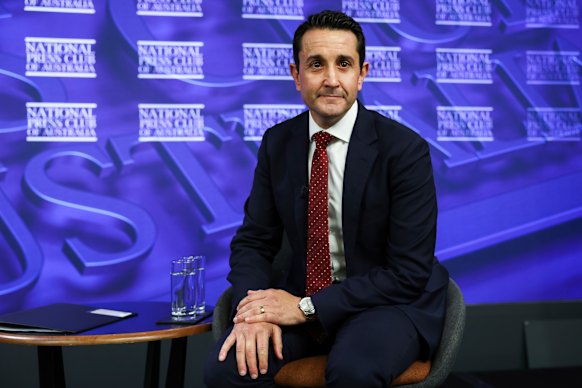
If the Queensland government wanted to, it could have changed electoral laws to its benefit and given voters the option to number just one box at last year’s byelection in Townsville.
“It would have been 100 per cent in our political interest to have done it … noone can deny that,” Premier David Crisafulli told journalists at a media conference on Brisbane’s south this month.
The government didn’t. Crisafulli said he believed this term of MPs were elected by requiring voters number every box on ballot papers, and should be replaced in the same way.
But come the next state election, this will no longer be the case. Crisafulli was elected promising to return state polls to optional preferential voting – and reaffirmed the commitment that day.
This vow, and the shifting political landscape around it, have prompted taunts from Labor and ascendent One Nation leader Pauline Hanson that it would now hurt rather than help the LNP.
While still more than two-and-half years away from the next state election in October 2028 – and the government yet to bring forward a change to the laws – many experts seem to agree.
“If you think optional preferential voting is going to help the LNP, your information is out of date,” election analyst Ben Raue told this masthead.
The debate over how many ballot paper boxes to allow, or require, voters to number is a long-running one, and often tied to how it benefits governments of the day.
This is particularly so in the Sunshine State, which Queensland University of Technology adjunct associate professor John Mickel – a former Labor parliamentary speaker – says has seen the most.
Its latest iteration emerged as a flashpoint in the 2024 election. Then, Crisafulli described requiring voters to number all boxes as “undemocratic” and “rigged” against the LNP.
In response, then-premier Steven Miles – whose Labor government had made the most recent change to that system – accused Crisafulli of wanting to “corrupt our electoral system”.
At the time, University of Queensland professor Graeme Orr, whose expertise covers political and election laws, said both major parties were hypocritical.
The conservative side preferred compulsory preferences before the LNP merger, and when it needed to rely on right-wing minor parties, and Labor preferred them “now that it bleeds votes to Greens”.
What do voters want? If recent polling for this masthead by Resolve Strategic is any indication, many back the LNP’s push. But most say they are likely to still number more than one square.
This sentiment was highest among non-major party voters (at 57 per cent), with LNP voters least likely (at 46 per cent) to say they would assign multiple preferences.
Support for optional preferences was highest among LNP voters (at 57 per cent), and lowest among Labor voters (at 42 per cent).
The polling also showed the first signs of lifting state support for One Nation, at 16 per cent – the highest non-major party primary vote in four years of regular polling for this masthead.
In contrast to the rise of Hanson’s party at the federal level, this appears to have come at the expense of the Labor opposition.
Despite this, Resolve director Jim Reed said it was still entirely possible the LNP may have “shot themselves in the foot” with a return to optional voting.
Independent election analyst Kevin Bonham told this masthead that regardless of the voting system, the LNP’s current primary vote lead would return it to government.
Were this to become narrower, optional preferences would tend to help the party with the higher primary vote in any given seat.
Raue agreed, saying his general rule of thumb was that while the proportions of preferences that flow to each party remain the same under either system, the volume is lower if they are optional.
“If you have optional preferential voting, it is harder to come from behind and win,” he said.
This means a shift to optional preferences will mean different things for different parties in different areas of Queensland’s large and decentralised electorate, depending on who remained as those with fewer votes were eliminated and voters’ preferences distributed.
If preferences are not allocated to all candidates, a voter’s ballot can be “exhausted” as the lowering polling people are struck from the count – and ultimately not count in the final result.
In detailed recent analysis on his own The Tally Room blog, Raue concluded that high support for right-wing minor parties such as One Nation would be as important for the LNP in regional parts of the state as preferences from the Greens are to Labor in the cities.
George Hasanakos, head of research at polling group DemosAU, predicted Pauline Hanson’s party could also perform strongly in regions on the fringes of Brisbane in south-east Queensland, such as Logan, Pumicestone and Morayfield.
“What makes this all tricky speculatively is, what’s the One Nation vote going to be like at the next election and what will their attitude be,” Hasanakos said.
“Is One Nation still going to be a ‘stick it up the majors’ sort of thing? Or is it part of the conservative parties in this country?”
Start the day with a summary of the day’s most important and interesting stories, analysis and insights. Sign up for our Morning Edition newsletter.
 Matt Dennien is a reporter at Brisbane Times covering state politics and the public service. He has previously worked for newspapers in Tasmania and Brisbane community radio station 4ZZZ. Contact him securely on Signal @mattdennien.15Connect via email.
 James Hall is the News Director at the Brisbane Times. He is the former Queensland correspondent at The Australian Financial Review and has reported for a range of mastheads across the country, specialising on political and finance reporting.Connect via X or email.
From our partners
Disclaimer : This story is auto aggregated by a computer programme and has not been created or edited by DOWNTHENEWS. Publisher: www.smh.com.au