
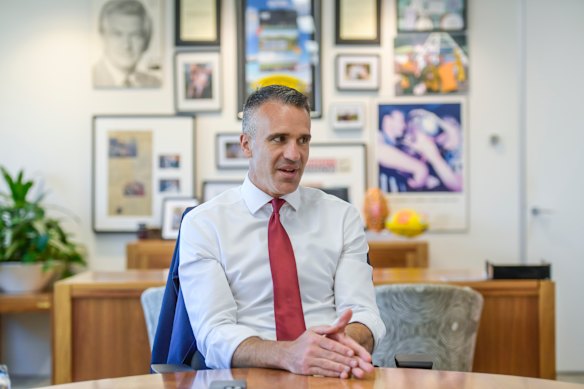

The only real question was scale. By the time the count settled, Peter Malinauskas had delivered something more than a win – he had entrenched himself as one of the most formidable political figures in the country.
Four years after toppling a first-term Liberal government, Malinauskas has returned with a result that edges towards the extraordinary. It’s left his opposition diminished and his Labor government with a mandate that is both broad and deep.
But his victory was not just built on policy or momentum. It was shaped by tone.
As the wave of populist politics that has found traction across the Western world finally took hold at home, Malinauskas chose not to meet it head-on with attack lines. He reframed the argument, appealing to a distinctly Australian idea of patriotism, grounded in inclusion rather than grievance.
With Pauline Hanson’s One Nation vote surging to more than 20 per cent and several seats across both houses of parliament, Malinauskas felt it was left to him to “turn the heat down” and unite a fraying electorate.
Standing in line at a polling booth on election day, he found a story that would anchor that message: a Vietnamese-born voter, a former boat person, quietly expressing his appreciation for the democratic process. For Malinauskas, it captured something larger about the country.
“It sort of struck me as being a clear signal of what patriotism can look like,” he said from the victory podium.
To make the point, he reached back to Henry Lawson and the bush tradition of quiet pride and generosity that sits in contrast to louder forms of nationalism abroad.
“’Tis the duty of Australians in the bush and in the town to forever praise their country but to run no other down,” he paraphrased.
It was a deliberate contrast to the sharper politics seen in the United States and Britain: a reminder that Australian patriotism, at least in Malinauskas’ telling, is less about grievance and more about decency.
“Australians’ version of patriotism is a little different … less brash and boastful and more dogged and determined,” he said.
It’s to be seen what he chooses to do with the authority handed to him. But he has never been inclined to sit on it. Malinauskas has governed in broad strokes and at pace, rejecting the incrementalism that has long shaped South Australian politics.
What sets him apart is not just the scale of his majority but the reach of his leadership. From Adelaide, Malinauskas has shown it is possible to shape national debates, weighing in on aged care, helping drive the conversation on social media restrictions, and stepping into federal policy fights when he judges South Australia has a stake.
He took on the Adelaide Writers’ Week decision to give Palestinian-Australian author Randa Abdel-Fattah a platform. It blew up the event and alienated a big part of his base. He has no regrets.
At the same time, he has fused politics with promotion. The capture of major events – LIV Golf, the AFL’s Gather Round and the return of the MotoGP – is not incidental; it is central to a broader project: recasting South Australia as confident, outward-looking and willing to compete.
To Graham Cornes, the foundation coach of Adelaide’s first AFL club and long-time commercial radio host, the explanation for Malinauskas’ dominance ultimately comes back to something less tangible. He is, Cornes argues, one of those rare politicians whose personal appeal cuts through; someone whose character resonates regardless of party.
The comparison Cornes reaches for is former SA premier Don Dunstan, still the state’s benchmark for transformative leadership.
“Occasionally politicians with great charisma arrive and he just happens to be one of those,” Cornes says. “His personality and, indeed, his character overrides his political leanings. It’s very hard not to like him.”
Cornes says the major events have been “tremendous” for South Australia’s tourism but he’s wary they might simply be sugar hits.
The risks – overreach, missteps, complacency – remain. But they are, for now, secondary to the scale of the opportunity.
“There are other significant issues, like cost of living and health, you know, which, to be fair, he’s addressing and trying to address. He hasn’t been perfect, but he’s earned himself another go through sheer effort, I think,” Cornes says.
For David Koch, former long-time breakfast TV host of Sunrise and Adelaide export, Malinauskas comes close to a model political build: disciplined, focused and instinctively connected.
Koch has described him as a “test-tube politician”, the kind you would design if you could start from scratch, while acknowledging it is “almost un-Australian” to praise a politician so directly.
That tension – between scepticism of politicians and recognition of effectiveness – runs through Malinauskas’ appeal.
“He’s challenged South Australians to think big,” Koch says. “He gives people confidence and he leads with that himself to actually get things done.”
He has constructed a persona that feels accessible without being loose, controlled without appearing distant. He can work a corporate room, then slip easily into the stands at a football match. The balance is deliberate.
Beneath it sits a harder edge. Those who have watched him closely point to a capacity for relentless persuasion – working every conversation, every opportunity, until an outcome shifts. His push to secure Gather Round for South Australia is often cited as a case in point: persistence, timing and a clear objective, executed with precision.
“He’s genuine,” Koch says. “Even if it’s not popular, he backs his beliefs. People respond to that.”
It is also part of a broader effort to change how the state sees itself. Malinauskas has challenged what some describe as a historically insular mindset.
There is a willingness, too, to step outside party lines when required. Malinauskas has not hesitated to break with federal Labor or take positions that cut across national settings if he believes the state stands to lose – a readiness that has helped elevate his profile well beyond Adelaide.
To Stephen Smith, the former high commissioner to the United Kingdom who worked with Malinauskas during the early days of AUKUS, that confidence is grounded in method rather than instinct alone.
Smith’s assessment is of a leader who is intellectually curious, strategically focused and attentive to the national interest as well as his own state’s priorities.
In early discussions on the submarine program, Malinauskas sought first to understand the broader strategic rationale before advancing South Australia’s case – an approach Smith suggests is unusual among premiers. He listens, processes and then argues his position clearly, whether dealing with local stakeholders or international counterparts.
“He’s very impressive, whether he’s on the stump, whether he’s dealing with the UK secretary of state for defence, or whether he’s dealing with the local mayor from Barrow,” Smith says. “He has a very good bedside manner.”
Those qualities have fed persistent speculation about a move to Canberra. Within Labor ranks he is widely regarded as capable of stepping into a senior national role.
“Whether at some stage he decides to make that leap, time will tell,” Smith, a former foreign minister, says. “He may not. I think family, local community and South Australia, just doing everyday ordinary and humble things, are very important to his make-up and to him.”
For now, his focus is on a second term that is unlikely to be smaller than the first. Malinauskas is expected to push for an overhaul of the GST distribution system – a long-running frustration for smaller states – and to intensify his advocacy for South Australia’s nickel industry as a cornerstone of the global energy transition.
Nickel, increasingly critical to electric vehicle batteries and high-performance alloys, offers the state a strategic opportunity. Malinauskas has framed it not just as a resource play but as part of a broader industrial strategy linking mining, manufacturing and future-facing industries.
“I think when we take stock, when he finally does depart, he will rank with the best of the Labor leaders,” says University of Adelaide’s emeritus professor of politics Clement Macintyre.
“I think it was easier in the 1970s to be the charismatic Don Dunstan than it is in the 2020s. I think voters are a lot more cynical now, there’s less faith and trust in politicians. So what he has achieved is impressive.”
Alexander Downer, part of South Australia’s Liberal establishment, says Malinauskas has been a safe pair of hands as premier.
“He is calm and good-natured, including in the teeth of attack from his political opponents,” he says. “He doesn’t have the Keating or Trump style of savaging his opponents with personal abuse. That works well with the public.”
Even Hanson found time for praise while warning that her tribe will hold him accountable over the next four years.
“Guess what, mate?” she said. “I’m leaving you some landmines … so I suggest, don’t step on them because they will explode.”
But in a country where it is often said to be almost un-Australian to praise politicians, Malinauskas has achieved something uncommon: sustained momentum, a reservoir of authority and a level of reluctant admiration that extends well beyond his own side of politics.
Cut through the noise of federal politics with news, views and expert analysis. Subscribers can sign up to our weekly Inside Politics newsletter.
 Rob Harris is the national correspondent for The Sydney Morning Herald and The Age based in Canberra. He is a former Europe correspondent.Connect via email.
From our partners
Disclaimer : This story is auto aggregated by a computer programme and has not been created or edited by DOWNTHENEWS. Publisher: www.smh.com.au





