If economists were making market forecasts for this AFL season, they would note that the round one MCG crowds, which contribute heavily to the club and league coffers, were “soft” and that they cannot expect the kind of records and bonanzas of the recent past given the underlying conditions of certain clubs.
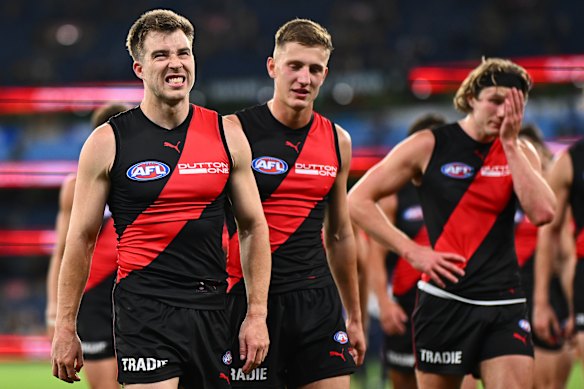
Essendon v Hawthorn was as hyped as any clash between the foes for two decades, on the back of Zach Merrett’s failed escape to the hated Hawks. The Bombers expected 80,000 to show up, as did the AFL. The turnout was a subdued 71,384, and a sizeable portion of them were at Richmond or Jolimont stations – or scurrying away to find refuge in a Richmond pub – while “We’re a happy team at Hawthorn” blared around the MCG.
Zach Merrett and the Bombers leave the field after the loss against the Hawks.Credit: Getty Images
Carlton v Richmond held less box office promise, but it had drawn 80,000 last year when the Tigers put Carlton’s season into instant turbulence. This game, no longer holding the prime slot of the season opener, drew 74,313.
Collingwood v Adelaide attracted 62,482, an excellent crowd for a Melbourne club against a non-Victorian. But it was slightly down on what the Magpies pulled for matches against the Crows in both 2024 and 2025 (67,697).
The Essendon and Carlton home games contained two themes that warrant exploration.
The first is that both marque events were designated as “fully ticketed”, which means that members of the clubs without a seasonal reserved seat had to book a ticket at the cost of $13, just to be assured of a seat. They could pay more if they wanted a superior vantage.
Essendon and/or the AFL were justified on making that game fully ticketed, based on Merrett. But it is reasonable to ask whether the ticketing slug, at a time when the cost of living remains challenging, acted as a disincentive for fans. Ditto for Carlton and Richmond, since the mid-week forecast was only for 72-74,000 from the AFL.
But the more pertinent and worrisome explanation for the soft crowds in those games is that Carlton and Essendon fans are tiring of prolonged failure this century – that even the commendable stickiness of the Bombers faithful is slowly loosening – and that Richmond people simply recognise the reality of a list reconstruction that will take much longer than the $100 million bricks and mortar version undertaken at Punt Rd.
Richmond, whose effort last Thursday was more encouraging than Carlton, are years from premiership contention, having committed to a full-bore list rebuild in 2024. Typically, these take about seven years, unless there are important legacy players who hang around.
Carlton, having relinquished Tom De Koning to free agency (rightly) and traded Charlie Curnow for first-round picks (and Will Hayward), are beginning what I would term a regroup, rather than rebuild. Regardless, they will not contend this year.
The Blues have taken the right approach in their decision to step back to assemble a genuine contender – Jagga Smith and Harry Dean are foundations of the reset. Next year, they will be joined by father-son Cody Walker, a potential top two pick in the draft.
Unfortunately for the Blues, they will pay a far heftier price for Walker and Dean than the Lions did for Will Ashcroft and Jaspa Fletcher in 2022, when Brisbane landed both, plus Josh Dunkley, a scenario nigh impossible under the new draft rules for father-son and academy players (without losing, say Zac Bailey and another good player).
The clubs’ objections to Brisbane’s father-son jackpot and a few academy recruits – and to those of the Bulldogs, Collingwood and Gold Coast (academy only), thus, have rebounded on Carlton.
The Blues have been lobbying the AFL to spare them from the new rule – for a delay to the change – that would mean they must give up two genuine first-round picks for Walker, subject to where the bid for him lands.
That leaves Collingwood, who have had a brilliant run under Craig McRae’s superb coaching, but still rely heavily on an older core of players (plus Nick Daicos), and do not have a functioning forward line, having let Brody Mihocek walk to Melbourne. While this was the right call over the medium term, it could well sting in 2026, when Bobby Hill is not available, either and might not return.
The Magpies have been reckless in trading out first-round picks for mature players, especially in the case of Dan Houston, despite his talents and improved form in two outings. As veterans retire or their output dwindles, the Pies do not have ready replacements of the same calibre.
Collingwood did not heed the advice of Fleetwood Mac; they did stop thinking about tomorrow. They defend very ably and are never easy to play, but few outside the inner sanctum would consider them a top four team this year, given the list profile.
Brian Cook, the erstwhile Carlton, Geelong and West Coast chief executive, used to refer to Melbourne’s big four clubs as “The Beatles”.
Hawthorn and Geelong are bands that usurped the Beatles on many levels – winning flags and finals, mostly (Pies somewhat excepted) – this century. But in season 2026, it is conceivable that none of the fab four will see September. Realistically, Collingwood are clearly the best chance, yet one cannot see their dad’s army conquering the competition, as they did for 16 rounds last year, and in 2023.
So, the league should be budgeting on at least three of the Beatles sitting down in the Octopus’ garden, under the sea.
For an AFL that has – understandably – placed great store on growth in the northern states, the economic impact of a dwindled box office in the heartland should be cause for concern.
Most Viewed in Sport
Disclaimer : This story is auto aggregated by a computer programme and has not been created or edited by DOWNTHENEWS. Publisher: www.smh.com.au