
The story goes that Greta Garbo screamed “give me back my beast!” at the end of a screening of Jean Cocteau’s La Belle et La Bete in 1946. It’s an outburst that must’ve reverberated through time, because who didn’t think the same thing when Disney’s 1999 adaptation transformed its hulking Beast into a sad, wide-eyed Von Trapp child? Garbo’s catcall underlines an age-old paradox that has propelled modern romance into the arms of modern horror: we love what makes the Beast unlovable.
It’s why we still want to see what’s under the Phantom’s mask and why we’ll watch anything by Guillermo del Toro. Thank god Maggie Gyllenhaal’s sprawling The Bride! is not a subtle film, because 20 minutes in and Frankenstein’s Monster (Christian Bale) tells us exactly why these himbo Beasts and blood-sucking marriages scratch the itch that used to be reserved for the romance genre: “People love a monster.”
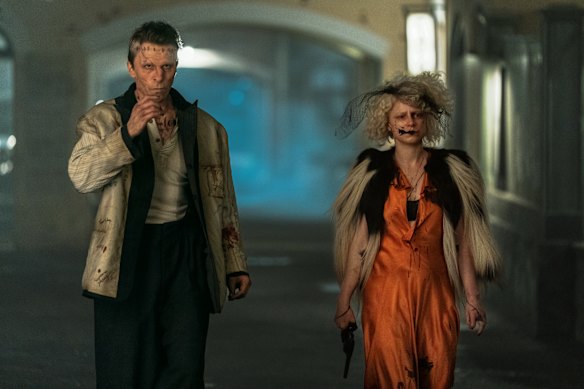
Frank, as he’s called in the movie, is on the run with the love of his undead life – the titular Bride, Ida (Jessie Buckley) – when he says this. Watching his doe-eyed gaze as the pair sprint away arm-in-arm from an angry mob wielding pitchforks (it’s 1930s Chicago, mind you), it’s clear what he really meant: I want our love to be monstrous.
Gyllenhaal has pitched The Bride! as an answer to the silence of the titular character in James Whale’s 1935 Bride of Frankenstein. It begins with Mary Shelley, our narrator and a near-demonic presence portrayed by Buckley in writhing gestures and Tim-Burton-via-Dangerfield makeup in extreme close-ups.
It’s an opening that inverts Whale’s original film, which begins with Mary (Elsa Lanchester, who also plays the Bride) gathering Percy and Byron around her to tell them about her sequel: something “stronger than a love story”. In Gyllenhaal’s version, Mary is more melodramatic, tricksy: “Is it a ghost story? A horror story? Or most frightening of all, a love story?”
It’s not a good story. But between the lines of the film’s part-Gothic, part-noir chaos is a near-thoughtful reflection on our collective fascination with the twin pillars of contemporary romance that have emerged in recent years: beloved monsters and monstrous couples.
I blame Del Toro. Jacob Elordi’s turn as the titular walking daddy-issue in his adaptation of Frankenstein last year joined the ranks of countless six-foot-five monstrous softbois in Del Toro’s oeuvre. The Shape of Water won Best Picture in 2017 because it’s a fantastic film, and also because we all wanted to be Sally Hawkins courting an active-listening amphibian with a boiled egg before sharing an eternal underwater embrace.
In Hellboy, Del Toro offered another romantic ideal in the form of a demon spawn and a pyrokinetic who have a kid together despite being told that their relationship will cause the apocalypse. The course of love, etc.
Unsurprisingly, Shelley’s Frankenstein describes perfectly the ideal these examples share when the monster comes to his creator asking for a Bride: “It is true, we shall be monsters, cut off from all the world; but on that account we shall be more attached to one another.”
There’s an “us against the world” appeal to these rose-coloured creature features, and there’s a bad boy air to the creatures in them softened by a fact essential to our ability to romanticise them: they are man-shaped but not man enough to be patriarchal.
Universal Studios failed to revitalise their famed cinematic monsters in 2017 because they thought The Mummy needed to be a dour action-thriller to be relevant. The influx of Frankenstein adaptations recently — from Larry Fessenden’s Depraved, Yorgos Lanthimos’ Poor Things, Del Toro’s Frankenstein and Gyllenhaal’s The Bride! —alongside a slew of other Gothic IP — Robert Eggers’ Nosferatu, Emerald Fennel’s Wuthering Heights — has revealed a counterpoint: it’s a mode of Gothic Romance heavy on horror that has become the most effective way to make these creatures lovable for a contemporary audience.
Last year, Neon saw their rival company, A24, struggling to find new social allegories to make into horror films and decided to turn to romance instead. The tagline for Osgood Perkins’ Keeper, a folk-horror film based around a romantic getaway, underlines this move: “Is there any way to keep love alive?”
Soon after Together made Frankenstein’s monster’s desire to “be more attached” literal by depicting the co-dependence of a 10-year relationship through increasingly extreme body-horror sequences.
The Frankenstein parallels go further still when the film’s monster is ultimately their bodies intertwined in grotesque formation. Even the slasher genre has taken a bloodied swing at the romantic comedy with Heart Eyes! The horror genre’s creature, slasher and victim are coupled up. Everyone’s got someone to be a monster with.
These parallel trends make sense if we look at the state of modern dating. I hate the line you’re about to read but I’ve been trying to make sense of a TikTok trend recently. Women go to an Austrian festival dedicated to Krampus, the demonic antithesis of Santa Claus, to meet the eligible bachelors dressed as the monstrous Saint Nick.
One shouldn’t take any social media trend too seriously. But a comment section that features gems like “Krampus > emotionally unavailable lazy misogynist males” reaches levels of irony that speak to the heart of the problems with modern dating.
Is it Gen Z’s prudishness making monstrous love easier to justify than a sex scene between two humans? Is it the dehumanising hell of dating sites that make becoming or courting something monstrous feel ironically more human? Or is it the “Manosphere”-led resurgence of misogyny prompting an uptick in boy sobriety that is drawing women away from anything man-like?
Gyllenhaal’s answer is all of the above. The driving force of her feminist thesis is that we don’t inherently fear what is monstrous, only how monstrosity is hidden. A mob boss kills in broad daylight; an allegedly “nice guy” detective reveals his corruption. Ida stares into the eyes of men and sees the women they’ve hurt. It’s not jagged scars, neck bolts or bright-white hair that reveal a true monster but a pinstriped suit and a police uniform.
With these fears in mind, it’s no wonder the overemphasis on nomenclature has overtaken modern love. I know my attachment style, love language and that my ex might be a narcissist. I know what sign I’m most compatible with and what pop-psych strategies I need to self-regulate.
I don’t think I’m alone in sharpening these linguistic tools like pitchforks. There is a safety in the self-knowledge they offer insofar as they stop you from revealing your own monstrousness and give you the tools to uncover the monstrousness of others at the same time. Are Monster Romance novels on the rise because they let us fall in love with what we fear — a monster and one’s personal monstrousness — safely? Kind of.
The Bride! feels fragmented in part because it’s been roughly stitched together out of the romantic styles of contemporary horror and the tensions of modern love that drive them. Ida and Frank become Bonnie and Clyde —or more accurately, Lady Gaga and Joaquin Pheonix in The Joker 2: Folie a Deux — running from the law in a stolen Cadillac.
Meanwhile, Mary Shelley keeps possessing Ida in increasingly orgiastic sequences. Buckley arches her back, cricks her neck and lets out a poetic couplet or two with the fervour of Lily-Rose Depp in Nosferatu, possessed to the point of sexual nirvana by the monstrously horny Count Orlok. With the former storyline, Gyllenhaal is trying to land a social allegory on feminist rage: an ode to #MeToo that makes Ida’s gun-toting anger and the monsters she trains that gun on political. With the latter, she is staging an inward reflection on desire, sex, love and fear and how they might co-exist against this political backdrop.
It’s a tension innate to our monsters. I have a soft spot for Del Toro’s Crimson Peak because it tests the limits of our capacity to romanticise these monsters. Near the film’s end and Del Toro, the adorable bastard, sneaks his ethos as a filmmaker into a monologue where Jessica Chastain justifies incest: “This love burns you and maims you and twists you inside out. It is a monstrous love, and it makes monsters of us all.”
That the figure of the monster allows filmmakers to flirt with the taboo is old hat. But Del Toro, a sentimentalist at heart, makes even his most taboo lovers recognisable as the fulfilment of something essential to desire and our experience of it. You bristle at what makes his lovers wrong because he never allows you to detach from them enough not to want what they have: to become monstrous in love.
Shelley had a similar eagle-eyed interest in making love and fear the two sides of desire and one of many binaries that the love of a good monster blurs: self and monster, good and evil, self-affirmation and self-immolation. It’s why we watch Beauty and The Beast and ask if we want a honeymoon phase like Belle and the Beast that is nearly indistinguishable from Stockholm Syndrome. Or a consummation as soul-destroying as the climactic mutual destruction that ends Eggers’ Nosferatu, or “till death to us part” exaggerated to its limit with vampire-like eternal life or dashed in bloody spectacle under a hail of bullets like Frank and Ida.
In a world that has increasingly understood desire, love and relationships in absolute terms to make it legible to ourselves and to our politics, we reach for monsters as an alternative. “Desire is, by nature, childlike and chary of government,” Pulitzer Prize-winning critic Andrea Long Chu writes. Monstrous talons, tentacles and bolt-pierced necks offer catharsis because they allow us to name an experience without needing to give it a name at all: the horror of contemporary love.
And so we stumble into the political power of monstrous love: it clarifies one’s experience of desire without ever asking that we resolve its messy complexities. For this reason, Gyllenhaal has given us the perfect film for our struggling love lives, marred as they are by this push and pull between our beastly desires and the horrors of a world full of beasts hiding in plain sight.
The Bride! is now showing.
 Guy Webster is a critic, dramaturg and moonlighting academic living on unceded Wurundjeri land.
From our partners
Disclaimer : This story is auto aggregated by a computer programme and has not been created or edited by DOWNTHENEWS. Publisher: www.smh.com.au