Australian Open with 4K on Stan Sport.
Every match, live & on demand.
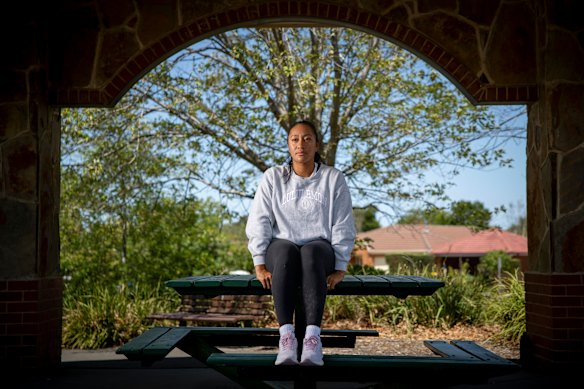
Destanee Aiava is at peace.
At age 25, her tumultuous professional tennis career – which promised grand slam glory and riches as a teenage prodigy who once traded ground strokes with Steffi Graf in Paris – is prematurely but mercifully all but over.
Destanee Aiava has detailed the horrific abuse she dealt with during her career. Credit: Eddie Jim
Aiava announced her pending retirement on Saturday night in a brutally honest, highly emotive and expletive-laden social media post, where she likened her relationship with the sport to a toxic boyfriend and delivered a series of “F— yous” to everyone who sought to rip her down.
There was a “ginormous” one to members of the tennis community who made her feel “less than”.
It also included the gamblers who made death threats to her, the keyboard warriors who body-shamed her – and more specifically, the racist spectator who she revealed to this masthead called her a “fat monkey” during a WTA match in Montreal in July last year.
That moment left her shaken and in shock, and it was only afterwards that she tearfully confided what had happened to her fiance, Corey Gaal, after trying in vain for the chair umpire to do something about it.
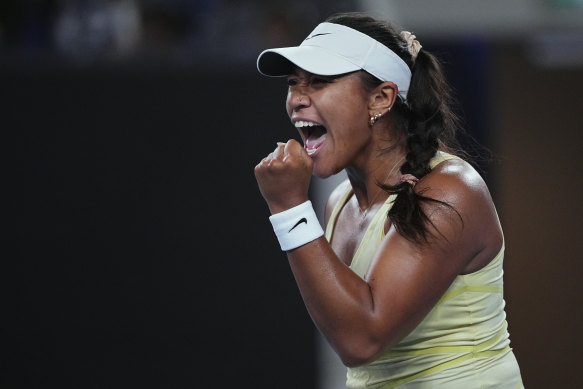
Destanee Aiava during her Australian Open run in 2025. Credit: AP
“I’ve been called ‘monkey’ a lot. That was the main word,” Aiava said.
“Or even people just calling me black in my DMs [on social media]. I got a really bad one in Montreal last year, in a match against a Canadian player, and this guy kept saying my name and going, ‘Oh, you’re a fat monkey’. Obviously, I lost that match.”
Aiava detailed her one-of-a-kind tennis journey in a wide-ranging interview at a Narre Warren South park on Monday afternoon, where she revealed that she was in a “beautiful” place after unburdening herself.
She wrote the lengthy social media post, which has created international headlines, before last month’s Australian Open, but made up her mind during a scenic holiday to Finland and Ireland afterwards.
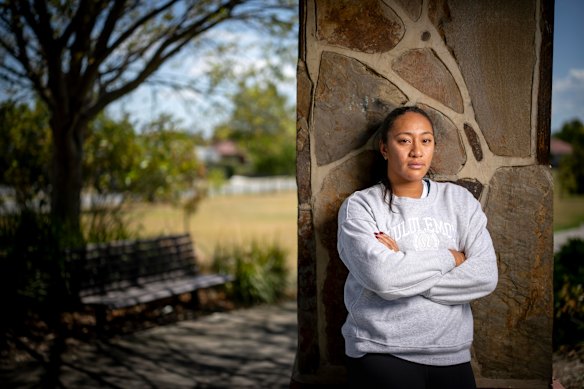
Destanee Aiava is at peace with her decision to retire from tennis.Credit: Eddie Jim
It was there that Aiava realised a break from tennis was not what she needed. After five years of wrestling with retirement, she came to the realisation the sport that tortured her mentally and caused her continual self-doubts was stopping her from living her best life.
“I found it hard to shut off, and I was angry at myself for not being able to do that, but then something clicked, and one day I was just like, ‘Where I am at the moment is so beautiful, and I am so grateful to be here’,” she said.
“I feel like that was something I really struggled to do while I was playing tennis, and I realised that I had no reason to keep playing tennis.
“I may not have reached my on-court goals, but I wanted to be happy and appreciate being able to breathe air … I didn’t want to keep playing any more because I wasn’t being fulfilled in any way. I wasn’t enjoying it, but I just never had the courage to stop until now.”
The problem gamblers Aiava called out in her Instagram post were a constant. Every time she left the court, even after wins or in a doubles match, a message would be waiting on her phone.
They were irate that she beat the player they bet on, or she conceded too many games. Aiava wants tennis authorities to do more to protect players, but understands it is a difficult one to stop. She has taken it upon herself to go back at them, even calling some of them.
Not one of them answered, and some blocked her.
“I just wanted to see first-hand how bad humans can be,” Aiava explained.
“Lately, I’ve been trolling some people back, and spam calling them. It’s not good to do, but I feel like if they’re allowed to do it, then I should at least be allowed to stand up for myself.”
Aiava has ruled out competing overseas again, and there is a possibility she already hit her last ball, although she left the door ajar to play the odd second-tier professional event within Australia.
In some ways, it is incredibly sad.
Aiava, who trained up to eight hours a day from age five, was once the top-ranked 14-year-old girl on the planet, and only three years later, was inside the top 150 women’s players in the world.
But in her social media post, she reflected on that time and how trusting the wrong people as an “unprepared and dangerously naive” 17-year-old cost her dearly, adding that “the trajectory of my career was never the same after that”.
Aiava eventually played in eight grand slam main draws. She had to wait until last year’s Australian Open, which she qualified for, to win her first singles match at that level, over Belgian Greet Minnen.
She is somewhat regretful she did not make this decision after that career-best moment, where she was the toast of the Melbourne major. Away from the adoring crowds who love a winner, life went back to normal once the Australian Open ended.
It was years since Nike and co. stopped sponsoring Aiava.
Her tennis outfits instead came from Kmart or were bought secondhand online by then. It was fewer than two years ago that Aiava’s bank account was overdrawn by $40 during a mid-season grind in London. Gaal was pickpocketed on the same trip.
She had to contact her mum, Rosie, to ask for help while waiting for her tournament paycheck to clear.
“It’s scary,” Aiava said.
“But I wouldn’t take it back. I am honestly really glad I went through that because it taught me so much and made me so aware and grateful for what I have today, even shopping at Kmart for my tennis outfits and playing a lot more tournaments just to make ends meet.
“I didn’t enjoy it at the time, but I look back on it, and I’m really proud that I even went through that. I feel like it’s a good life lesson.”
Aiava lumps the gamblers in the same bucket as the online trolls who targeted her about her weight, with some cruelly describing her as an “elephant”. As Aiava puts it, it was almost every adaptation of “fat”.
“People are still messaging me today, saying, ‘You didn’t succeed because you couldn’t stop eating’,” she said.
It is no surprise with that knowledge to learn that Aiava, who is Polynesian, struggled with eating disorders, including bulimia, throughout her career and even starved herself at times.
“Some of it was because people kept calling me overweight and fat, but it was also because I always saw thinner girls in tennis,” she said.
“I felt like to be a better tennis player, or to get extra opportunities, I had to look like them.”
Aiava also revealed in 2022 that she planned to take her own life, only for three strangers to intervene.
She told this masthead during last year’s Australian Open that she no longer related to the person she was at that time, explaining it was “a really low time in my life” and that she needed to hit rock bottom to “be where I am now”.
Later the same year, after Aiava experienced daily panic attacks at a tournament in Darwin that she made the final at, she sought medical advice. Doctors diagnosed her with borderline personality disorder.
BPD impacts how people manage emotions and relate to others, and can cause instability in relationships, mood swings and impulsive behaviour. Individuals are not born with the condition, and instead it often comes from childhood trauma.
Her parents, Rosie and Mark, are no longer together, but she remains extremely close with her mum and is still in contact with her dad.
“I try not to look back on [my childhood] too much,” Aiava said last year. “I just try to remember the good times, and all the hard work that I put in that has led me up to this point.”
Aiava turned to therapy to deal with her challenges, but part of her enlightenment in recent months came from the Bible.
She grew up a Catholic in a deeply religious family, but was not deeply religious herself.
“I wanted to try something different, just to get some sort of guidance,” Aiava said.
“No one’s talking back at you, and it’s just words on a book that you can somehow find comfort in. I started reading the Bible, and I started to feel a bit more peaceful, and like I had a purpose, and had something to work towards.”
Tennis will forever be a complicated part of Aiava’s life, but she remains grateful for the opportunities it gave her. She travelled to more than 30 countries, and her career prizemoney of $1.3 million enabled her to buy her first car and home.
She plans to study interior design.
“Hopefully in the future, I remember tennis fondly, and I think of all my good memories and all the things I’ve achieved,” Aiava said.
“At the moment, I’m not at that place, and I always said, when I’m done, I don’t want anything to do with it. I’m still at that place. I know a lot of people have reached out to me and said, ‘I hope you reconsider’.
“But that’s far from what I would like to do. I don’t want to do anything in tennis at all.”
Crisis support is available 24/7 from Lifeline (13 11 14)
News, results and expert analysis from the weekend of sport sent every Monday. Sign up for our Sport newsletter.
Most Viewed in Sport
Disclaimer : This story is auto aggregated by a computer programme and has not been created or edited by DOWNTHENEWS. Publisher: www.smh.com.au