
The Australian Centre for the Moving Image, an institution dedicated entirely to screen culture, will stage an exhibition about music and the art of listening this winter, in collaboration with the RISING festival.
It might seem an odd choice but ACMI boss Seb Chan insists the Reverb exhibition, which was first mounted by London-based The Vinyl Factory in 2024, is a logical fit for this venue at this time.
“I think it makes sense, because Melbourne’s obviously such a music city,” he says, citing the For The Record report issued by the Victorian Music Development Office in December that found Melbourne’s “inner core” had more record stores per head of population than any other city in the world.
That report noted that vinyl was more than just a storage and distribution platform for recorded music and that it “uniquely provides intentional music experiences, community gathering spaces, and discovery pathways built through human relationships rather than algorithmic recommendation”.
Or, as Chan puts it rather more succinctly, “This is all about the sociality of music.”
Much of the work in Reverb is film-based, which certainly makes it an easier fit. But at any rate, Chan adds: “I think sound and music is one of the underexplored parts of moving image [culture]. We all know the importance of soundtrack and dolly sounds and all of these other things, but the visual dominates in the cinema space.
“This show really looks at how contemporary artists work with music and musical subcultures, and explores how those music subcultures have meaning for us and are so much part of people’s identities.”
Among the key works is Turner Prize-winning artist Jeremy Deller’s hour-long 2019 film Everybody in The Place: An Incomplete History of Britain 1984–1992, a documentary essay in which he attempts to convince a high school politics class that the rave culture that emerged in Britain in the late 1980s was both significant and deeply political, with roots in colliery brass bands, the miners strike, Detroit club culture and German electronic music.
The longest piece is Luanda-Kinshasa, Stan Douglas’s six-hour film of a group of 10 musicians in the studio, deep in a jazz-funk jam session. Though it looks for all the world like it was shot in the early 1970s, it was actually made in 2013, and loops footage of the session to extend it seamlessly.
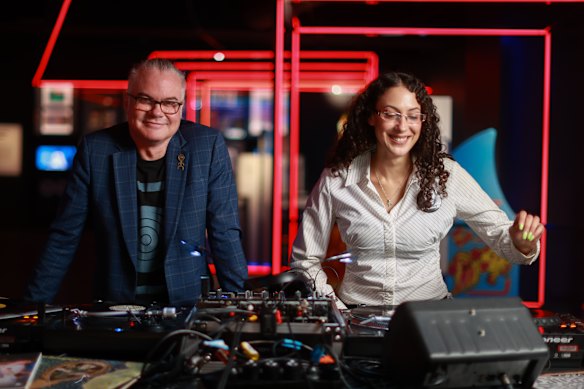
There are physical elements, too: a massive functioning sound system covered in pink foam spikes (Virgil Abloh’s 12 Inch Voices); Carsten Nicolai’s Bausatz Noto, in which visitors are invited to make their own mixes using four turntables and an array of brightly coloured vinyl records; the room-sized collection of 100 records pressed at The Vinyl Factory; and a listening room where DJs (including RRR’s Yasmine Sharaf, who is also RISING’s music curator) will spin records for an audience invited to really lean in and listen.
The Vinyl Factory is a gallery, performance space, publisher and record pressing facility. The last part of the operation, in Hayes in west London, first pressed bakelite discs in the 1920s, was operated by EMI for decades (with albums by the Rolling Stones, Pink Floyd and the Sex Pistols to its name) and is now the UK’s only remaining vinyl plant.
Artists who have issued high-end limited-edition records through it include Massive Attack, Radiohead, Skrillex, the xx and Fred Again.
“We’re neither part of the traditional music industry nor fine art world, but rather a mix of both and something different,” says Vinyl Factory creative director Sean Diller, who oversaw the creation of Reverb.
Much of what’s in the show draws on black culture in the UK, Jamaica, Africa and the US. The common theme is music as a grassroots expression, a place where identity can be explored, affirmed and celebrated.
There is, then, a certain paradox in the fact that vinyl – once the domain of the mass market – has become such a rarefied and expensive medium, and one that is now deemed museum worthy.
While noting that about 73 per cent of all physical sales revenue now comes from vinyl, For the Record also observed tension between the communal aspect, where people congregate and socialise in record stores or listening parties, and the economic barriers to entry that work against both emerging artists and young audiences.
“Vinyl’s $40-60 standard pricing positions the format beyond many households’ budgets,” the report noted. Neil Robertson, project manager at the VMDO, added: “Some operators [report] they’re not seeing the next generation of 17- to 19-year-olds coming through like they used to, and that worries them.”
Diller, though, is bullish about vinyl’s unique and ongoing cultural value.
“On one level, it’s incredible that analogue culture is going so strong. On another, it’s not all that surprising,” he says.
“As omnipresent and convenient as digital culture is in all its many forms, many people still crave the feel, process and community of tangible things, be they records or books – perhaps more so.”
That need is giving rise, he says, to “a renaissance of spaces to listen to music in, predominantly vinyl, where fans can gather and enjoy the music in a space that gives them space from the hectic pace of social media and technology”.
And this winter, ACMI will be among them.
Reverb is at ACMI from May 22 to August 31. The full Rising program will be announced on March 11.
From our partners
Disclaimer : This story is auto aggregated by a computer programme and has not been created or edited by DOWNTHENEWS. Publisher: www.smh.com.au