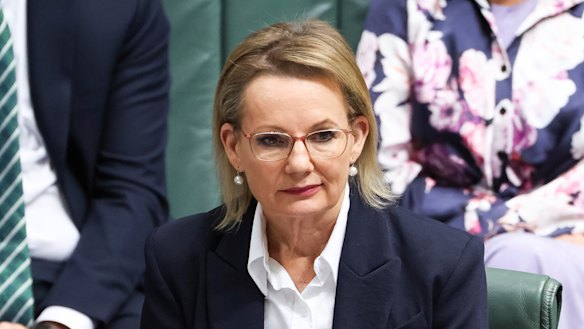
By the time Sussan Ley rose to the dispatch box for one final question time on Thursday, her political fate was sealed.
She had less than 24 hours remaining as leader of the Liberal Party, but it did not show. The composure held. The smile remained fixed.
But the faces behind her told the story: colleagues who had concluded the greater risk lay not in change, but in standing still. The argument that had ultimately toppled her was not ideological purity nor factional revenge. It was survival.
James Paterson, a key player behind Angus Taylor’s accession, had earlier given it blunt expression that, under Ley, the party had lost about 200,000 voters every month since last May’s worst-ever election result.
“It’s more than 50,000 votes a week. It’s more than 7000 votes a day. This cannot go on,” the Victorian senator said, announcing he was joining Taylor and resigning from the shadow cabinet. “If it goes on, there’ll be nothing left of the Liberal Party by the next election.”
That arithmetic – repeated in corridors and offices – reframed the contest. If the trajectory continued, MPs warned privately, no seat would be safe: not marginals in outer suburbs, not regional Queensland strongholds, no chance of regaining once-blue ribbon electorates eroded by teal independents. The fear was no longer of losing more seats; it was of mass extinction.
The scale of the revolt became clear internally at 10.30am on Thursday, when James McGrath, a member of Ley’s shadow cabinet and leadership group, wandered into her Parliament House office.
Accounts of that short conversation are disputed, but his message to Ley was ultimately clear. Her leadership was doomed. McGrath would hold off on making his resignation public until 3.30pm, after the end of question time.
“While I realise this news won’t please everyone, it is important that Australia has a strong and effective opposition,” he said. “I have made this decision as I believe it is in the best interest of Queensland, Australia and the Liberal National Party.”
McGrath has a reputation for sniffing the breeze. In 2015, he was a central player in the move to kill off Tony Abbott’s prime ministership. He then moved on Malcolm Turnbull three years later when his leadership was in peril.
A key supporter last May and rewarded with a role in Ley’s inner circle, allies now paint it as a major betrayal. But others say McGrath’s move should not have blindsided her. In recent weeks, they say, the Queensland senator had sharpened his interventions, pressing colleagues about electoral losses and questioning whether the leadership could arrest the slide reflected in polling.
Facing a looming preselection battle within the LNP, he was acutely aware of conservative grassroots anxiety and the rise of One Nation.
“The McGrath switch was a big deal,” says one MP, aligned to the party’s moderate faction. “When he deserted Sussan, it gave an impression to others on the fence that this thing was over. People wanted to back a winner.”
The numbers men in both camps slowly shifted names from one list to another. Ley supporters from May were moved into Taylor’s column, among them WA’s Dean Smith, South Australian Tom Venning, Queenslander Leon Rebello, Victorian Zoe McKenzie, and Tasmanian Wendy Askew.
But the collapse had deeper roots.
For much of her two decades in parliament, Ley had been a steady if largely nondescript presence; a competent minister across portfolios including health and environment, but rarely a dominant personality shaping the national argument. What she was not was a political insurgent capable of redefining a party in crisis.
The chaos had spread dramatically lately after Nationals leader David Littleproud detonated the Coalition arrangement when Ley attempted to discipline three National senators who had crossed the shadow cabinet’s position on hate speech laws.
Littleproud’s declaration that he could not serve under her leadership – later reversed – left her authority exposed. The attempted reconciliation, staged at a joint press conference, convinced few that unity had been restored. In parliament, Labor MPs revelled in the spectacle of an opposition fighting itself.
Ley had tried to recalibrate many times along the way. She toughened rhetoric on immigration, linking migration to housing affordability. Likewise, she dumped the Coalition’s net zero policy to placate conservatives. But the shifts failed to cut through.
Close allies argue that right-wingers in the party room were never comfortable with a woman leader, especially one who made clear in her first press club speech that she wanted to ditch the types of culture wars increasingly animating conservative voters.
One ally said: “If we got every decision right, every hour of every day, this party room never would have allowed her to succeed.”
Ley herself hinted as much on Friday when she resigned.
“It is important that the new leader gets clear air, something that is not always afforded to leaders, but which in the present moment is more important than ever,” she said.
Another moderate MP says Ley was an introvert who took advice from a small group of figures, including NSW numbers man Alex Hawke, trusted staff, and, occasionally, moderate faction figures such as Anne Ruston and Maria Kovacic. On the whole, though, even MPs who believed in the Ley project were often perplexed by her tactics and felt cut out.
Shrill attacks on the prime minister’s fashion sense, on Penny Wong’s emotional state and demands to recall parliament early to vote on hate speech legislation left the Coalition wedged and many questioning her judgment.
“She didn’t talk to people. It was really quite bizarre. No leader ever has had so few MPs who would really fight for her,” the same MP said.
A deeper dispute was about identity. Should the Liberals attempt to win back moderate, teal-held inner-city seats? Or pivot harder toward cultural conservatism and economic nationalism to reclaim voters drifting to One Nation?
“It was never going to be easy to lead the party after its worst-ever defeat,” Abbott, who elevated Ley to cabinet in 2014, said on Friday, adding she had shown strong character and dignity, often under great pressure.
“As John Howard once said, politics is a hard and unforgiving business, but it’s the highest and noblest form of public service.”
Ongoing tensions came to a head about 10 days after the first damning Newspoll of the year, published in The Australian, which showed the Coalition behind One Nation on primary vote for the first time.
In Melbourne, on the morning of former Liberal MP Katie Allen’s memorial service on January 29, senior figures gathered.
Ley had emerged from what supporters considered her strongest stretch – internal critics quiet over summer as she led attacks on Anthony Albanese over the Bondi massacre. Then the poll landed.
At the suburban home of a party figure, Taylor expressed strongly that he was intent on running. Fellow leadership aspirant Andrew Hastie was less conclusive, according to sources in the room. Hastie’s key supporters there – senators Jonno Duniam and Matt O’Sullivan – had urged him to nominate, but acknowledged he would have time on his side if he stepped back.
Taylor told Hastie that a challenge could only succeed with his support. Paterson advised Hastie that he did not have the numbers and would be better served by waiting. Former PM Tony Abbott was also strongly lobbying internally for Taylor.
Hastie, in the end, determined he should withdraw and give Taylor a clear run, avoiding a damaging split among those on the Right of the party that would further diminish the party.
But even then, there was no fixed timetable. Those involved were open to waiting weeks or months. But secrecy collapsed after photojournalist Liam Mendes, of The Australian, unexpectedly exposed the talks. Once it became clear that Paterson and Duniam – senior members of the shadow ministry – were discussing Ley’s leadership, pressure intensified for movement.
Those images had infuriated many MPs, who likened them to a meeting of mafia bosses, labelling the meeting “grotesque”, “student politics” and “amateur hour”. Some even thought they might even buy more time for Ley.
But the next Newspoll would become pivotal. On Sunday night, it showed One Nation up five points to 27 per cent and the Coalition, down three percentage points, to 18 per cent.
Taylor did not move immediately. He delayed declaring until late Wednesday, prompting internal jokes about a “TACO spill” – a reference to the “Trump Always Chickens Out” insults circulating in US politics. The hesitation reflected his concern that Ley might call a snap spill the moment he declared, catching him before every commitment was secured.
In recent weeks, McGrath, Ruston, Hawke and leading moderate figure Andrew Bragg had all attempted to convince right-wing MPs to give Ley a few more months. The need to give her a budget reply speech became a narrative.
In these whispered talks, Ley’s supporters suggested they could convince Ley to stand down sometime after the May budget if she was unable to lift the party’s standing in the polls.
But the overtures went nowhere. Members of the conservative grouping felt the case for change was too urgent to wait. Hawke’s suggestions were not believed by his right-wing enemies.
When Taylor eventually walked to Ley’s office just after 7pm on Wednesday, he found the door locked. Security guards were closing up for the night. Ley and her senior staff were minutes from leaving for an evening engagement.
The pair spoke in her suite for just three minutes before Taylor left and publicly announced he would quit the frontbench. The next morning, he moved. NSW senator Jess Collins and Queensland MP Phil Thompson wrote to the whip the next day, demanding a party room meeting.
Shadow treasurer under Peter Dutton’s leadership, Taylor had narrowly lost the previous leadership ballot, 29-25, and waited as defence spokesman while polls weakened Ley’s standing. Events had forced him to launch earlier than he had planned.
“I am running to be the leader of the Liberal Party because I believe that Australia is worth fighting for,” he said in a slick Instagram video.
By Friday morning, the party room met. Ley lost 34 votes to 17. Taylor had the leadership.
The margin was emphatic. It formalised what had been obvious in the corridors days earlier.
“What we’ve been through over the last 10 or 11 months has been incredibly difficult,” said Victorian MP Dan Tehan, who withdrew his support for Ley and ran unsuccessfully for deputy, said on Friday.
“The feedback I was getting was that things did need to change and there was no criticism against Sussan and what she’s done.”
The symbolism will linger. The Liberals have removed their first female leader after 276 days. But for MPs staring at polling that suggested erosion on multiple fronts – to Labor, to the teals, to One Nation – symbolism proved secondary.
“We’re at a critical juncture right now. Sussan Ley has been a diligent, hard-working servant to our party and to the country, but unfortunately, we’re simply not cutting through now,” Senator Jane Hume, who won a ballot for deputy leader, told reporters.
Taylor’s win on Friday morning was decisive and hands him a mandate larger than many predicted. However, the party room remains fractured and the coup has left scars.
A supporter of Ley suggests Taylor has little time to prove his mettle and begin reviving the Liberal Party’s fortunes in the polls – rather than just getting a short sugar hit from the change of leader – or supporters of his conservative rival, Hastie, would come knocking.
“He will need to hit the ground running,” the MP, who asked not to be named so they could speak freely, said.
“I think he has six months. Angus’ first gift to the party could be handing Farrer [Ley’s seat] to an independent at a byelection.”
Taylor inherits both the numbers and the warning. Fifty thousand voters a week. 7000 a day.
The arithmetic that felled his predecessor will not spare him if it continues.
Cut through the noise of federal politics with news, views and expert analysis. Subscribers can sign up to our weekly Inside Politics newsletter.
 Rob Harris is the national correspondent for The Sydney Morning Herald and The Age based in Canberra. He is a former Europe correspondent.Connect via email.
 Paul Sakkal is chief political correspondent. He previously covered Victorian politics and has won Walkley and Quill awards. Reach him securely on Signal @paulsakkal.14Connect via X or email.
 James Massola is chief political commentator. He was previously national affairs editor and South-East Asia correspondent. He has won Quill and Kennedy awards and been a Walkley finalist. Connect securely on Signal @jamesmassola.01Connect via X or email.
From our partners
Disclaimer : This story is auto aggregated by a computer programme and has not been created or edited by DOWNTHENEWS. Publisher: www.smh.com.au