
Brand new sounds floated through a concert hall at Georgia Tech this weekend, as the 28th annual Guthman Musical Instrument Competition showcased an array of new instruments from around the world—and crowned one champion.
Ten finalists, chosen from candidates who built all kinds of new music-making devices, converged in Atlanta, Georgia, to present their instruments to a panel of judges. They ranged in size and shape from behemoths like a 6-foot-11 combination of a double bass and a Rudra Veena to a stringed instrument shaped like a bicycle wheel to a collection of modules activated by electrical impulses in salt water.
Jeff Albert, an associate professor at Georgia Tech’s School of Music and the head of the Guthman competition, says that selecting the finalists largely revolves around creativity, but it is hard to pin down.
“Once you say this is what we’re defining as an instrument, it leaves some stuff out, and it makes it hard for new things to break in,” Albert says. “A little bit of it has to do with what makes a good concert. Does it sound good for 5 minutes?”
Albert says the instruments get points for being well-crafted and looking nice, but also for being novel in some way. Audio quality matters too. Finalists showed off their devices to the judges on Friday, then were paired with local Atlanta musicians for a performance on Saturday, where each inventor showed their chops playing their instrument. The presentation was a sonic bath of drones and chaotic, unpredictable weirdness—which is the point.
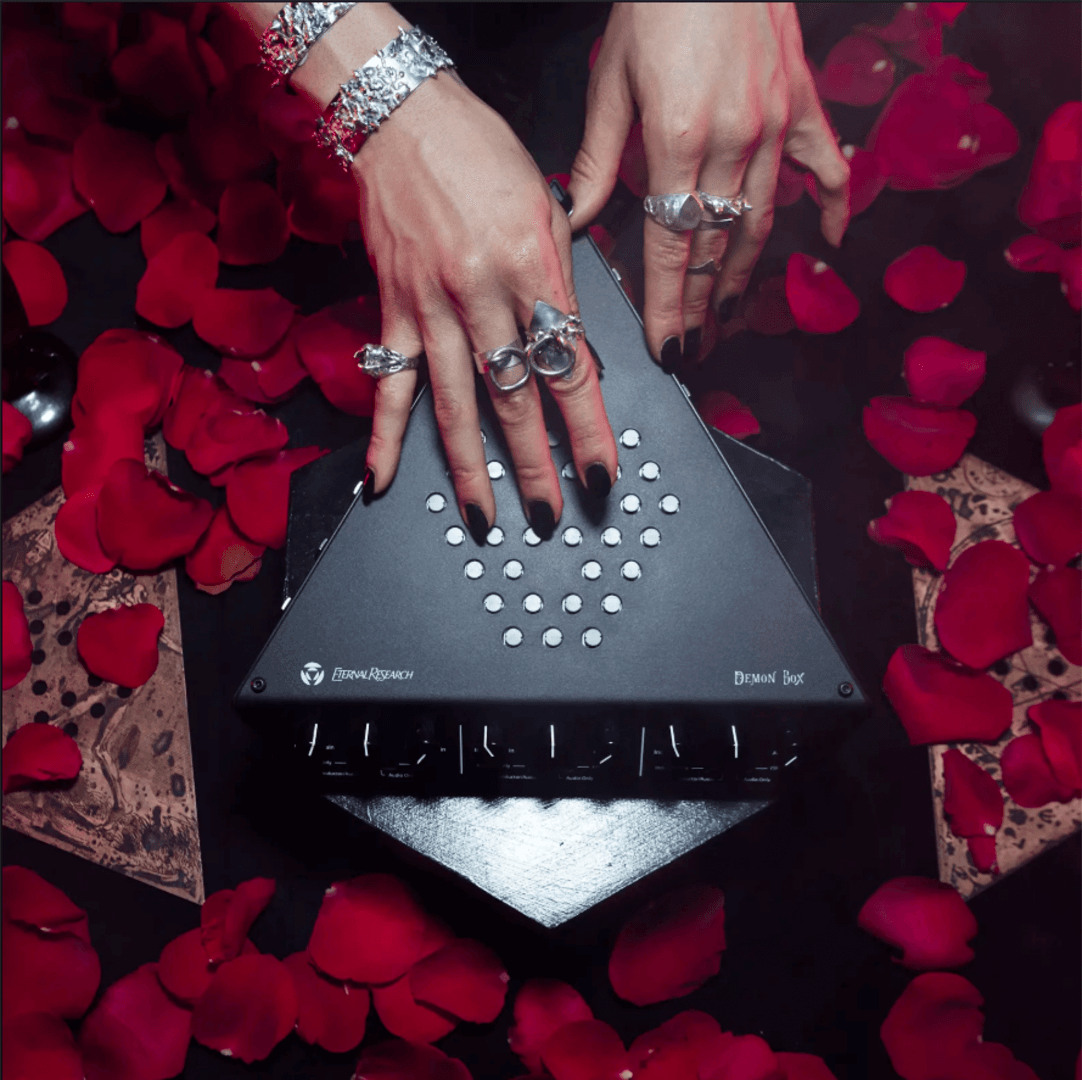
“We just made this Pandora’s box of things,” says Alexandra Fierra, one of the creators of the Demon Box, an ominous-looking electromagnetic synth that can pick up frequencies from anything from a finger to a power drill.
The award is a $10,000 grand prize. This year, the winner is the accessibility-focused Masterpiece, an open source touch-based synth inspired by fidget toys and sensory devices—it can be played by pressing just about anything on the surface. Second place went to the Fiddle Henge, an installation of four fiddles standing upright around a spinning circular bow that creates rather haunting drones. The people’s choice winner—chosen by audience vote—was the Lethelium, an instrument built out of bicycle and guitar parts and shaped like a wheel.
The Guthman Competition can be a helpful barometer for sensing trends in the music-making world. Case in point, the concerted efforts to make instruments more accessible.
The Masterpiece, the first-place winner, was developed by Brian Culligan, a musician and teacher who works with Daniel’s Music Foundation, a nonprofit that provides music opportunities for people with disabilities.
“The individuals I was working with are very musical and very expressive and have such big personalities,” Culligan says. “But the musical tools, the instruments that we were working with, were not maximizing their self-expression.”
The Masterpiece is a touch-operated synth built to resemble a puzzle piece and keep accessibility at the forefront. A pressure-sensitive surface allows for polyphonic synthesis—it can play multiple notes simultaneously—and can be triggered by hands, feet, textured fabrics, or even Play-Doh.
“If I could make an instrument where this is the interface, then it could potentially draw people into music making just by exploring something that feels good in their hands,” Culligan says. “Then all of a sudden they realize that they are making music. It kind of lowers that barrier, that intimidation factor of trying out a new instrument.”
The showcase presentation also aired a video of special recognition highlighting New Zealander Andrew McMillan for his Ultrasonic Accessible Wind Instrument, who couldn’t attend the event and be listed as an official finalist because mobility issues kept him from traveling to Atlanta.
Upcycled Art

Another theme of the competition was the repurposing of materials that would otherwise be thrown away to create something new.
“Taking extra or discarded materials and turning them into musical instruments; I’m seeing more and more of that coming into the mainstream,” Albert says. “They’re beautiful pieces of art, and they also sound really cool.”
The most literal example of that upcycling is the people’s choice winner, the Lethelium. Creator Lateef Martin, a Montreal-based builder, musician, and author of a Cyclepunk comic book series, says the idea came to him after plucking the spokes of a bicycle in a bike shop. Combining that with guitar strings in place of the spokes led to a circular playing surface that can be played by plucking or with a bow.
“I’d say it’s a lovechild between a dulcimer and a harp and a steel pan,” Martin says. “They had a threesome, and that’s the Lethelium.”
Unpredictability is inevitable when you put on a show with unconventional instruments. There was a sense of chaos from the performances that felt fundamentally human. For the participants, that was the goal.
Disclaimer : This story is auto aggregated by a computer programme and has not been created or edited by DOWNTHENEWS. Publisher: wired.com



