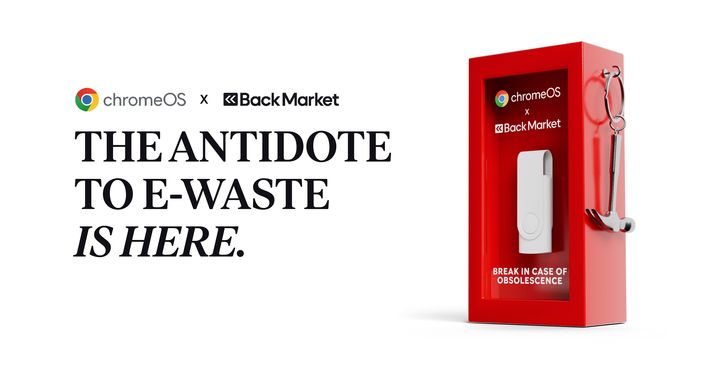
Google and refurbished-tech marketplace Back Market have a plan to help keep old laptops and computers running longer. Part of a pilot program, Back Market will soon sell USB sticks housing software that people can use to plug into their computers to install ChromeOS Flex, Google’s cloud-based operating system that can run on many existing laptops or desktops.
The stick costs $3, and there are no monthly fees. An initial run of 3,000 USB keys will go on sale March 30, and Back Market says it will expand from there based on demand. The goal is to give a lifeline to older PCs with aging hardware or operating systems that lack software support, like Windows 10, so they don’t end up as e-waste. The two companies announced the partnership at the Slow Tech Uprising summit, an event hosted by Back Market in Barcelona, which deliberately coincides with Mobile World Congress 2026, where hundreds of companies are announcing new products.
Flex On, Flex Off
Google’s ChromeOS Flex is a service that lets users install the ChromeOS operating system directly on a device. Because the software that powers the service is primarily based in Google’s cloud, it can run more resource-intensive programs than the computer’s hardware may be able to handle. It’s slightly different from ChromeOS on Chromebooks—there’s no Android app support, for example—but the experience is largely the same.
The Flex service works on just about any Windows laptop with an internet connection, but only a few older Intel-powered Apple computers, as the software doesn’t really work on Apple’s custom M-series silicon. (Google has a full list of compatible devices here for ChromeOS Flex.)
Computer hardware costs, like RAM and GPUs, have skyrocketed due to memory shortages driven by companies looking to beef up their AI farms. That means PCs are harder to afford and harder to replace. For example, Apple’s new MacBook Air and MacBook Pro, announced yesterday, come with a price increase.
“The prices of tech products are just increasing every year, and even more now that CPUs and GPUs are getting crazy,” says Thibaud Hug de Larauze, CEO and cofounder of Back Market. “More people need tech. We need to ultimately find a solution because we need to do more with what we already have.”
Trying to find a solution is perhaps a curious pursuit coming from Google, a company that is partially responsible for the memory shortages in its arms race to open more data centers that power its AI efforts.
“People want something that lasts them a long time, that is quality, that is useful,” says Google senior director Alexander Kuscher. “Eventually, when it breaks or when you lose it, you get a new one because you feel taken care of. So I think that builds trust, and the trust is important.”
Flex started as an enterprise service for businesses; Google offered companies worried about security vulnerabilities on aging hardware a way to easily update to a more secure operating system. Or, at least, one that still received updates. After a while, other users started to get ahold of the software, downloading and installing it on their own USB sticks for their personal machines. “We didn’t make it particularly easy at the time,” Kuscher says. “But people did it.”
What led to the more consumer-oriented push of ChromeOS Flex—like this partnership with Back Market—was the end of software support for Microsoft’s Windows 10 operating system last fall. While the OS still technically works, it stopped receiving security updates, and Microsoft has encouraged users to update to Windows 11. But Windows 11 has specific hardware requirements, and it may not be a simple upgrade on certain machines. Google saw this as a moment to provide a cheaper alternative to the “Windows 10 cliff,” as Kuscher puts it. Back Market agreed.
“Ultimately, [Microsoft is] saying that people need to throw away their existing laptop to buy another one,” Hug de Larauze says. “And we say politely, no.”
If you’re tech-savvy, you can forgo Back Market’s $3 stick and download ChromeOS Flex onto a USB drive you have lying around right now.
Buying Refurb
Back Market has done very well for itself despite economic turmoil. As devices become more expensive, people turn to cheaper, refurbished options. He compares the device market to the auto industry.
“Ninety percent of cars are being sold pre-owned,” Hug de Larauze says. “The new normal is to purchase them pre-owned because it’s almost dumb to buy a new one.”
When US president Donald Trump announced sweeping tariffs last year, Hug de Larauze says Back Market sales tripled afterwards. Even after the dust settled a little and it became clear that tariffs would not directly affect smartphones or computers, Hug de Larauze says sales stayed around twice what they’d been before. Back Market made $3.8 billion in 2025, making the company profitable for the first time. While Hug de Larauze says these kinds of economic fluctuations may be good for sending more people to Back Market, he hopes it will shift buyer mindsets to buying refurbished tech writ large.
“We have one planet, and resources are limited,” Hug de Larauze says. “We need to do more with what we already have in every sector. Fashion is the same, transportation is the same, energy is the same, it’s the same for everything.”
Disclaimer : This story is auto aggregated by a computer programme and has not been created or edited by DOWNTHENEWS. Publisher: wired.com