As our captain steers us towards the entrance of the Antarctic Sound, I ask if he ever wakes in the middle of the night, dreaming he’s got us all trapped in the ice like early Antarctic explorer, Ernest Shackleton. He dismisses my serious question with a laugh.
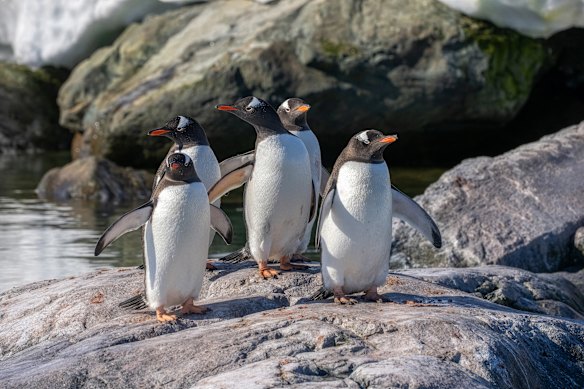
But a few hours later, I wake at 5.30am, and we’ve stopped, surrounded by thick ice. As I peer out from my balcony, a family of gentoo penguins is staring up from an iceberg.
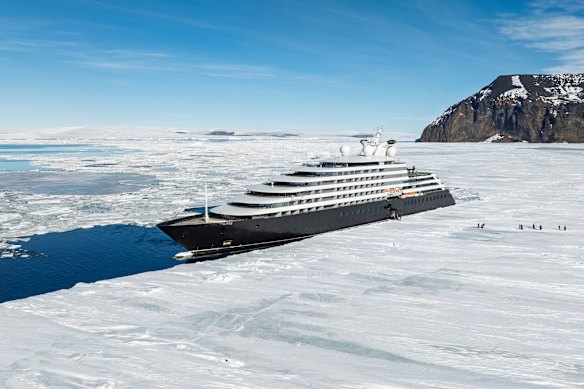
On the bridge on deck seven, Captain Ned Tully appears to be in his element. “I love the challenge of Antarctica,” he tells me, with a child-like grin. “This is what expedition cruising is about, you need to ride the weather and react and replan. I could see we’d run out of gaps (in the ice). Once you have no other choice, it’s easier to know it’s time to go the other way.”
We’re over halfway through a 22-day journey to Antarctica via the Falkland Islands and the South Georgia islands, but this is our first view of the Antarctic Peninsula. Passengers have gathered outside – mostly on the front observation deck on deck five – as Captain Tully broadcasts our change of plans.
He’s turning us around and aiming us north-west, towards the western edge of the Antarctica Peninsula. “We tried,” he explains to all. “But we’ve come to the end of that road, the Antarctic Sound is covered in impenetrable ice. But I suggest you all strap yourself in for a spectacular ride out of here.”
Sign up for the Traveller Deals newsletter
Get exclusive travel deals delivered straight to your inbox. Sign up now.
We may have a butler for our suites, 10 possible culinary experiences and an awfully fancy 550-square-metre day spa, but that doesn’t diminish any of the sense of adventure onboard our Discovery Yacht, Scenic Eclipse I.
Despite an increasing number of ships plying these southern waters, it’s important to note: one doesn’t take a cruise to Antarctica. No, one makes an expedition to Antarctica, aboard an expedition ship (or, in this case, an expedition yacht). There are no set itineraries; if you wish to know exactly where you’ll stop each day ahead of time, best to cruise in the Med instead. We can only go where the weather – and the ice – allows us.
Right now, we’re crunching our way right through thick ice and the ship is groaning as it stops and starts with the strain of it. Directly below, crabeater seals shuffle across the ice to avoid us, while chinstrap penguins escape by skating on their white bellies.
In the gaps between the visible ice, humpbacks blow out steam in spouts of warm whale air. Then a transient type A orca more than six metres long swims right across our bow. The passengers – mostly Australians – sound slightly delirious with the excitement of all this. I step away from the cackle for a minute, just to breathe it all in.
Our travel plans are formulated as we move forward. Captain Tully – who says he’s as much a logistics manager as the person steering the ship – negotiates with other ship captains for a sheltered bay with no one else in it. Nobody, he says, likes a crowd in Antarctica. It’s agreed that we can have Palaver Point tomorrow, on Two Hummock Island, just west of the Antarctic Peninsula.
Scenic, our cruise line, is part of the International Association of Antarctica Tour Operators, whose members include almost all expedition ships operating here. Members bid for sites across the Antarctic Peninsula six months ahead, but last-minute ice and weather conditions mean constant changes. In the peak of the season, with many ships visiting at the same time, agreements are made through discussion and compromise. It helps to have a captain with a strong background in the region, like Captain Tully.
I wake early – I find the peace and quiet of dawn is my favourite time to roam the ship’s many observation decks (I start at the top on deck 10 and work my way down) – and there’s snow piled ankle-deep. A thick curtain of cloud hides my surroundings, then it’s drawn back dramatically, replaced with blue sky and a glistening ocean. There are thick layers of glacier at the base of every mountain around us, and a thousand ski slopes that will never be ridden.
Imagine the winter destination that overwhelmed you most: the pyramidal peaks of your favourite ski mountain in the Swiss Alps, or maybe in New Zealand’s Southern Alps around Queenstown – then multiply that by 10. Because this is so much bigger. And it’s better. And infinitely more … well, infinite. And there’s no one here but thousands of penguins “swim-flying” across the water, and whales … more whales than empty patches of ocean, it seems.
Each day in Antarctica, we have the option to ride a Zodiac to explore the peninsula and offshore islands – or, space allowing, to take a kayak or paddleboard tour. Today I’ve chosen to kayak. We launch our vessels from a Zodiac; almost instantly, a humpback whale and her calf rise from the depths of the Southern Ocean to apparently check us out. Minutes later, on the shore, chinstrap penguins ride on their bellies down steep snowy slopes to stand beside us and stare.
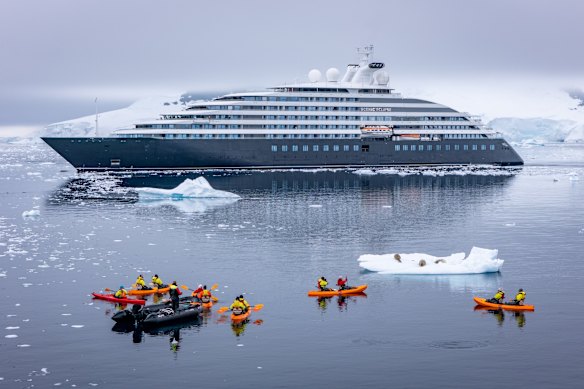
When the kayaking tour is over, I stand on a back observation deck as passengers around me try to make sense of these surroundings by taking endless photos. They’re trying to capture… this, for you back home. But later, like me, they’ll discover their pictures won’t really do that. They’ll wish instead they spent longer trying to process what being here feels like, right here, right now.
While it’s impossible to get your head around the scale of this uninhabited wilderness, we have something to help us on deck eight, which all but one other ship company don’t. Two helicopters. After lunch, and moments after I return from my first walk on the Antarctic Peninsula at Portal Point, I take a 30-minute ride above the peninsula.
“We have 100 miles’ [161 kilometres] visibility today,” pilot Pascal Fischer tells us. “Think of this as Alaska or Greenland … on steroids. It doesn’t get better … anywhere.” Beyond the mountains I could see from the ship are more mountains – there is seemingly no end to these mountains.
We fly low over dark blue crevasses in the glaciers. It’s difficult to get an idea of scale in Antarctica because there are no man-made structures, but up here I can use the ship as reference. And I can tell you: Antarctica still appears to be infinite: the world’s largest desert rolls on and on and on.
And here, high above the water in the helicopter, we’re following humpback whales, their tails appearing luminescent blue below me. There’s also a submersible on board, taking passengers deep into the ocean for a different perspective. But I prefer the view from above and back on the ship, I’m also content with the panoramic view from the bubbling hot tub.
The sun barely stops shining for a moment. There’s only partial darkness for an hour or two now in mid-summer; some passengers seem to spend most of that time in the hot tubs. There’s a bar up here too. I’m not sure there’s a more hedonistic place on Earth than in these hot tubs, here in Antarctica, with all-inclusive beer, champagne, wine and cocktails in hand while whales circle the ship below.
Each day goes much like this one. When the wind and waves increase on the open ocean, Captain Tully always manages to find us another perfect, deserted and calm bay full of penguins, whales and the occasional orca. One morning at dawn, we ride through Lemaire Channel (known as Kodak Gap for its famous scenery) as retreating glaciers calve just beside the ship with piercing, gunshot-like explosions.
When we stop at a bay just beyond for a Zodiac ride, I take a paddleboard tour instead, where chinstrap penguins dart in circles under and around my board. Another ship is visible a few kilometres south. It’s the first time I’ve seen another ship since the Falkland Islands two weeks ago – and even though it’s barely visible, it feels … wrong.
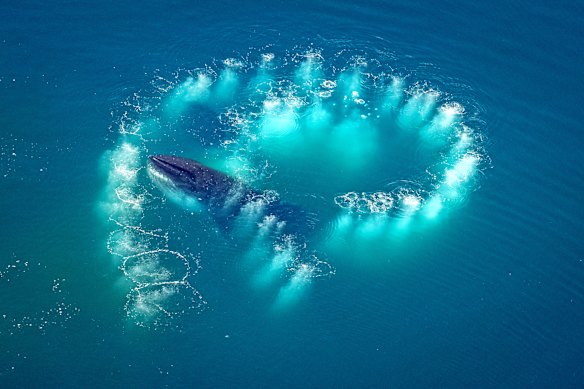
Half the ship joins in on a polar plunge into the freezing waters, which we do as a pair of humpback whales lingers at the back of the ship, watching on (I envy their thick blubber in these waters). And on our last evening, a humpback whale comes so close to the Zodiacs that I can actually feel its breath as it rises to the surface beside me for a fresh intake.
As we leave the Antarctic Peninsula, the clouds return, and the seas build in the notorious Drake Passage for our journey back to Argentina. The magic is fading. “It seems like an illusion, like it didn’t really happen,” resident geologist and discovery guide, Simon Hook, echoes my thoughts as we sit on the bridge, searching for whales. “It knocks people around, the memory of this place, having to leave. I’m just glad I’ll be back next week.”
THE DETAILS
CRUISE
Scenic has a range of Antarctica voyages from the 14-day Antarctica in Depth to the 20-day Antarctica, South Georgia and Falkland Islands, and 24-day East Antarctica and Ross Sea voyages (departing from New Zealand or Hobart). The Antarctica, South Georgia and Falkland Islands departure costs from $44,245 a person, including a $9000 Super Earlybird saving and a 30-minute helicopter experience. See scenic.com.au
FLY
LATAM flies from Sydney or Melbourne to Buenos Aires via Santiago (Chile); return flights from $2300. See latamairlines.com/au/en. A chartered flight from Buenos Aires to Ushuaia (where the cruise begins) is included in the cruise.
MORE
See iaato.org
The writer travelled courtesy of Scenic Luxury Cruises & Tours
Disclaimer : This story is auto aggregated by a computer programme and has not been created or edited by DOWNTHENEWS. Publisher: www.smh.com.au