At 5.30 am, Sakthisri Anburaj ties her shoelaces in the half-light of a shared room in Chennai.
By 6 am, she is downstairs for exercise. By mid-morning, she is seated at her desk, preparing for another day of technical training. Her evenings stretch until 8 pm, and her phone is collected at 10 pm. Tomorrow, she will wake up and do it again.
When she first arrived here, the routine felt overwhelming. “They asked me, ‘How will you survive in a strict residential programme? If you leave midway, what would be the purpose of the investment made in you?’”
At the time, she did not know how to answer. She only knew she needed an opportunity.
Sakthisri grew up in Tamil Nadu and lost her parents young. Her grandmother, a gardener, raised her. During her second year of college, she got married. With her husband’s encouragement, she completed her Information Technology degree. Yet after graduation, she found herself uncertain about what came next.
No one in her family had worked in a corporate office. No one knew how interviews were conducted or how recruitment systems functioned.
“I had very few connections outside my village, and this felt like my only chance,” she says of the day she applied to a residential programme in Chennai designed for first-generation graduates.
Her journey into that space points to a question that had been troubling hiring managers for years.
The hiring gap that kept surfacing
Inside corporate boardrooms, resumes arrive in large numbers, each one neatly listing degrees and qualifications. Yet even as applications pile up, hiring managers continue to face a shortage of job-ready talent.
When Umang Doctor was leading a digital bank, he found himself facing that contradiction repeatedly. India produced millions of graduates each year. Yet companies struggled to find candidates they felt ready to onboard.
Over time, he observed that candidates without polished degrees or elite college names rarely made it past early screening. Their applications were filtered out before their ability could be tested.
In 2021, after joining a UK-based bank, he decided to examine whether those filters were blocking capable individuals from being seen.
He launched an internal initiative through which candidates without traditional degrees were given structured training and then placed directly into corporate roles. The training was funded personally by him, and talent was sourced in collaboration with non-profit partners. Residential bootcamps were conducted by renting space at one of those campuses.
Over the next three years, 81 careers were launched. Seventy-one candidates entered roles as software engineers, while 10 were placed in non-technical roles. The average starting salary stood at Rs 50,000, and 12 of them earned promotions within their organisations.
The figures were meaningful. What affected him more were the individual shifts. People who had once been screened out were now contributing to teams, solving problems, and growing in demanding work environments.
Between 2021 and 2024, he continued running bootcamps in collaboration with non-profit partners while working as Senior Director of Software Engineering at the same UK-based bank. The model was evolving quietly in practice.
By mid-2024, he felt ready to build something more structured.
On 15 August 2024, he founded Xcelevate in Chennai.
A residential year that reshapes confidence
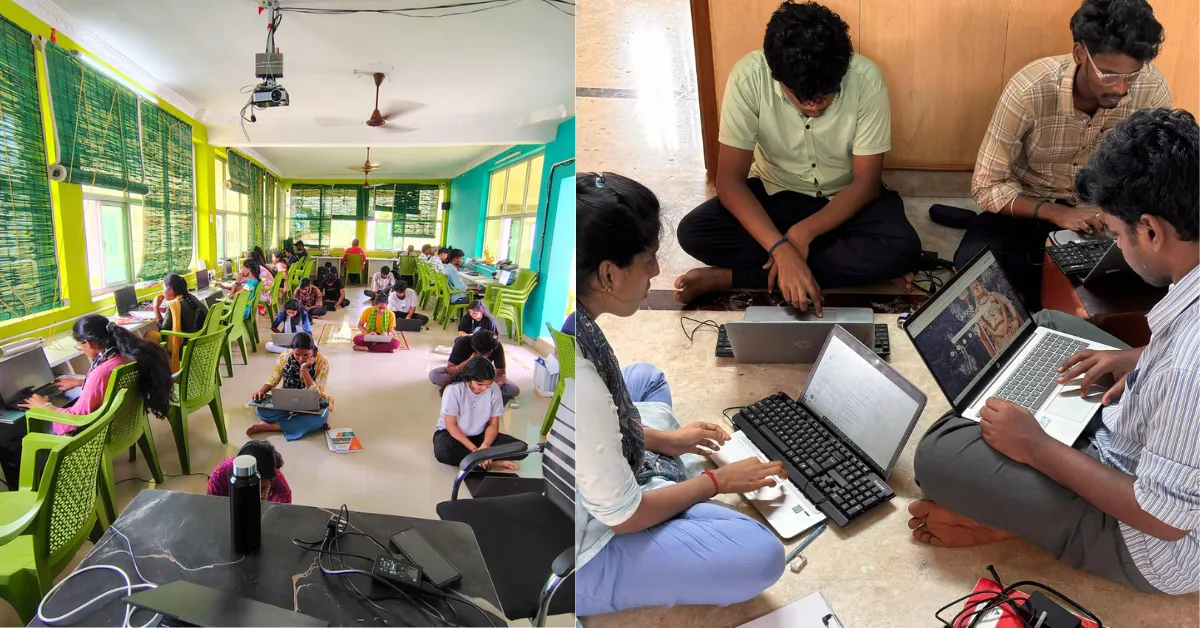
The programme runs from a residential gurukul(traditional residential learning centre) in Chennai, where apprentices live and train for a full year. The 2025 batch includes 29 students, 14 of whom are women. All are first-generation college graduates, and 80 per cent come from families with monthly incomes of less than Rs 10,000.
For many, this is the first time their abilities are being assessed beyond marksheets.
The selection process reflects that seriousness. Applicants sit for aptitude and psychometric tests, write essays, and attend interviews that examine commitment as much as skill. Family background and financial details are verified through field visits and document checks before admission is finalised.
Once they enter the programme, the training becomes structured and technical.
Students preparing for software engineering roles work through Core Java, Spring Boot, microservices architecture, DevOps, JPA, SQL, and Data Structures and Algorithms. They are introduced to AWS, Site Reliability Engineering practices, low-code platforms, and AI-assisted tools such as Claude Code, Cursor, and Copilot. Git and Agile methodologies are part of daily practice, and Python is also covered.
/filters:format(webp)/english-betterindia/media/media_files/2026/03/02/exercise-2026-03-02-13-02-41.png)
Those training for banking roles focus on data analysis using Python, automation through Power Automate, Advanced Excel, and version control using Git. They also complete introductory modules tied to specific domains such as banking or insurance, depending on employer requirements.
Alongside the technical curriculum, there is sustained focus on English communication and workplace readiness. Students practise professional writing, learn about office etiquette and POSH policies, and discuss values such as resilience, collaboration, growth mindset, and time management. The aim is to reduce the cultural distance many first-generation graduates feel when entering corporate spaces.
“It is a two-year structured journey,” Umang says. “One year in the ‘gurukul’ and one year of guided deployment.”
Support continues after placement. For every ten students deployed, a mentor remains connected during the first year of employment. Most mentoring happens in person, with some sessions conducted over video calls. Mentors are industry professionals who are guided on pedagogy, assignments, and mock interviews. Some serve full-time or part-time roles, while others volunteer. As funding strengthens, the programme intends to rely less on personal networks and engage more paid trainers.
Where hiring conversations begin to change
Arun Malaiarasan, Director of Technology Platforms at NatWest, has hired candidates from the earlier initiative and has observed their progress closely.
“Across all four candidates I have worked with, I have seen them come out of their shells very quickly. Within six months to one year, I do not see them as any different from graduates who come from established colleges with formal technology degrees,” he says.
For him, the experience has reshaped how merit is discussed within teams. “Merit itself has not changed. What has changed is how we define merit.”
/filters:format(webp)/english-betterindia/media/media_files/2026/03/02/training-xcelevate-2026-03-02-13-25-50.png)
Three multinational companies, including the UK-based bank, have waived academic degree requirements for roles connected to this model. Once policies change, they open doors more broadly, not only for these apprentices.
Some employees who joined without degrees are now pursuing undergraduate programmes through distance learning while working full-time.
For Sakthisri, that shift carries weight. Back in Chennai, the early mornings remain part of her life, but how she experiences them has changed.
The discipline that once felt intimidating now feels purposeful. She understands the technical frameworks she is studying. She practises interviews with clarity. She refines her English communication without hesitation. As placements approach in April, the uncertainty that followed her graduation has begun to give way to direction.
She can now picture herself in a corporate workspace. That image no longer feels distant.
From trainee to mentor
Anjali Tiwari once stood where Sakthisri stands today.
Raised in Uttarakhand and educated in government schools in Delhi, she lost her family home to a landslide. Without a BTech or formal technical degree, corporate employment had seemed unlikely.
Through the earlier initiative led by Umang at the UK-based bank, she entered the technology workforce. Today, she works as a software engineer.
When Xcelevate was being shaped in 2024, she helped during its early stages. In August 2025, she returned to Chennai to teach Java and design internal quizzes.
“It’s my way of giving back,” she says.
Her presence offers students something tangible: proof that the path can be walked.
/filters:format(webp)/english-betterindia/media/media_files/2026/03/02/anjali-training-2026-03-02-13-18-09.png)
Looking ahead
The programme’s operating budget for the current financial year stands at approximately Rs 50 lakhs and is expected to grow to Rs 1 crore next year as expansion remains steady and measured.
Apprentices are not required to repay fees. Instead, once employed, they are encouraged to contribute 25 per cent of their salary for one year under a “Pay It Forward” model, helping another student access the same opportunity.
By 2030, plans are in place to open four additional centres across North, West, South, and East India.
For Sakthisri, those plans feel distant compared to the next interview she is preparing for. But somewhere in that larger ambition lies a simple shift: first-generation graduates who once had no entry point into corporate spaces are beginning to find one.
And tomorrow at 5:30 am, she will wake up again, lace her shoes, and step toward it.
Disclaimer : This story is auto aggregated by a computer programme and has not been created or edited by DOWNTHENEWS. Publisher: thebetterindia.com