
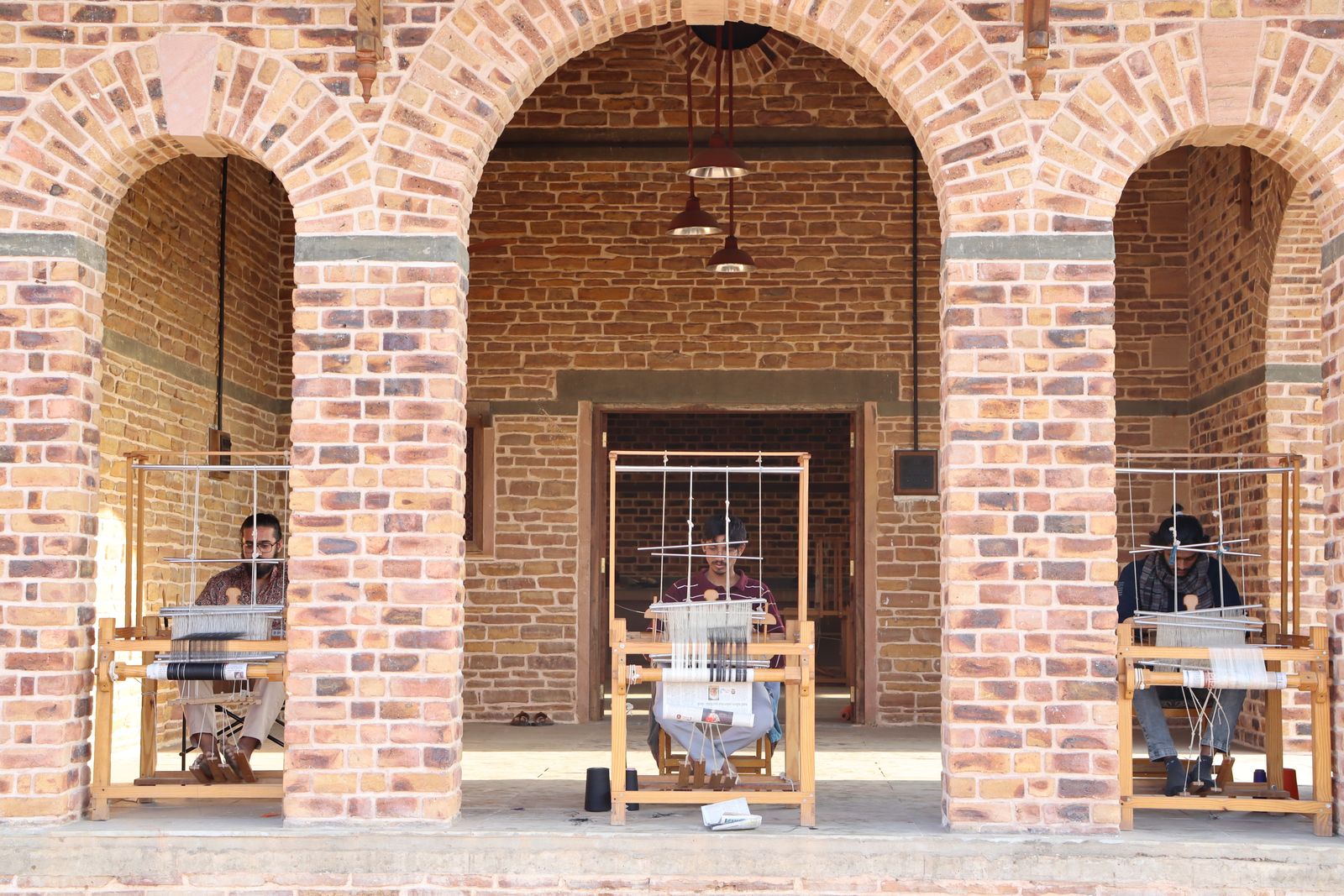
Three girls sat on a johoola (swing) outside a low brick campus in Kutch, applying mehendi to each other’s hands and debating last-minute design decisions. It was the night before the graduation show at Somaiya Kala Vidya, where I had travelled in December 2025, to attend the annual presentation of its year-long design programme for artisans. As I approached, they stood up, careful not to smudge the drying henna and led me into their classroom.
I sat with the graduating batch as they prepared for the show—passing around mood boards, swatches, drawings and laptops open to trend forecasts. They spoke in a shared design vocabulary that would have been unthinkable for many of them a year ago: rhythm, balance, proportion, colour stories. References moved fluidly between lived experience and global forecasting tools like WGSN (World Global Style Network). Some had created Bandhani motifs based on flamingoes found in the White Rann near their house. One student had created Bhujodi motifs based on a festival, Poonam Rath, combining it with trend forecast keywords. A young Bandhani artisan showed me a football jersey he had created in honour of Lionel Messi using just Bandhani tie and dye technique.
Somaiya Kala Vidya (SKV) was founded with a clear belief: If craft is to remain culturally honest and economically relevant, innovation must come from within. And that artisans must determine the evolution of their own traditions. That belief began years earlier when the famous craft conservationist Judy Frater, originally from the US, launched an initiative called Kala Raksha in 2005 in Mundra in Kutch. Long before craft became a keyword, Kala Raksha recognised something essential. Craft does not stagnate for lack of skill. It fails financially for lack of access, language and, therefore, confidence.
When Kala Raksha later merged with the Somaiya Trust to become Somaiya Kala Vidya, the philosophy gained structure. Today, SKV runs as a year-long residential programme for artisans of Kutch for craftspeople from various communities. There is no age limit and no literacy requirement. On the syllabus are design principles and business management skills. Some students are as young as 16 years old. Others are in their 30s, with children to raise and households to run. The institute spends Rs 3-4 lakh per student. Men pay ₹12,000, women ₹6,000. When asked why as most artisan courses are free, Nishit Sangomla, director of SKV replied: “Deliberately so, to instil ownership without creating barriers.”
Disclaimer : This story is auto aggregated by a computer programme and has not been created or edited by DOWNTHENEWS. Publisher: vogue.in



