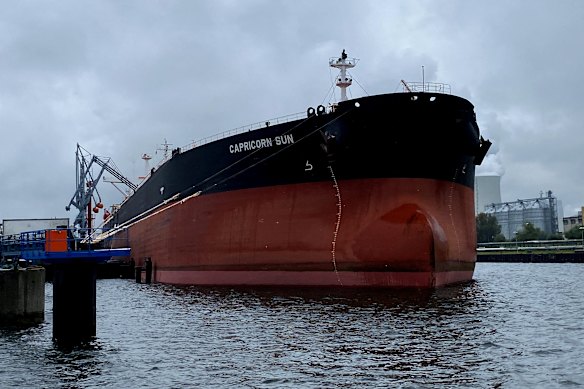

The oil industry says it is open to tough new laws to prevent Russian-origin oil from entering Australia, declaring stricter regulations would allow importers to renegotiate contracts with overseas refineries fuelling Vladimir Putin’s war machine.
The Ukrainian-Australian community is urging the federal government to take action as it blames a lack of political will for Australia falling behind like-minded democracies in cutting off Putin’s oil revenues.
Australia has imported about $24.7 billion worth of oil since 2022 from countries that refine Russian crude, delivering an estimated $2.5 billion in tax revenue to the Kremlin, according to the Centre for Research and Clean Air.
Australia has provided $1.7 billion in military aid to Ukraine since the war began.
“In effect, Australia is sending more money to Moscow than Kyiv,” the Australian Federation of Ukrainian Organisations said in its submission to Senate inquiry examining the effectiveness of Australia’s sanctions regime against Russia.
“Australia is now an outlier among its closest partners … Australia’s failure to take action risks turning the country into a dumping ground for blood oil that is illegal in comparable jurisdictions.”
This masthead’s “blood oil” series, published last year, highlighted the vast quantities of Russian-origin oil that have flowed into Australia since the start of the war.
Australia banned imports of Russian oil after Putin’s invasion of Ukraine, but a loophole has allowed Russian crude oil to enter the nation after being refined in countries such as India, China and Brunei.
The Ukrainian diaspora is urging the government to change the definition of sanctioned goods to include petroleum products derived from Russian crude, regardless of where it is refined.
Importers would be required to present certificates of origin stating that their oil products are free of refined Russian crude and the government would establish a unit dedicated to sanctions monitoring and compliance.
Since January 21, the European Union has made it illegal to import petroleum products which have been obtained in a third country from crude oil originating in Russia.
Australian Institute of Petroleum chief executive Malcolm Roberts told a Senate hearing on Wednesday: “If the government changes policy, the industry will comply.”
Roberts said that, under current rules, oil importers had limited capacity to prevent Russian-origin oil from entering Australia because of long-term contracts with overseas refineries.
“Where term contracts are in place, there’s not a legal basis to trigger a renegotiation of that contract so you are reliant on the good will of the refiner to take into account your concerns,” he said.
“If the law changes materially, an importer will have the opportunity to trigger a review of a contract … That’s the firm ground on which you can reopen a discussion with your overseas refinery.”
Roberts, representing major oil companies, said private companies alone could not eliminate the Russian oil trade.
Pointing to the recent decision to end the use of Russian oil at the giant Jamnagar export refinery in India following pressure from the United States and Europe, he said: “It does take converging advocacy and pressure to bring about change.”
Any new policy should be implemented carefully, with sufficient lead time, to limit the impact on fuel supply and prices, he said.
Australian Federation of Ukrainian Organisations chair Kateryna Argyrou said ordinary Australians had been shocked to discover the fuel they were putting in their cars was helping fund Russia’s war effort.
“This is something that Australians don’t stand for,” she said.
She blamed a lack of conviction from the federal government for the failure to ban all Russian-origin oil from entering the country.
“We have seen other countries and partners do it. So in the opinion of the Ukrainian community, it just requires political will,” she said.
Ukrainian Council of NSW President Andrew Mencinsky said: “The community absolutely feels that it is an absence of political will, and is very surprised by the absence.”
Mencinsky said it was “appalling” that Australia had delivered more in tax revenues to Russia than military aid to Ukraine since Putin’s invasion.
“It’s shocking, it’s unjustifiable, and it’s unacceptable to every person to whom I speak,” he said. “This has to stop.”
The Department of Foreign Affairs and Trade said the interconnectedness of the global oil trade made it difficult to prevent oil products refined in third countries from Russian-origin crude from entering Australia.
“Once an oil or petroleum product has been refined, substantially transformed, blended or co-mingled, the origin of its inputs is obscured,” the department said in a submission to the inquiry.
 Matthew Knott is the foreign affairs and national security correspondent for The Sydney Morning Herald and The Age.Connect via X, Facebook or email.
From our partners
Disclaimer : This story is auto aggregated by a computer programme and has not been created or edited by DOWNTHENEWS. Publisher: www.smh.com.au