Opinion
In this series, My Happy Place, Traveller’s writers reflect on the holiday destinations in Australia and around the world that they cherish the most.
My first visit to Venice didn’t go so well.
My hotel room was in a shabby pensione above a noisy restaurant street. The clatter and chatter barely stopped all night.
The bed was a single cot, the bathroom not more than a plastic shower curtain and grubby soap. I was staying there alone, on my first-ever trip overseas, and the door didn’t close properly. I didn’t get much sleep.
But I found that this didn’t matter at all. Because Venice is a waking dream, and I always feel as if I’m sleepwalking through it.
Venice existed in my imagination long before I crossed any of its bridges.
Sign up for the Traveller Deals newsletter
Get exclusive travel deals delivered straight to your inbox. Sign up now.
I knew the city from films such as Nicholas Roeg’s Don’t Look Now and Visconti’s Death in Venice. In the paintings of Canaletto, Titian and Tintoretto. In the news stories of the acqu’alta, the high waters, that flooded buildings, eroded facades and threaten the city’s very existence. The Carnivale in February, when masked revellers in fantastic costumes take over the streets.
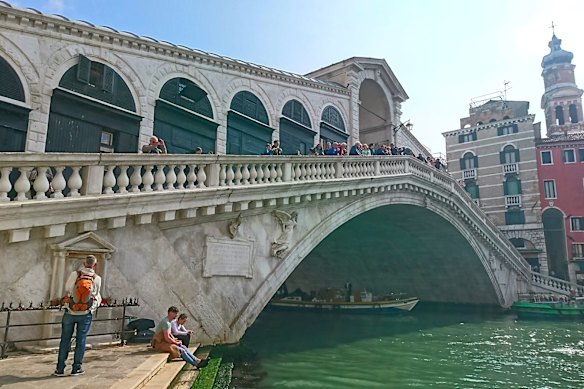
I suppose it shouldn’t be a surprise that the city seemed familiar the first time I viewed the Grand Canal and the campanile of St Mark’s Square. It also felt unreal, like one of those dreams where you’re suddenly thrust onto a stage and expected to know your lines.
Venice appears out of the marshy water like a theatre set. Its domes and spires and reflections seem to have been painted against the sky by a feverish stage designer. The island of San Giorgio Maggiore floats in the lagoon as if stagehands had pushed it out from the wings.
I have been to Venice many times now, in all seasons except when it snows, staying in hotels that are way more comfortable than the flophouse I experienced that first time.
My heart soars whenever the water taxi from the airport turns into the Venice lagoon, as if I were coming home. Yet I have no family connection with the Veneto region. There is no Italian in my DNA. I can barely speak the language, apart from grazia and panettone.
The city is shimmeringly, overwhelmingly beautiful at all times of the year.
I’m just a tourist, even though I’ve never been on a gondola. The longest I’ve stayed there in one hit is about two weeks. I don’t pretend to even understand its nuances. But in a subliminal way I do.
Even as a writer, I struggle with the precise words to describe it. Countless other writers have done much better than me. John Ruskin (The Stones of Venice), Mary McCarthy (Venice Observed), Peter Ackroyd (Venice Pure City), John Berendt (The City of Falling Angels), John Banville (Venetian Vespers), Donna Leon’s Commissario Brunetti series.
The best I can do is think of it this way: in Greek mythology there’s a beast called a chimera, which is made up of parts of different animals. The word has come to mean something that is illusory or impossible. I think Venice is a chimera. Impossible.
It doesn’t make sense.
That Venice has existed in some form since the 5th century and continues to exist in the 21st is quite remarkable. It is incredibly fragile. It is held up by centuries-old tree trunks. A lacework of over 100 islands, it is slowly, but inexorably sinking.
It is a city of ghosts. Turn any corner and you are suddenly thrust into another age. Medieval. Renaissance. Ottoman, Habsburg. Layers of the past and present meld, so you can have a disembodying experience that you’re existing in different centuries at the same time.
The city is shimmeringly, overwhelmingly beautiful at all times of the year. An autumn sunset is joyous, and a winter fog is thrilling.
It’s also sinister, intriguing, which is maybe the side of Venice I like most.
I was there last December, arriving late at night. The water was high, and the speedboat barely cleared the bridges. Out of the blackness, some corners were illuminated with bright red. Few people were about, except in the shadows. I had arrived in the Venice of Don’t Look Now.
I’ve decided it’s not a place best viewed with logic. It needs to be experienced emotionally and sensually, engaging the right side of the brain. Its transient and transcendent beauty, all manmade, has drawn artists, writers and art-lovers for centuries.
You need to give in to it. Venice rewards the person who follows their instincts. The best way to experience it is to deliberately get lost.
If you trust your senses this can lead you to magical places – an unexpected, pocket-sized vineyard, an out-of-the-way church that holds a masterpiece by Bellini, a printing house in Tintoretto’s workshop, a glass furnace still in operation, a tiny supermarket hidden in an old theatre, a women’s prison that sells handmade soaps.
Stones and doorways and secret gardens. Bars, shipyards, artisans’ workshops.
No tour guide can give you a map to this. You find the places that resonate with your heart.
Or perhaps they find you.
Traveller Guides
From our partners
Disclaimer : This story is auto aggregated by a computer programme and has not been created or edited by DOWNTHENEWS. Publisher: www.smh.com.au