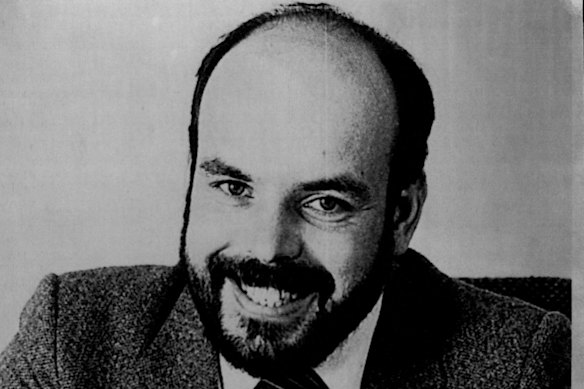
SBS’s series about conman John Friedrich is fascinating, but to Philippe Charluet, it looks a lot like a project he submitted to SBS years ago.

The integrity of SBS’ commissioning process has been called into question by a veteran filmmaker who claims the documentary Australia’s Greatest Conman?, the first part of which airs on Tuesday, bears an uncanny resemblance to a project he submitted to the network on three separate occasions in the late 2000s.
Philippe Charluet, who has worked in the industry for more than 30 years, on Sunday went public with his assertion that the two-part program about John Friedrich, the former head of the National Safety Council of Australia, which went belly-up in 1989 owing around $300 million, bore striking similarities to a project his company repeatedly submitted to the broadcaster as it sought a pre-sale that would help secure finance to bring the project to fruition.
“We could assert SBS allegedly used, without our knowledge, and any communication with us whatsoever, the comprehensive material we submitted to them for a pre-sale,” Charluet wrote in a post published on his company’s website on Sunday afternoon.
Charluet presented his outline for John Friedrich: Catch Me If You Can to three different commissioning executives at SBS in 2008 and 2009.
The first two of those individuals have since left, but the third is now a senior executive at the broadcaster.
This masthead is not suggesting SBS has done anything untoward. However, documents we have seen appear to support Charluet’s outline of events.
They include letters acknowledging receipt of his proposal, which in its final stage included a 55-page shooting script as well as extensive footage of interviews and archival material, and pro forma rejection letters stating that “unfortunately it is not a commissioning priority for us at this time”.
“Our proposed documentary was not a quick idea penned on the back of an envelope. It was a meticulously researched script, developed over years,” Charluet wrote. “We also secured a potential pre-sale from a German network on the condition that we would secure a pre-sale from Australia.”
This masthead has seen documents that appear to show the project had strong interest from European broadcasters and sales agents. The project had also received development funding from Film Victoria. But without core funding from a local broadcaster, it was dead.
While Charluet’s film would have been an independent production co-financed by SBS and international partners, the new two-part documentary was made by SBS’ in-house documentary unit, established in 2022.
In a written response to questions from this masthead, SBS insists its project was conceived that year, “when the documentary team was exploring a potential series on Australian conmen that would have included profiles on Peter Foster, Jody Harris and potentially John Friedrich”. They settled on Friedrich because he “seemed not to be driven by personal financial gain”.
Development began in earnest in September 2024, and pre-production started in January 2025.
SBS insists there is no link whatsoever between the Charluet project and the one it ended up making. Submissions are retained for seven years and then destroyed, it claims. Additionally, “any email communications archived from 2008-09 are not accessible to SBS staff beyond SBS’ technology specialists”.
The executive who received the submission in 2009 and remains with the broadcaster “had no recollection of Mr Charluet or the 2009 submission prior to Mr Charluet contacting SBS on 2 February 2026”.
The broadcaster insists “any similarities between the 2025 program and Mr Charluet’s 2009 submission is indicative of nothing more than the factual nature of documentary filmmaking founded on historical research and archival material”.
Though it differs in many ways from the film Charluet proposed to make, Australia’s Greatest Conman? necessarily covers much of the same territory as it tells the tale of Friedrich’s rise from obscurity to head the largest and best-equipped search and rescue operation in the country (indeed, one of the best in the world) from a small base in Sale, East Gippsland. It was all funded by a tapestry of fraud, false ledgers and faked invoices.
One striking similarity, in Charluet’s view, is that the SBS documentary interviews Stelian Moculescu, a Romanian-born German volleyball player who knew Friedrich in his younger years in Bavaria.
Charluet alleges that a video sample of his team’s interview with Moculescu formed part of “our last application”, adding that “only we knew about this person, as his identity was not common knowledge”.
However, SBS insists this is not the case. “The first public mention of Mr Moculescu comes from a 1989 interview by Channel 9 correspondent Robert Penfold in Munich, when Friedrich went on the run,” the broadcaster says. “The SBS documentary team discovered archival footage of this interview during their research and have featured the interview in Australia’s Greatest Conman?.”
Charluet is not claiming the makers of Australia’s Greatest Conman? have directly or deliberately lifted from his project. But while he accepts that the film SBS has made differs in substantial ways from the one he proposed, he believes the issue raises important questions about the way the broadcaster treats the independent production sector.
“If a network receives comprehensive documentary submissions, sits on these for a while and then reinvents them ‘magically’ a few years later, in house (for a fraction of the cost, dare we say), we all, as independent documentary producers, face an alarming future where the commissioning process undermines any fair outcomes,” he writes.
“Ultimately, we must ask does this meet the pub test. We believe it does not.”
Find out the next TV, streaming series and movies to add to your must-sees. Get The Watchlist delivered every Thursday.
From our partners
Disclaimer : This story is auto aggregated by a computer programme and has not been created or edited by DOWNTHENEWS. Publisher: www.smh.com.au